Crypto Commerce
Costway FP10052WL-WH chest freezer — Two chest freezers for finding what you stored
Compare Costway FP10052WL-WH chest freezer by stated capacity, basket access, lid swing, defrost drainage, temperature claims, and placement checks.
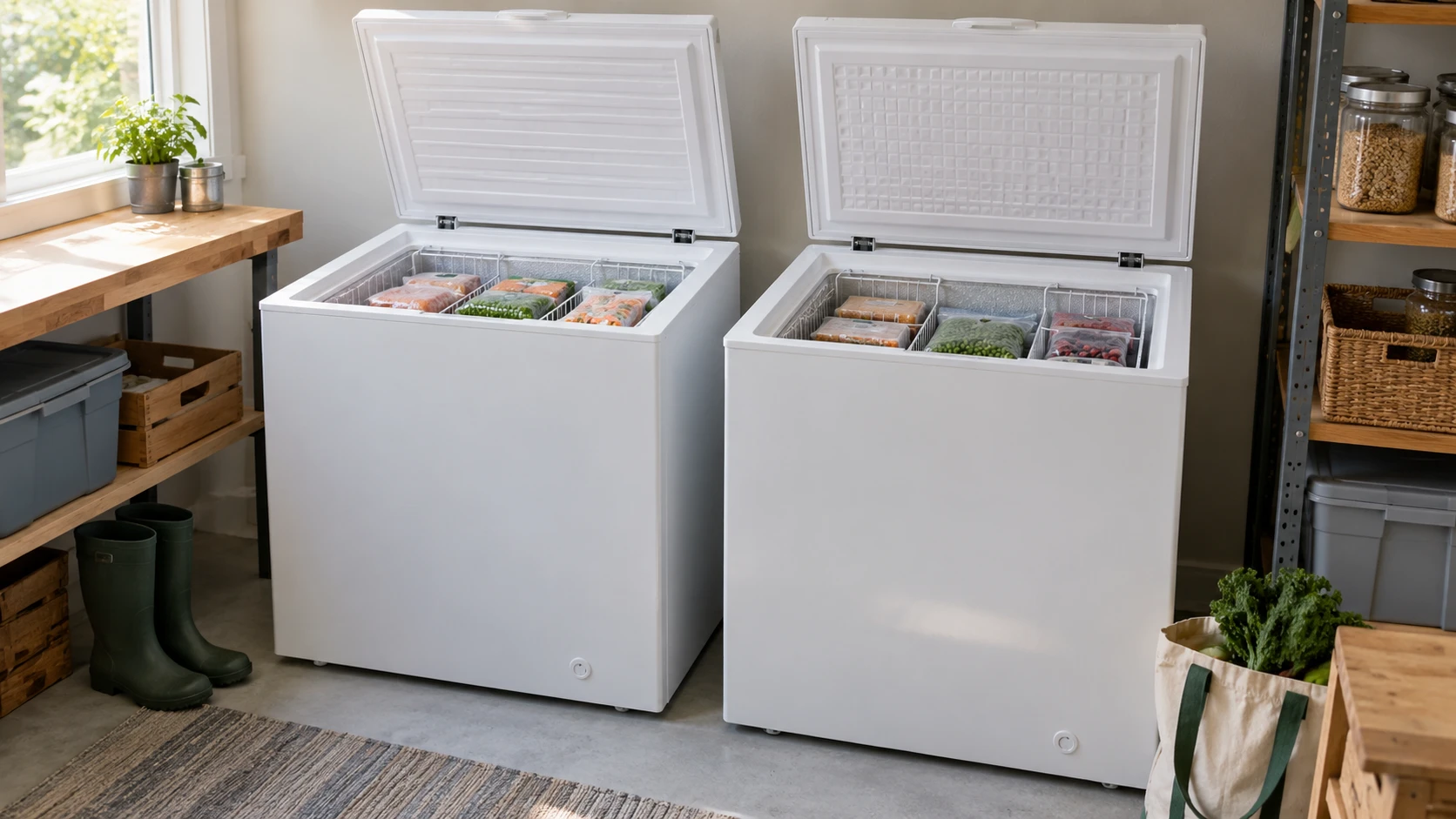
An extra chest freezer can make room for frozen meals and bulk groceries, but capacity is only one part of daily use. You also need to lift the lid fully, reach the bottom, keep small items visible, and drain meltwater when it is time to defrost. The Costway FP10052WL-WH and Igloo 5.0 cu ft listings both describe compact top-opening freezers with baskets and drains. Their catalog details differ, and some figures within each listing need confirmation. Plan around the packages you actually store and the place the freezer will stand before treating a small capacity difference as decisive.
The Costway FP10052WL-WH chest freezer is named as a 5.2 cu ft model in its title, while its description calls the interior 5.0 cu ft. The title mentions three baskets; the description mentions hanging storage baskets, a drain plug, an ice shovel, and a top-opening lid. Igloo's title calls its unit 5.0 cu ft, and its description names a removable wire basket, a front defrost drain, and wheels. Those details are useful for planning storage and cleanup. They are not a verified measurement of how many frozen packages will fit in either cabinet.
Resolve the capacity and temperature entries — chest freezer capacity and controls
The published guide to chest freezer capacity and controls shows why similar-looking volume and thermostat statements need careful reading. Start with the Costway discrepancy: the title says 5.2 cu ft, and the description says 5.0 cu ft. The saved source does not explain whether these refer to different measurements, a listing error, or a product revision. Ask for the manufacturer's current capacity specification for FP10052WL-WH. Until then, treat the exact number as unresolved rather than rounding it to the one you prefer.
Igloo's page states 5.0 cu ft in its title. Its text offers no interior dimensions in the saved excerpt. Even if both products prove to have the same nominal capacity, a freezer's interior shape, basket position, and compressor hump can change how boxes fit. Measure a package that you commonly buy, then ask for usable internal width, depth, and height. A figure in cubic feet cannot tell you whether a wide pizza box lies flat or whether a tall container fits under a basket. Check the current product drawings for both exact models.
Costway describes mechanical controls with eight positions: seven freezing levels and an off setting for defrosting. The listing gives a temperature range whose endpoints are written as 10.4 degrees Fahrenheit and minus 11.2 degrees Fahrenheit. That is a control claim, not an independent test of temperature throughout a loaded compartment. Igloo's title gives a range of minus 10 to 10 degrees Fahrenheit, while its body text includes a different minimum and maximum. Resolve those conflicting Igloo figures against the current manual before relying on a setting. Neither page gives a comparable record of temperature stability during door openings or warm-room conditions.
If you store food that needs a specific frozen temperature, put an appropriate freezer thermometer inside after installation and follow current food-storage guidance. The position of a dial is not the same as the temperature measured near the food. Check the manufacturer's instructions for first use, defrosting, and the time needed before loading a large batch. These steps apply to either product; the saved catalog claims cannot guarantee what will happen in a particular garage or utility room.
Make the baskets useful for your actual groceries — Igloo 5.0 cu ft chest freezer
Costway's title mentions three baskets, while its description speaks of hanging storage baskets without confirming a count. If you expect three organizers in the box, confirm the current contents of the exact listing. Multiple baskets could help separate items you reach for often from food stored below, but they also occupy vertical space. Ask whether each basket can be removed independently and how much clearance remains beneath it. The included ice shovel mentioned in the source is a small convenience; it does not settle the larger question of how you will reach the bottom safely.
The Igloo 5.0 cu ft chest freezer describes one removable wire basket. A basket can keep small packets within reach, while larger packages can occupy the cavity beneath it. The source does not give the basket's dimensions or load limit. If you usually buy several identical boxes, sketch how they would stack and whether you could lift out one without unpacking the entire freezer. The nominal capacity does not tell you how much time you would spend searching for an item at the bottom.
Labeling can make either arrangement easier to live with. Group frequently used food in a basket, keep a simple inventory for the bottom layer, and rotate older packages forward according to their storage guidance. Those are household practices, not specifications of the Costway or Igloo. If a basket blocks the lid or rises above the rim when filled, adjust the load rather than forcing the door closed. Confirm the exact basket configuration and internal height before choosing the freezer solely from the number of included accessories.
Give the lid room and a safe place to stand — Igloo 5.0 cu ft chest freezer
Both listings describe a lid that can stay open across a range of angles around 45 to 90 degrees. That could make loading and sorting easier if the freezer has enough space above and behind it. It does not provide the clearance needed for the lid in your chosen spot. Measure the closed unit, the overhead shelf or cabinet, and the wall behind it. Then request a lid-open dimension from the current manual. A freezer that fits under a shelf while closed may be frustrating if the lid stops short of the angle needed to lift out a basket.
Costway describes handles and sealing strips. Igloo describes a recessed handle and a balanced hinge-style door. Those details suggest different ways of opening the units, but the saved listings do not provide the force needed to lift a full-size lid or an accessibility assessment. Try to picture the person who will use the freezer most often, especially if the unit would sit in a narrow corner. Leave room to stand directly in front, reach down into the cavity, and set a basket on a nearby stable surface. Check the manual's placement and ventilation clearances instead of pushing the cabinet tight against a wall.
Igloo's listing says it has caster wheels and presents it as suitable for some garages, with a claim about continued operation at a low ambient temperature. Treat that as a model-specific claim to verify, not a general promise for every unheated space. Ask for the current allowed ambient temperature range and whether warranty coverage changes by location. Wheels may make an empty unit easier to position, but the source does not say the freezer should be rolled while full or powered. Costway's excerpt does not mention wheels or a garage temperature rating. That absence leaves those questions open rather than proving the unit lacks either property.
Plan the defrost path before the first load — Igloo 5.0 cu ft chest freezer
Costway names a drain plug, and Igloo names a front defrost water drain. These features can help when frost buildup needs to be cleared, but both still need a way to collect and dispose of the water. Look at where the drain sits in relation to the floor and whether a shallow pan can fit. The saved Costway source does not identify the drain's exact side, while Igloo's excerpt calls its drain front-facing. Do not assume that either unit empties itself into a floor drain. Read the manufacturer's defrost instructions and protect the surrounding floor before starting.
A freezer on a carpeted floor, near paper storage, or behind a heavy piece of furniture makes water handling more awkward. Choose a location that permits access to the drain and enough room to move food to safe temporary storage during cleaning. The listings do not give a frost buildup interval or a time needed to defrost. Those depend on use and conditions. Include this periodic task in the placement decision, since an easy-to-reach lid does not help much if the drain is blocked against a wall.
Igloo's page mentions an LED light and a low-noise claim. Costway also describes a low-noise compressor. Neither saved source supplies a comparable operating-noise measurement for both units under the same conditions. If the freezer will sit next to a bedroom or desk, seek current specifications with units and test conditions. Likewise, the source gives no shared energy-use figure for these two exact models. A general energy-efficient phrase should not decide a purchase without a comparable label or rating.
Choose by verified fit and the storage work you do. Costway may provide more basket positions, but its capacity and basket count need confirmation. Igloo explicitly names a removable basket, front drain, wheels, and a garage-use claim that needs model-specific verification. Measure the available lid clearance and the packages you buy most often; obtain the current internal dimensions, temperature guidance, and exact box contents. That evidence will tell you more than a disputed fraction of a cubic foot in a saved listing.