Office Supplies & Stationery
Correction tape not covering: isolate the failed strip
Separate a failed start, interrupted run, incomplete coverage and write-over result on expendable paper without improvising an internal applicator repair.
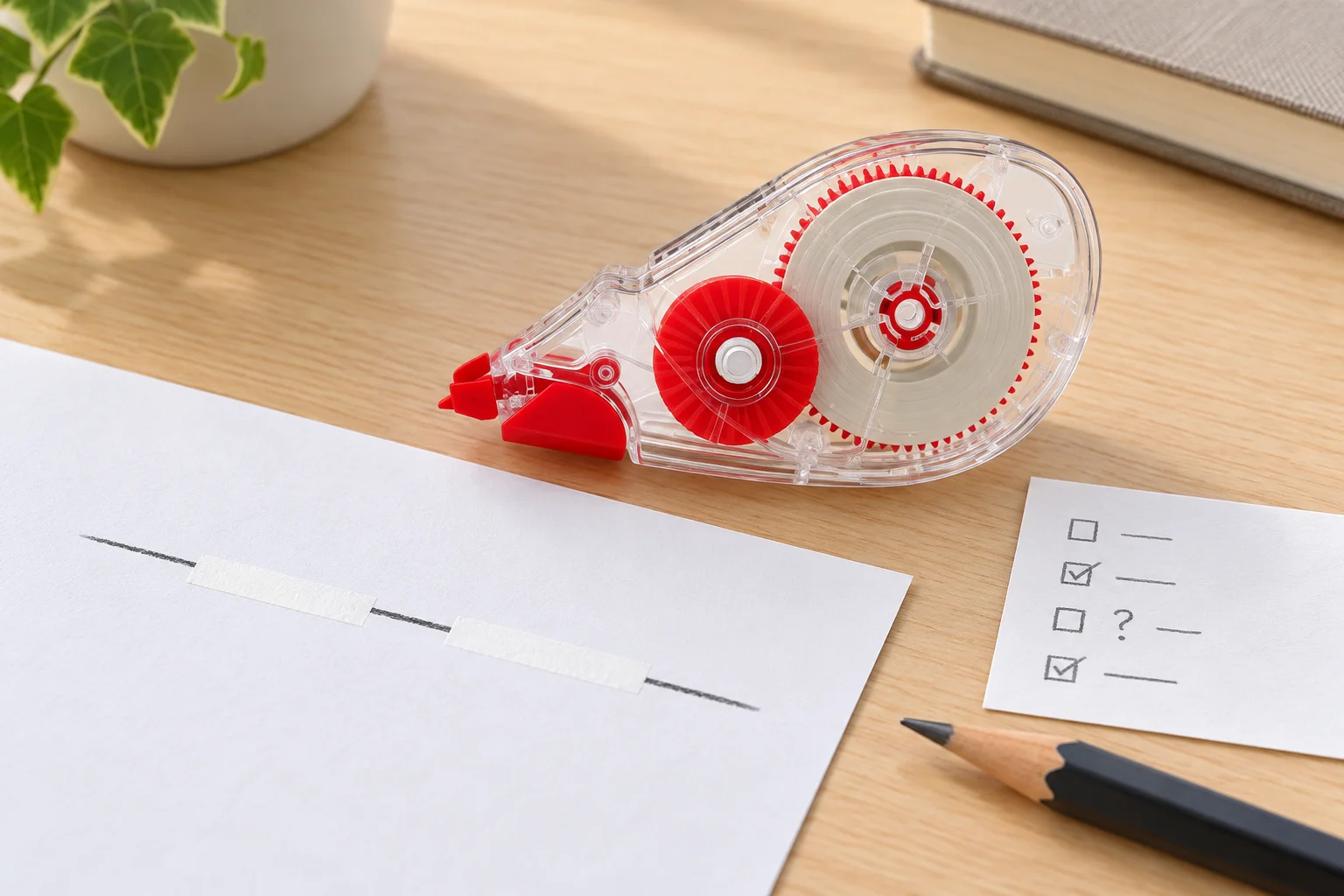
Correction tape not covering a line can describe several different failures. The applicator may leave no strip at the start, deposit an interrupted run, miss the edge of the intended area or leave a surface that does not accept the next written mark as expected. Keep those outcomes separate. Start with an expendable copy and the directions for the exact item in your hand. A successful mark on a blank scrap does not prove that the original line is covered, and a covered line does not by itself complete a write-over check.
Preserve the sheet before testing the tool
Set aside the actual sheet while you work out what is happening. Use an expendable piece of the same paper where possible, or identify the substitute if the same paper is unavailable. A trial on different stock remains a trial on that stock. Do not present it as proof about the original. If the document must retain its existing contents or follow a controlled correction process, use that process instead of covering a line simply because a dispenser is available.
Describe the visible fault in a sentence. “No strip appeared during the first part of the run” is more useful than “the tape is bad.” “The strip covered the center but left the final letter visible” points to a different check. Do not keep adding passes to the original while trying to decide which statement applies. Repeated changes can make the initial fault harder to see and can leave you unsure whether the newest problem came from the tool, the paper or the attempted correction.
Keep the affected tool identifiable during the trial. If several dispensers look alike, set the others aside rather than swapping between them without a note. You want the observation to belong to one applicator and one paper sample. Record the exact item name where it is available, together with any obvious external condition. An unreadable model should stay unreadable in the note. A case color or a nearby package is not enough to invent a more precise identity.
Read two complete applicators within their limits
The BIC Wite-Out EZ Correct listing identifies a complete non-refillable correction-tape product. Its gallery shows packaged handheld applicators with colored cases and application ends. The description's dry-application and immediate-write wording is a product claim, not a matched result on your paper. Do not treat the non-refillable description as an invitation to open the case or substitute a refill. Check the directions for the actual item rather than copying a repair for another dispenser.
The Integra correction tape listing shows complete transparent applicators with visible reels and application tips. Its description says the tape level can be monitored through the case. That gives a visible feature to examine where it is available on your item; it does not establish that a particular feed fault can be repaired internally. Accuracy and immediate-write advertising do not prove either outcome in your trial. Keep the external observation separate from an unsupported explanation of the mechanism.
Neither native example was physically tested for this article. Use the selected pages to identify the products and read their current descriptions, then use the applicable directions to conduct your own small check. This guide does not supply one universal pulling direction, angle, pressure or rewind procedure. If the actual instructions are missing or unclear, obtain the right instructions before treating another brand's illustration as a substitute. A similar outline is not evidence that the internal arrangement is the same.
Make a test strip with a known start
Put the expendable sheet on a stable writing surface and identify a short area you can afford to change. Follow the item's actual starting and movement instructions. Keep the motion within that small area, then look at the result before repeating it. Did a strip begin where you intended, begin later or fail to appear? Record the observed start rather than calling every absence an empty dispenser. The same appearance can leave more than one explanation open until the item and its directions are checked.
Inspect the applicator tip from outside
Look at the applicator tip without pulling out material or inserting a tool into the case. Note an obvious obstruction, loose-looking material or visible break if you can actually see one. If you cannot see enough to describe the condition, write that limitation down. Do not turn an uncertain view into a diagnosis of a broken reel. Follow only the maintenance or fault guidance that applies to the exact product. A reader-run external observation is different from a manufacturer-authorized internal repair.
If the directions identify a removable cover or a specific starting arrangement, check that requirement on your item. Do not assume every applicator has the same cover or that every protruding part should be removed. Once you have corrected a clearly identified external setup mismatch under the applicable directions, make a new short trial beside the first one. Keep both results available. The comparison should show what changed, rather than leaving a single patched strip whose history you cannot explain.
An interrupted run needs its own observation
A strip that begins and then stops is different from one that never starts. On the sample, mark where the interruption occurred and whether it repeated during a new trial made according to the item's directions. Keep the sample small. You do not need to consume a long length of material to record that the same visible fault recurs. Nor should a different result on the next run silently erase the first interruption. Keep the two observations and decide what is still unknown.
If the case permits viewing the tape, look for the level and condition that you can actually identify. An apparently loose section or a visible break is a reason to consult the exact product guidance, not permission to pull, wind or dismantle it. If the item is non-refillable or no applicable repair is provided, stop the improvised mechanism work. A replacement or a product-specific enquiry may be the appropriate next action. Do not present opening a case as a routine fix for every dispenser.
Keep a suspected paper mismatch separate from a feed fault. If the strip repeatedly fails on one expendable paper sample, you have an observation about that pairing. You have not yet proved whether another surface would behave differently or whether the applicator is faulty in every setting. Where the manufacturer's directions permit a suitable comparison, identify the second paper and preserve its result separately. Avoid changing the paper, tool and movement together and then crediting one change for an unexplained improvement.
Coverage is more than a visible white band
Use a simple mark of your own on the expendable paper when you reach the coverage question. Do not begin with the only copy of a record. Decide exactly which part is intended to be hidden and apply the product only as directed. Inspect the sample afterward. Is the whole intended mark covered, or does an edge remain visible? A strip can be continuous and still fail to cover the area you meant to change. State that result at the scope of the actual sample.
In an invented example, a writer wants to cover the word “draft” on a practice sheet. The first trial leaves the final letter visible. That does not establish a failed reel; it establishes incomplete coverage of the chosen word on that trial. The writer keeps the sample, reviews the exact permitted application method and chooses whether a new practice trial is worthwhile. The example promises no particular result and supplies no universal number of passes needed to hide an ink mark.
Do not add layer after layer merely to make the sample appear successful. If the material catches, lifts or leaves an uneven patch, preserve what you can see and stop extending the experiment. Follow the exact item's guidance about an incomplete application. If it offers no applicable remedy, keep the outcome unresolved rather than inventing one. A tidy-looking surface is not evidence that the original sheet is unchanged, that the content can later be recovered or that the correction is suitable for a controlled document.
Keep the write-over check separate
Only consider writing on the correction when the actual item's directions permit it. Use a writing tool appropriate to that guidance and record which one you tried. A visible strip does not by itself prove that every pen, pencil or printer process will behave the same way on it. If the next mark skips, smudges or changes the strip, describe that event separately from whether the underlying practice mark was covered. Two different outcomes can exist on the same small sample.
Do not call a write-over result a test of the product's entire lifetime or every possible paper pairing. It belongs to this tool, paper, writing material and trial. If the result is unsuitable, consult the exact product guidance or select a different permitted correction method for your own working copy. A new copy can be a practical writing choice without being presented as a repair to the earlier sheet. Preserve the earlier sample if someone else needs to understand why you stopped using that arrangement.
Keep covering and removal as different tasks. The eraser smears pencil marks guide owns graphite removal, tool care and the distinction between loose material and a changed paper surface. Correction tape deposits a covering strip; it does not carry out that erasing process. Do not use a graphite-cleaning method as an assumed cure for a tape application fault. If your real aim is to remove a pencil construction line while preserving a drawing, resolve that different medium and paper question before substituting a covering product.
Record four outcomes before choosing the next step
Give the sample four short notes: start, run, coverage and write-over. Each note can say what you observed or what remains untested. For instance, “start appeared; run interrupted; coverage not assessed; writing not attempted” leaves a clear next question. It is more useful than marking the whole test as failed. Another person can see which stage stopped the trial without being encouraged to repeat later checks on a sample that never reached them.
If a tool works externally according to its directions but a particular mark still cannot be covered acceptably, retain that limitation as a pairing problem. If an obvious internal condition prevents a run and no applicable repair is provided, keep that product fault separate. If the applicator's identity or instructions are uncertain, obtain those first. These outcomes lead to different actions. None requires forcing the mechanism or inventing a claim that the article's two retail examples would succeed where your current tool did not.
An obstruction created by another holder is a different fault again. The clipboard clip covering a form header guide addresses a page held beneath a clip and checks whether the first and last fields remain usable. Use that guide when the information is physically hidden by the holder. Depositing more correction material will not expose a title under a metal clip. Establish whether you are changing a mark on the sheet or merely trying to see a part of it before applying a product.
Keep purchasing separate from a successful trial
If you consider an order through republeq.com using crypto such as USDT, read the current exact product page and the current checkout before choosing a payment method. A product's appearance in this guide does not establish that a particular payment route is available for your order today. Confirm the listed seller, the exact item and package quantity, the delivery destination and the displayed total. If a crypto option is offered, verify the particular token and network named in its current instructions. Similar names do not make networks or assets interchangeable. Review any displayed fees, timing information and order conditions yourself. Do not infer a transfer destination from an earlier purchase, a product description or a message about a different order. If an amount, network, destination or instruction is unclear, stop and seek clarification from the responsible service before sending anything. This article does not promise acceptance, transfer success, a refund route or a particular delivery result. Keep the information relevant to your actual order through the arrangements appropriate to the purchase. A payment option cannot resolve whether an applicator will deposit a continuous strip on your paper or accept your next writing tool. Those are separate product and trial questions. If the current checkout does not offer the method you intended to use, do not construct an alternative transfer route from old information. Use only the current verified process for the exact order. You can retain the failed sample and leave the purchase pending while the necessary product-specific questions remain unanswered, without turning an uncertain trial into a successful correction.