Office Supplies & Stationery
Copy paper cost per usable sheet: plan the usable stock
Compare 2,500- and 4,000-sheet premium paper packs through actual print use, current order totals, and usable inventory.
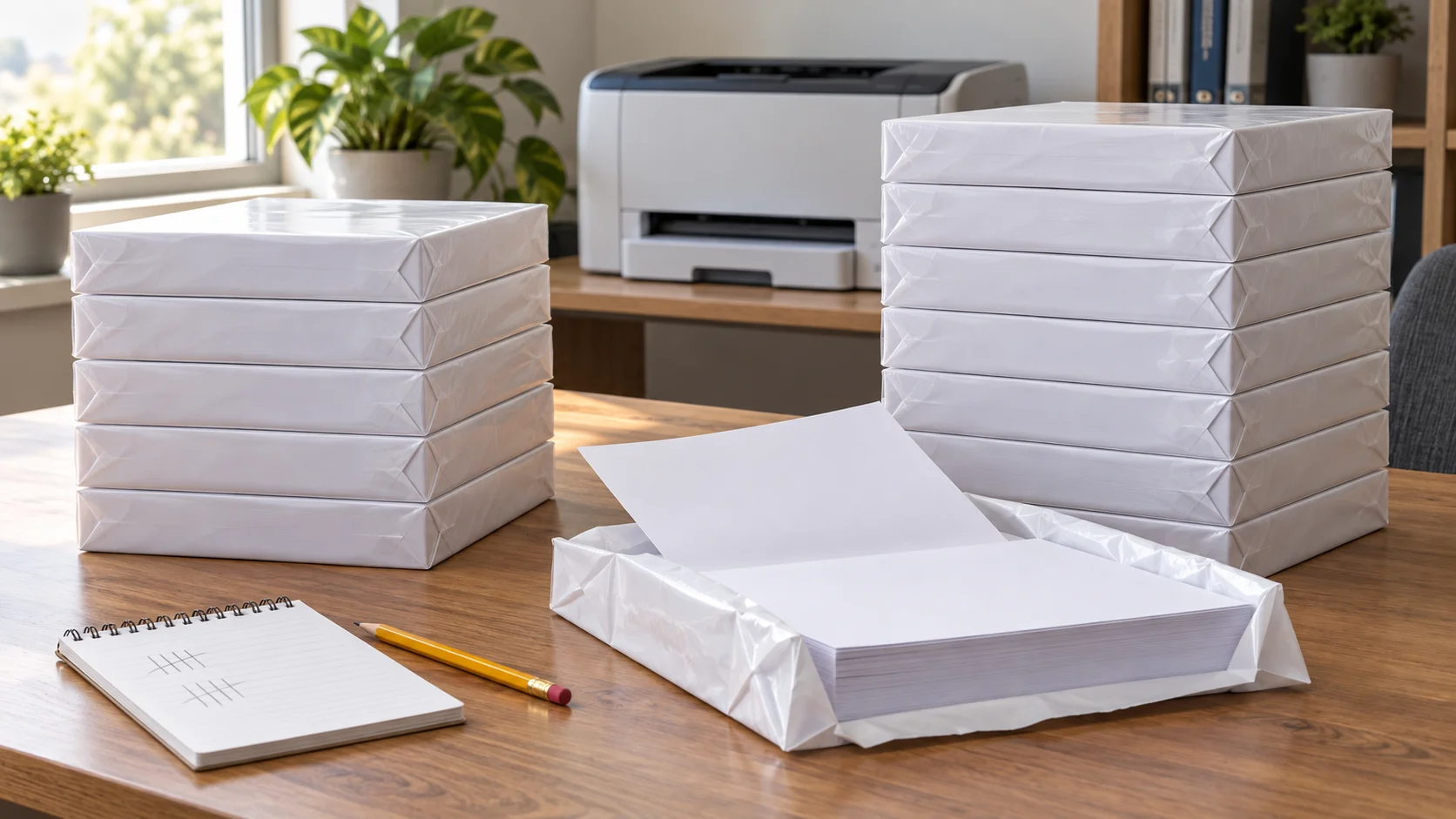
Copy paper cost per usable sheet depends on how many sheets reach a printer and serve the intended job. A large carton can lower an offer's quoted unit cost while leaving more paper than a household or small office will use soon. The current HP premium printer paper listing describes 2,500 US-letter sheets in five reams. The International Paper color copy paper listing describes 4,000 US-letter sheets per carton. Both are listed at 28 lb. Use those counts as starting quantities, then compare them with the print work and storage space you actually have.
Count the sheets the work will use
Look at the last several print jobs, not just the number of people sharing the printer. A household might print a few forms each week and a large packet once a month. A team may use a steady stack every day. Write down a reasonable range of sheets per month, separating routine copies from unusual jobs. If the usage history is uncertain, start with a short observation period rather than projecting a year's demand from one busy week.
For each job type, note whether it needs this 28-lb paper. The HP page describes its paper for full-color printing in inkjet and laser printers and copiers. The International Paper page describes smooth, photo-white, 28-lb paper for multipurpose use. Neither description establishes that every document in your workflow benefits from that weight or finish. If simple internal drafts can use a paper you already own, count only the jobs that really need the proposed stock.
A print-job count is more useful when it includes reprints. If pages are routinely discarded because of a wrong setting or a draft revision, record that separately from the final usable pages. The aim is to reduce preventable waste, not to assume a particular brand causes it. A small test batch can reveal whether the chosen paper and printer settings produce the intended result before a full carton is opened.
If multiple people print from the same supply, ask them to distinguish final documents from temporary proofs for a week or two. A simple tally beside the printer is enough; it need not track private document contents. This reveals whether a proposed premium stock would be used for routine pages just because it sits in the tray. A separate, clearly identified supply for special jobs can make the forecast more accurate.
Compare quantity over a realistic horizon
The two captured listings differ in pack size: 2,500 sheets for the HP option and 4,000 for the International Paper option. Divide each count by the typical monthly use of this kind of paper to estimate how long the stock could last. This is a planning estimate, since an unusual project may change the rate. The larger count is useful only if those additional sheets have a practical future use and a suitable place to wait.
Choose a horizon that fits your ability to forecast. A small office with a stable monthly report can estimate farther ahead than a household that prints only occasional forms. If the proposed 4,000-sheet carton would last beyond the horizon you can confidently plan, treat the leftover as inventory rather than immediate savings. It may still be a sensible purchase, but its quoted per-sheet arithmetic does not tell you how quickly the carton will be consumed.
Consider the physical amount arriving at once. Five reams already take shelf space; a 4,000-sheet carton takes more. Measure an actual clear storage position before choosing a quantity. Keep packages in a location consistent with the manufacturer's storage directions and your own conditions. If the only available spot is crowded or damp, the risk to unused sheets belongs in the decision. The listings do not give a universal shelf life for every room.
Plan for delivery and handling, too. Decide whether the full carton can be brought to its storage location and opened without scattering sheets into another paper supply. A pack that fits the purchase plan but has nowhere orderly to go often creates work later. If storage is shared, mark which ream belongs to the premium stock. That small step protects the quantity count used in the cost calculation.
Work out cost per usable sheet
Take the current offer total for the exact pack you are considering and divide it by the number of sheets in that pack. That gives a quoted cost per sheet. Then estimate how many sheets you are likely to use during the chosen horizon, allowing for a small observed share of setup tests or reprints. Divide the same total by that usable count. The second figure answers a more practical question: what the purchase costs for the sheets that will actually do work.
Use the same horizon and the same definition of a usable sheet for both offers. If one pack is expected to leave unopened reams that you will use later, do not count them as waste; carry them forward as inventory. If some sheets are damaged or become unsuitable for the intended print job, exclude only those sheets from the usable count. Avoid inventing a loss rate. Use your own handling history, and revise the estimate when real use differs.
For example, suppose the plan calls for 2,000 sheets of 28-lb letter paper before the next purchasing review. The 2,500-sheet pack leaves a smaller reserve than the 4,000-sheet carton. That does not determine which offer has the lower cost per usable sheet, because the current offer totals are needed. Put the two actual totals beside their counts and calculate both results. Do not infer a product price from the pages' sheet counts.
When an offer includes shipping, pickup, or a minimum order, use the total amount you would actually pay for that exact order. Keep any tax or account-specific charge consistent across the comparison. If two sellers quote different delivery times, note whether a delayed delivery would force an additional interim purchase. These are buyer-specific inputs, so this guide provides a method rather than a claim about which current listing is cheaper.
Write the calculation in a few columns: offer date, pack sheets, expected sheets used by the review date, current order total, and cost divided by expected usable sheets. Keep a separate line for the unused remainder. This makes the assumption visible when someone asks why a carton with more sheets did not win. If the expected use changes, update one input and see how the result changes instead of replacing the whole decision with a new hunch.
Keep the printer and paper match in view
Both current product pages name US-letter size and 28-lb weight. Confirm that the printer's tray and the print application are set for the size and stock you intend to use. A mismatch can create rejected or poorly laid-out output, and those sheets are not useful merely because they were inexpensive in bulk. Check your own printer instructions for supported media weight and printing method; a product listing alone cannot certify compatibility with a specific machine.
The HP description refers to ColorLok technology and brighter color or bolder black output. The International Paper description gives a 100-brightness rating, smooth finish, and an FSC certification claim. Those details may matter for a presentation or client document, but they do not make a cost comparison by themselves. Decide first what the document requires, then check whether each listing and the printer support that job. A higher specification that never matters to the output cannot be treated as a proven saving.
Try a small number of representative pages before opening every ream. Include a page with the text, images, and duplex setting you normally use. Check legibility, handling, and whether the print application sends the intended number of pages. If an output problem appears, adjust the printer setup using its instructions before blaming the paper. Keep the unused stock protected while you diagnose the issue.
The published printer cartridge replacement cost guide asks buyers to match the exact part and estimate the work a spare must do. Paper has a separate quantity problem: even a compatible carton can be too large for the planned print run. Review paper and cartridge requirements together for the same project, while keeping their product identities and replacement decisions distinct.
Plan where opened paper goes
Once a ream is opened, give the remaining sheets a clear place away from spills and routine handling. Keep its packaging or other suitable protection as directed for the paper. Do not leave loose pages on a shared desk where someone can mix them with a different size or weight. Label a storage spot by the actual stock so a later print job uses the right sheets without a search.
The published desk organizer paper plan covers sorting active papers by next action. Unused printer stock serves a different purpose and should stay separate from documents awaiting review or filing. This distinction makes it easier to see how much unopened inventory remains before another order is placed.
Check the stock at a set purchasing review, not whenever a crowded shelf merely looks low. Count unopened reams and estimate the sheets remaining in the open one. Compare that total with upcoming work and delivery time. A reorder point based on actual use prevents both a surprise shortage and repeated purchases that create a large forgotten reserve.
If a project ends with several unopened reams, keep them in the next review rather than assigning the full purchase to the finished project and forgetting what remains. The unused sheets have value only if they still fit a future print job and remain in usable condition. This is why the inventory note matters as much as the initial unit calculation. It also keeps the next buyer from ordering the same stock twice.
Make the purchase decision from the usable amount
If both papers meet the intended printer and document requirements, compare current order totals against the quantity you can use and store. The HP listing's 2,500 sheets and International Paper listing's 4,000 sheets are concrete counts, but the more economical choice depends on real offer totals, delivery needs, and usable volume. Record the date and exact offer checked, since those terms can change after this article is written.
For a small print run, a smaller carton can leave less idle stock even if its quoted unit cost is different. For steady large-volume work, a larger carton may reduce how often the buyer needs to order, provided the full stock can be kept usable. Neither conclusion is automatic. Use the same horizon, test the intended output, and keep a truthful count of inventory that remains for later jobs.
Copy paper cost per usable sheet is a simple calculation with one important judgment: how many sheets will actually serve the intended printing. Start with the 2,500- and 4,000-sheet listing counts, check printer and document fit, enter the current total for each offer, and divide by the number you expect to use. Recheck that estimate against actual printing before the next order.