Crypto Commerce
Commercial Chef CHMR17GB over-the-range microwave vs GE Profile PCHK11S1WSS: a place for the microwave
Compare Commercial Chef CHMR17GB over-the-range microwave by installation, venting, dish fit, controls and space.
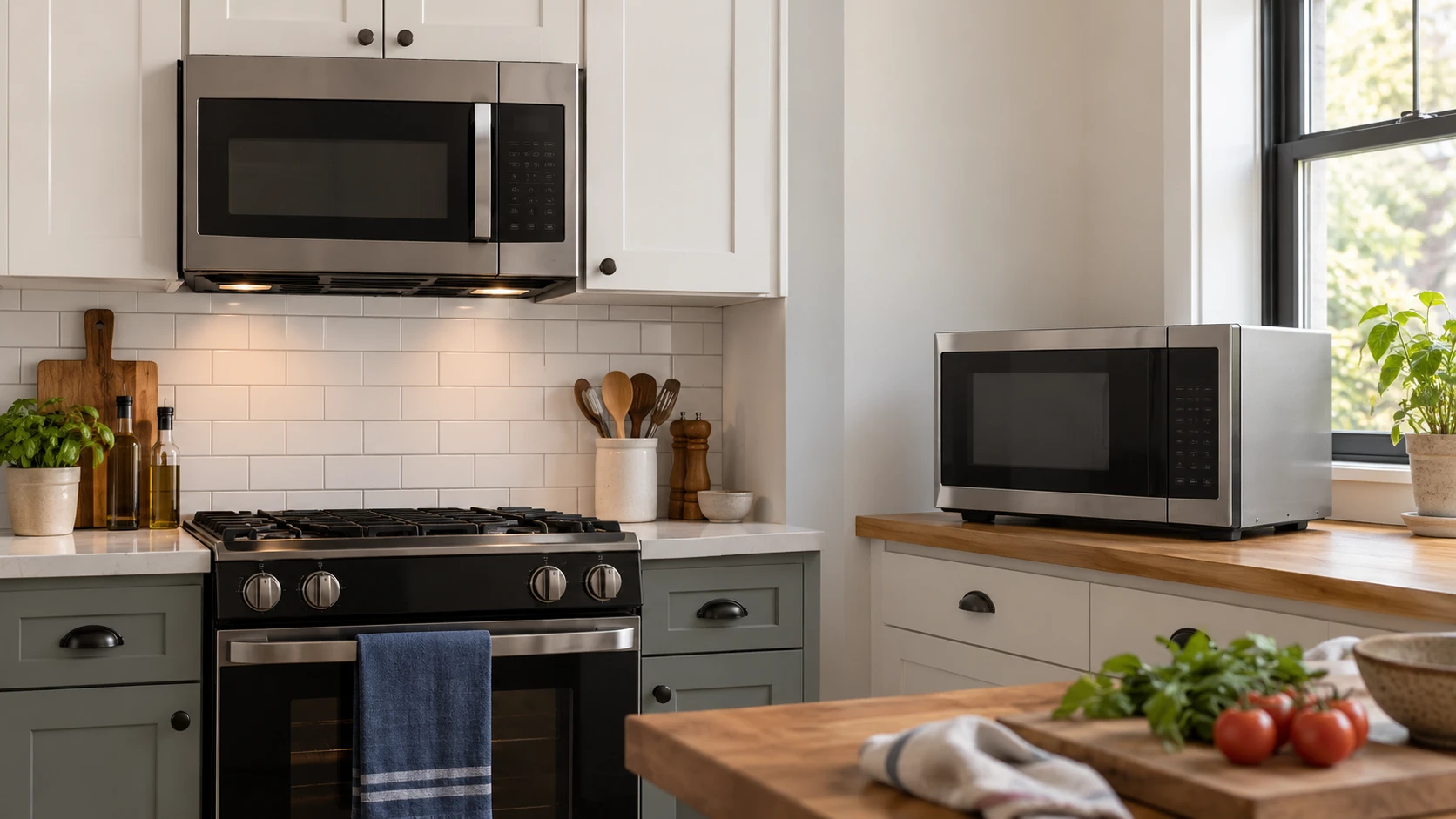
These microwaves solve different layout problems. The Commercial Chef CHMR17GB over-the-range microwave belongs above a range and includes a hood fan. The GE Profile PCHK11S1WSS is listed as a countertop appliance, with a separately available trim kit for a compatible built-in arrangement. A kitchen with an existing over-range opening may have a straightforward reason to investigate the Commercial Chef. A renter who cannot change that opening may have a straightforward reason to investigate the GE. Check the exact installation instructions before treating either reason as a decision.
The catalog describes a 1.7-cubic-foot cavity and 1,000-watt cooking output for the Commercial Chef, versus 1.1 cubic feet and 800 watts for the GE Profile. Those numbers describe different aspects of the machines. They do not tell you whether a covered casserole fits, how a full plate heats, or how easy either control panel is to use from its installed position. First settle where the appliance can safely go, then test the dishes and cooking routine it must accommodate.
Start with the installation space — GE Profile PCHK11S1WSS countertop microwave
An over-the-range microwave has to fit a particular cabinet and range arrangement. The Commercial Chef listing calls the CHMR17GB an over-the-range model and recommends professional installation by two qualified installers. Before buying, obtain the current installation manual and compare the opening, mounting surface, power supply, required clearances, and venting path with the kitchen. Measure the actual opening rather than relying on the width of the old microwave's door. Confirm that cabinets and wall construction can accept the specified mounting method. If a range or cooktop below has its own clearance requirements, those instructions also matter.
The listing names a hidden 300 CFM hood fan with two speeds. That figure is a stated fan specification, not a measured account of how well smoke will leave your kitchen. Installation can change the result. Ask whether the exact unit and kit support the vent direction your kitchen uses, whether ducting exists, and what filters and maintenance the manufacturer specifies. A recirculating setup and an exterior duct are different projects. Do not assume the listing includes every part required for either one. If the current hood already works well, consider what replacing it with an integrated microwave would change for your cooking habits.
The GE Profile is described as a countertop microwave. Its listed exterior measures 24 inches wide, 12.88 inches deep, and 12.13 inches high. Those dimensions are a starting point for finding a landing place, not a clearance diagram. The catalog also says the door-open depth at 90 degrees is 31.875 inches and that the door swings from right to left. A nominally deep-enough counter can still put the open door against a wall or leave no safe place for a hot dish. Check the manual's ventilation clearances and electrical instructions for the exact model before placing it beneath cabinets or inside a niche.
GE lists the JX830SFSS trim kit separately as compatible with this model. A trim-kit mention does not make any cabinet opening ready for installation. Verify the kit's dimensions, required air paths, and approved configuration together with the microwave instructions. If you are comparing an over-range replacement against a built-in plan, budget for the actual cabinet work and kit rather than comparing microwave prices alone. The saved catalog prices are point-in-time offers; neither includes a reliable estimate for labor or modifications.
Fit the dishes you already use — GE Profile PCHK11S1WSS countertop microwave
The Commercial Chef description gives a 12.4-inch glass turntable and a removable wire shelf intended to heat two plates at once. Its 1.7-cubic-foot volume sounds generous next to the GE's 1.1-cubic-foot figure, but volume does not reveal usable width, height above a loaded shelf, or safe clearance around a tall container. If two-plate heating is a reason to buy it, check the shelf instructions, permissible dish sizes, and whether your normal plates leave enough room to handle them safely. You may also want to know where the shelf will be stored when cooking a tall dish.
The GE Profile listing gives more detailed cavity measurements: 17.375 inches wide, 12.25 inches deep, and 9 inches high. It says the glass turntable can be switched off for oversized or rectangular dishes. That function deserves a practical check. Turning a plate off does not enlarge the cavity or guarantee even heating of a long container. Measure the dish including handles and lid, and consult the manual about where to position it and when to stir or rotate food. The catalog calls out plates and casseroles, but does not identify the dimensions of a particular casserole that will fit.
Bring one large dinner plate, one lidded storage container, and the baking dish you reheat most often into the decision. Record their outside dimensions and the room needed to lift each item without tipping it. If shopping in person is possible, check with Republeq to demonstrate placement with the machine unplugged and the correct accessories installed. Otherwise compare the dimensions against the manual, and ask about any missing measurement. Over-range placement adds another concern: a dish that fits inside may still be awkward to remove at shoulder height, especially when it holds hot liquid.
The removable shelf in the Commercial Chef may help a household warming two plates together. It also divides the available vertical space. The GE's switchable turntable offers a different kind of flexibility for an oddly shaped dish. Neither listing supplies comparative heating tests under those arrangements. If a special dish is the purchase trigger, verify its fit and the applicable cooking instructions rather than inferring performance from capacity alone.
Controls for the meals you actually make — commercial microwave controls versus home presets
Commercial Chef lists touch controls, an LED display, ten one-touch menu options, ten power levels, and multi-stage cooking. The menu list includes a kids-meals auto-cook option. Those features may be useful for repeated household tasks, but the catalog does not specify every menu's assumptions or the sequence needed to program a multi-stage recipe. Find a control-panel image or manual and walk through the three tasks you perform most: perhaps reheating leftovers, defrosting a package, and reducing power for a delicate dish. Include how many button presses are needed from an ordinary starting state.
GE says its sensors adjust cooking power during reheating. It also lists weight and time defrost settings, one-touch cooking, and a child safety lock. Sensor operation can reduce manual timing in the circumstances the manual supports, but the product description does not provide a comparative result against the Commercial Chef's presets. Check container and covering instructions for the foods you commonly reheat. Find out whether the functions you care about work when you start from the machine's usual default state. A control panel can look convenient in a catalog and become less so if its most-used options are hard to reach in the installed location.
The published guide on commercial microwave controls versus home presets uses a Midea commercial model to explain why a dial timer and a household preset panel suit different routines. It provides a way to think about repeated, measured heating tasks versus varied home meals. Neither product in this comparison is the Midea commercial unit. Use the guide's questions about routine and controls; do not transfer its Midea-specific claims to either Commercial Chef or GE.
The child lock on the GE may matter to a family, though the listing does not say how it is activated or how the panel behaves while locked. The Commercial Chef listing does not establish whether an equivalent lock exists. Look up the manual if that feature is a requirement. A lack of detail in a catalog entry is not evidence that a product lacks the function. Likewise, more menu choices do not necessarily make food easier to heat: the useful menu is the one that matches your container, portion, and instructions.
Power, venting, and upkeep — GE Profile PCHK11S1WSS countertop microwave
The Commercial Chef's stated 1,000 watts and GE's 800 watts are cooking-output figures in their descriptions. GE also labels 800 W as rated wattage, but the catalog alone is not a reliable electrical-installation specification. Consult each unit's nameplate and manual for supply requirements, then have the intended outlet and circuit checked as needed. Cooking-output numbers should not be used as substitutes for electrical input, circuit sizing, or a promise that one oven will heat every meal a fixed percentage faster.
Consider the work around the microwave. With the Commercial Chef, the hood fan and filters become part of the appliance you must clean. Confirm the filter type, replacement availability, and access once mounted. If it vents outdoors, inspect the duct plan before installation. With the GE, confirm the countertop ventilation space stays open and the cord can reach an appropriate outlet without an unsafe arrangement. A trim-kit installation has its own air path and should follow the approved instructions. In either case, wipe spills promptly and check how the turntable and any shelf should be cleaned.
An over-range microwave also changes service access. If the machine has to be removed to repair or replace it, the work is different from carrying a countertop unit off a clear counter. Ask about warranty handling for installed appliances and whether local service is available for the exact model. For the GE, a separately purchased trim kit may complicate removal compared with ordinary countertop use. These are planning questions, not claims that one product will fail sooner. The catalog contains no reliability comparison or repair-rate data.
Decide with your kitchen's constraints — GE Profile PCHK11S1WSS countertop microwave
Choose the Commercial Chef for further investigation if you need an over-range replacement, can satisfy the documented mounting and venting requirements, and value the listed shelf and hood features. Verify the exact opening and the way your kitchen handles cooking fumes. Its larger stated capacity may be useful, but the shelves, turntable, door position, and mounting height still need to work with your dishes and the people who use them.
The GE Profile PCHK11S1WSS countertop microwave is a candidate when you can dedicate counter space and want to investigate sensor reheating, a switchable turntable, and its stated interior dimensions. Confirm the door swing and full door-open depth in the intended location. If you plan to use the separately sold trim kit, verify the approved installation as a separate project.
Before ordering either one, draw the proposed location and mark the open-door space. Then measure the dishes that create the most trouble in your current microwave and read the installation and cooking instructions for those use cases. Those checks can rule out an attractive listing before you pay for an appliance that cannot fit the kitchen or the food.