Office Supplies & Stationery
Clipboard listening map: a paper portrait of an everyday pause
Make a subjective paper portrait of one listening pause with your own marks, a simple legend and a caption that preserves uncertain directions.
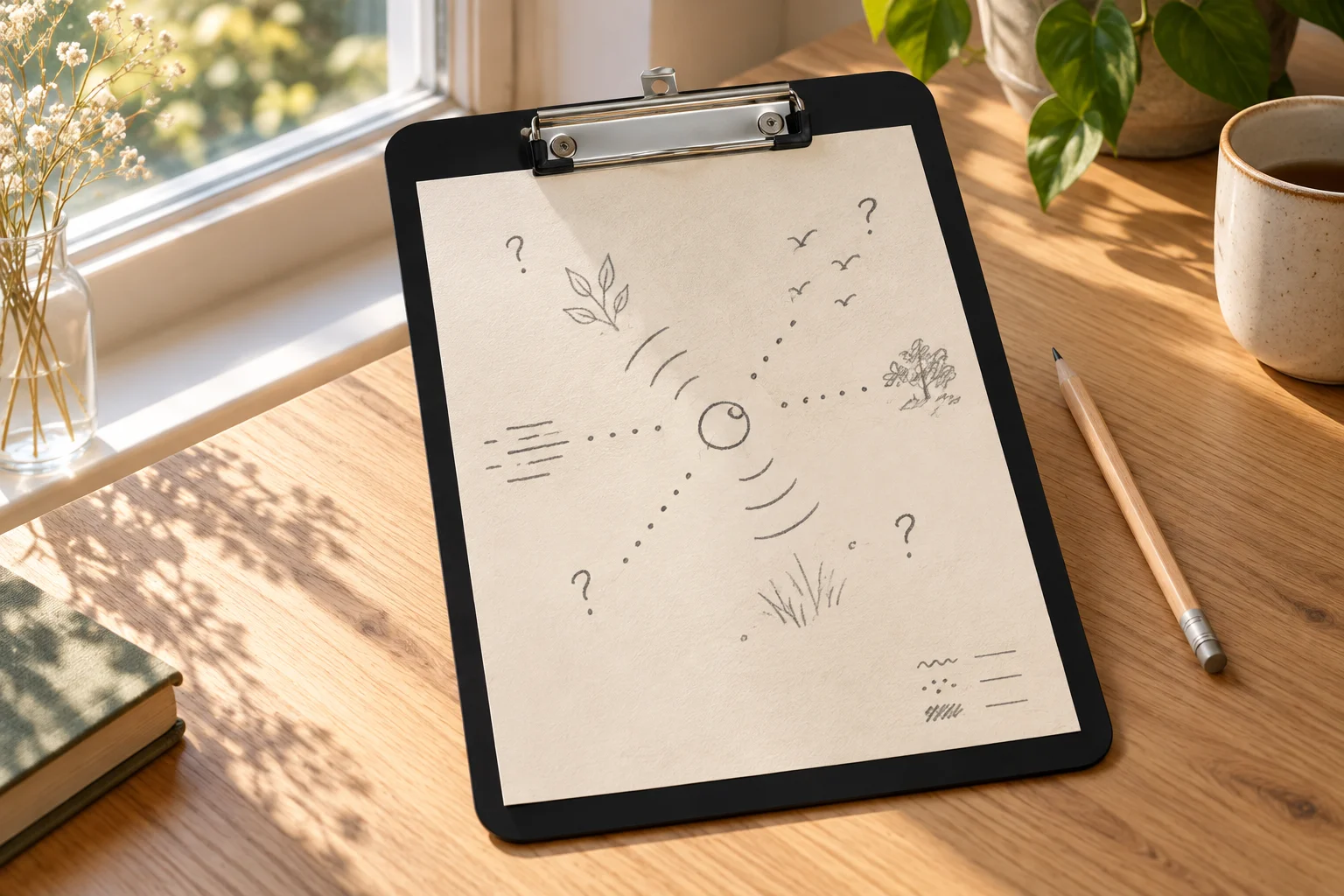
A clipboard listening map is a small paper portrait of what you notice from one ordinary place. Put a mark for yourself near the middle, then choose a few symbols for sounds you personally hear around you. You might draw a short ripple for water or a dotted line for an intermittent rattle. The marks need no universal meaning: a small legend can explain your choices. Keep the page tied to this particular pause. It is an expressive record, not a measurement of sound levels or a verified diagram of where every sound began.
Choose an ordinary pause worth keeping
Imagine sitting near an open doorway with a page on your lap. A hum seems to come from inside, an occasional tap appears to come from the left and a brief rustle is harder to place. This is an invented scene, not a description of a particular room or a promise about what you will hear. It gives the page three different kinds of mark to hold. Your actual setting may be quieter, busier or simply different. Start with what you notice rather than trying to reproduce the example.
Choose somewhere you are permitted to sit or stand still with the page. Keep the activity separate from a task that needs your attention, including moving through traffic or operating equipment. You do not need an unusual destination. A familiar room or a place beside a window can supply a personal page. If the setting is unsuitable, leave it and choose another occasion. The point is making an optional paper portrait, not completing a challenge in a place where the activity does not fit.
Give the page a modest intention. Perhaps you want to remember the background of a quiet afternoon or give an ordinary waiting moment a visible form. You do not need to hear every possible sound, sit for a prescribed duration or produce a complete scene. Choose a stopping point that suits the occasion. No health, concentration or listening improvement is promised by the exercise. A short unfinished page can still preserve a few details you chose to notice.
Let the clipboard carry the paper
The Officemate magnetic clipboard listing describes a black plastic board with a low-profile metal clip for letter or A4 documents. Its gallery shows a flat board with the clip at one end, without a storage compartment. Use that visible form as a reference for a loose-page setup. The listing's broad mounting and durability claims do not establish a result in your setting, and its odd reference to keys is not adopted here.
The clear acrylic clipboard listing describes a low-profile spring clip with rubber corner grips and support for letter or A4 documents. The image shows a transparent flat board and its paper-retaining clip. This is another example of the same basic writing-support role. No material toughness, universal grip performance or outdoor suitability was physically tested for this article. Check the current exact offer rather than inferring what is supplied from an abbreviated bundle title.
You can use a suitable board you already own. Try one ordinary sheet on it and see whether you can make the marks you want without holding the clip open. The clipboard paper and storage capacity guide separates supported paper size, the active clip stack and any storage compartment. Those are purchasing questions for that guide. This activity needs a page you can use comfortably in your chosen setting, not an elaborate supply arrangement or a claimed capacity advantage over another board.
Make directional marks from your own position
Put a small circle or an X near the middle of the sheet to represent your chosen position. Write a short note explaining what counts as the top of the page: the window, the doorway or the direction you are facing. It is a personal reference, not a compass bearing. If you turn the board while drawing, look back at that note before adding another directional mark. Otherwise a sound placed on the left may mean different things in different parts of the same page.
Leave open space around the center. The page does not need a street plan or a measured outline of the room. A few recognizable landmarks can help you remember the occasion, but do not crowd out the marks you came to make. If you include a doorway, label it as a memory cue. Its drawn size and position do not make the page a building plan, an access route or evidence of the exact path a sound took to reach you.
Decide what the distance between a mark and the center will mean. You might use it for a simple impression of near and far, or leave every mark equally spaced and write those impressions as words. State the choice in the legend. Do not let a larger gap on the paper masquerade as a measured distance. If you cannot judge distance, use a question mark or an unplaced note at the edge. The uncertainty is part of your account of the moment.
Choose a personal legend for this occasion
Pick marks you can draw quickly and explain afterward. In our invented doorway scene, the continuous hum gets a short wavy band, the tap gets a row of small ticks and the uncertain rustle gets a loose loop with a question mark. These are fictional choices for a personal legend. They are not standard acoustic symbols. You can use words alone if drawing adds no pleasure, or let a simple pattern carry the distinction between something continuous and something you noticed only briefly.
Give one mark one meaning while you are making the page. If you change your mind, update the legend instead of expecting the next reader to infer the change. A broad loop might mean an uncertain direction for you; someone else might read it as a boundary. A few words beside the loop settle that ambiguity. The legend should explain the page you actually made, including any unplaced marks, rather than becoming a general code you feel obliged to reuse forever.
Avoid using the symbols to identify a person or explain their intentions. A sound you notice may have more than one possible source. “Several short taps, direction uncertain” describes your impression without identifying who made them or why. You do not need to record conversations or collect personal information to make this page. If spoken words happen to be part of the setting, you can leave them out and choose a different sound or a purely abstract mark.
Keep a sound impression separate from its source
You may think you recognize a hum, rattle or scrape. Write “seems like” if that is what you mean. The page can preserve the impression without settling its cause. If you directly see an ordinary source at the time, you can describe what you saw separately, but the drawing still records your perspective. It does not establish how the place sounds to someone elsewhere. A paper portrait should not grow into a noise complaint, an equipment diagnosis or an exposure assessment merely because it contains directional marks.
In the invented doorway scene, suppose the tap stops before the listener can place it. The listener leaves three ticks near the margin and writes “brief; direction unclear.” Nothing requires moving those ticks beside the nearest visible object. That would give the page a tidier composition while changing its meaning. Keep the uncertain observation where the legend can explain it. The blank space between the ticks and the center can be a deliberate part of the page rather than a gap you must fill with a guessed source.
Choose whether to add a remembered impression after the pause ends. If you do, label it as added from memory. Do not silently present a later recollection as a mark made at the moment. This is a personal art exercise, so you can include memory if you want it. The small distinction makes the resulting page easier for you to understand later. It also leaves room for an honest note such as “I remember something rhythmic, but not where it came from.”
Let the page have its own shape
The map can be spare. One center, a few marks and a short caption may be enough. You might leave a broad empty area because nothing there caught your attention, or group the marks close together because their relationship matters more to you than their apparent direction. Explain that choice. Empty paper is not proof of silence, and a dense cluster is not a measured concentration of sound. Your arrangement expresses what you selected for this page.
If the clip hides the place where you intended to write the title, do not force the whole map into a cramped band. The clipboard clip covering a form header guide owns that specific board-and-page visibility problem. Refer to it for a sample-based placement or permitted layout adjustment. For this personal page, you may simply choose a clear space for your caption after checking the sheet on your actual board. This article does not promise that a low-profile clip leaves every top margin visible.
You could give each noticed sound a word, a drawn rhythm or a different line quality. Pick what makes the finished page readable to you. There is no need to compare pencil grades, reproduce a product photograph or make a series of improved compositions. The aim is one occasion with its own legend and caption. If the sheet becomes crowded, stop adding marks and finish the explanation rather than moving earlier observations into positions that suggest a different account.
Give a caption more than a place name
A caption can say where you chose to pause, what the top of the page means and which marks remain uncertain. Keep location detail as general as you prefer, especially if you may show the page to someone else. “By the kitchen window, facing the table” may preserve all the context you need. You can omit an address, a date or other identifying information. An expressive map does not require a public record of where you or another person spends time.
Try reading the page once without looking at the legend, then with it. Which meaning depends on a word you have not yet written down? Add that word if you want to preserve the distinction. If someone else looks at the page, let them describe their interpretation before explaining yours. Their reading can be different without either person being wrong about their own experience. The useful outcome is a clearer explanation of your choices, not agreement that everyone hears the same scene.
Finish the page where the occasion ends. You can keep it in a folder, display it privately or leave it as a loose sheet if that suits your materials and space. It does not need to become a daily log. A later page would belong to another occasion and another set of choices; it would not establish a trend merely because the same symbols appeared. Give this page a caption you recognize and leave its uncertain marks honestly uncertain.
Check an order on its own terms
If you decide that a clipboard belongs with this activity, check the exact current product and purchasing conditions independently of the example. A flat board with a clip is the relevant form here; a storage model or portfolio is a different arrangement. Confirm what the selected offer supplies, including its unit or bundle quantity, and check your own paper against the usable face. The personal page can be made without buying either native example. No pack count is a target for how many portraits to make.
If you intend to purchase through republeq.com using crypto such as USDT, open the current exact product page and the current checkout before deciding how to pay. The presence of a product in this guide does not establish which payment methods are available for your order today. Check the listed seller, the precise item and quantity, the delivery destination and the displayed order total. If a crypto payment option is offered, read its current instructions and confirm the specific token and network it names. Similar names do not make networks or assets interchangeable. Review any displayed fees, timing information and order conditions yourself. Do not infer a transfer destination from a product description, an earlier purchase or a message about a different order. If an instruction, amount, network or destination is unclear, stop and obtain clarification from the responsible service before sending anything. This article does not promise acceptance, transfer success, a refund route or a particular delivery result. Keep the information relevant to your exact order through the arrangements appropriate to the purchase. A payment choice cannot answer whether the board supports your paper, whether the clip leaves the caption visible or whether you enjoy making this kind of page. Those remain separate decisions. If the current checkout does not offer the method you planned to use, do not construct an alternative transfer route from old information. Use only the current verified process for the actual order. You can also keep the activity simple with suitable materials already available to you and leave the purchase undecided until the open questions have answers.