Problem-Solving Articles
Classical guitar capo buzz or changed tuning: choose the right check
Investigate classical guitar capo buzz and unwanted tuning changes with G7th’s placement and pressure guidance, keeping Performance 2 and Newport controls separate.
Classical guitar capo buzz and an unwanted tuning change call for different observations. A string that does not ring cleanly raises a pressure or placement question. An unwanted tuning change raises a different question about the clamped result. G7th's beginner guide discusses both insufficient and excessive pressure, alongside placing the capo close to the fret wire.
This guide uses the actual G7th Performance 2 Classical and Newport Classical descriptions. It assumes an appropriate, already set-up instrument and an applicable capo. It supplies no string replacement, neck adjustment or repair procedure. Keep the actual capo model identifiable before borrowing a control instruction from another design.
Describe the unwanted result before adding pressure
Begin with what you can hear and establish. Is there a buzz, an unwanted tuning result or both? Which strings are involved? Keep a simple description of the current observation. Calling every result a capo problem can hide differences that matter when choosing the next check.
G7th's beginner explanation says too little pressure can leave strings buzzing, while too much can pull them out of tune. That identifies a reason to assess the applied pressure. It does not establish that every buzz comes from insufficient pressure or that every tuning issue comes from the capo. An unresolved instrument condition needs its own appropriate assessment.
Do not begin by assuming that more clamping pressure will improve every result. The intended outcome includes both a clean sound and the appropriate tuning result. If one changes while the other remains unresolved, keep both observations visible instead of treating a single improvement as proof the whole problem has been solved.
Match the actual classical capo to the instrument
The G7th Performance 2 Classical Black offer identifies G7P2CLBK-U and SKU 102738577. Its description names classical and flamenco guitars, patented tension control and squeeze-on, squeeze-off operation. It also describes making adjustments while the capo is on the neck. Those are claims for this selected capo account, rather than every G7th product.
The manufacturer's current Performance 2 Classical Black page specifies classical and flamenco guitars with a flat fingerboard. That scope matters. A familiar brand or a guitar's general nylon-string description does not independently establish that every variant suits every neck. Confirm the actual combination when its relevant details are unresolved.
The manufacturer also distinguishes the former steel-string versions from the classical product. Its statement that earlier steel-string versions were succeeded by Performance 3 does not make this selected Performance 2 Classical an ART-equipped Performance 3. Keep the model name with any instruction or feature claim you use.
The selected description calls Black both the colour and size. That size field does not supply a measured jaw width or a neck-dimension limit. Do not turn a colour word into a physical fitting specification. If dimensions determine suitability, obtain the actual information for the instrument and capo combination.
Read the Newport account on its own terms
The G7th Newport Classical Silver offer identifies G7NPCLSL and SKU 48846142. It describes a low-profile flip lever, adjustment of tension while the capo is on the neck and a harder string pad intended to improve tone. Its protective and buzz-free wording remains a product claim, without a verified result for your guitar.
The manufacturer's actual Newport Classical Silver page identifies the flip-lever design and a knob for fine tension adjustment. That is a different control account from the Performance 2 squeeze mechanism. Use the actual model's adjustment information instead of assuming that the two accessories operate alike because they share a brand.
Neither selected retail description supplies a universal tension value, a number of knob turns or a measured amount of hand pressure. This article does not invent those settings. The relevant manufacturer guidance concerns the applied result and the actual mechanism, rather than a fixed setting presumed to suit every instrument.
Capo pressure and tuning need a matched observation
For capo pressure and tuning, distinguish a normal change associated with using a capo from an unwanted tuning result. The beginner guide describes a capo as an accessory for playing in different keys. Hearing a higher note than an unclamped reference does not, by itself, establish a tuning fault.
Establish the intended comparison through the applicable musical and instrument context. This guide gives no target notes or tuning procedure for a particular capo position. A comparison based on the wrong expected note cannot tell you whether the clamped result is correct, even when the listening or measuring tool appears precise.
Keep that question separate from buzzing. You might have a clear-sounding note whose tuning still needs assessment, or a correctly identified pitch with an unwanted buzz. Describe the actual result before changing another variable. A statement such as “it sounds different” may need a more specific explanation before it can guide the next step.
If you cannot establish the intended pitch reference, obtain that information rather than trying to compensate with progressively different clamping pressure. The capo's adjustment is not a substitute for knowing the musical result being assessed. Keep the unresolved reference question in the account you give a teacher or suitable support contact.
Use the manufacturer's placement and tension guidance
G7th's beginner guide says to place the capo close to the fret wire and adjust its tension so the strings ring cleanly. It says that close placement reduces the risk of pulling the instrument out of tune. Follow the applicable instructions for the actual combination; this account supplies no universal millimetre gap or force value.
After an appropriate change, assess the observation you began with. Has the buzz changed? Is the intended tuning result established? Keep any remaining issue separate. A temporary improvement does not establish the cause of every earlier symptom or approve an otherwise unverified capo and instrument combination.
Stay within the actual capo's supported external adjustments. This article gives no permission to alter strings, file a part, change the instrument's neck relief or modify the accessory. If the documented placement and pressure approach leaves the result unresolved, retain the observation for appropriate model-specific advice.
G7th capo control differences matter during the check
For G7th capo control differences, keep the Performance 2's squeeze attachment and release mechanism separate from the Newport's flip lever and fine-adjustment knob. The manufacturer's beginner guide identifies the Performance 2 release lever. The Newport page identifies its own knob for pressure adjustment while on the neck.
This is not a procedure to twist an unspecified part on a Performance 2 or operate a Newport by copying another model's release action. Identify the actual control before following its instructions. A photograph of a similar accessory can help identify a question, but it does not replace the matched model information.
The selected offers both discuss adjustment on the neck. That shared capability does not imply identical actions or a common numeric setting. Keep the supported control and the result under assessment together, so an instruction about one design does not silently become an instruction about the other.
Separate two changes in a fictional practice check
Imagine Ellis hears a buzz after fitting an appropriate capo. In this fictional example, they change the position and applied pressure together, then hear a cleaner sound. The improvement is an observation, but it does not isolate which of the two changes mattered. It also does not establish the intended tuning result.
If Ellis wants to understand the issue more clearly, the next comparison needs a defined starting position and an identified change within the applicable instructions. There is no need to create an arbitrary tension scale or invent a test score. Keep the observation understandable enough to describe which condition changed and which question remains.
Now imagine Noor reports that the guitar sounds sharp, but has not established the expected notes for the capo position. That is a different unresolved prerequisite from Ellis's buzz. Changing pressure without an appropriate reference would not settle the tuning question. These characters illustrate how observations differ; they are not reports of a real trial.
Someone assisting can ask which result the player is checking rather than taking over every adjustment. An instruction about a particular control should name the actual capo. If the person cannot identify the mechanism or applicable instrument scope, pause the physical change while resolving that information.
Keep shared music and reference sounds in their own scope
The harmonica call-and-response session guide describes a short musical opening, a reply and taking turns leading. Its actual Hohner Special 20 Pink and Discovery 48 descriptions remain different instrument accounts. The social arrangement provides a reason to establish your own instrument's result before sharing an exchange; it supplies no guitar-capo technique or fit approval.
If another person is listening during a shared session, give them the specific question. They can tell you which sound they are being asked to compare without treating every difference between two instruments as a fault. Keep a question about one clamped guitar separate from the sound or response chosen by a different player.
The metronome tempo and beat-settings guide distinguishes the documented Korg KDM-3 metronome controls from its separate sound-out pitch-reference mode. Its actual Matrix MR800 description leaves the corresponding controls unknown. A beats-per-minute number is not a tuning reference for this capo check.
That guide supplies no target note for a guitar at a particular fret and no full guitar-tuning method. It helps identify which kind of reference a device is providing. Keep a rhythm signal, a pitch reference and the intended note as separate pieces of the comparison rather than treating any repeating sound as proof the guitar is in tune.
Keep an unknown earlier condition unknown
If you did not establish how the instrument sounded before the current capo use, say so. A remembered impression from another day is different from an observation of the relevant setup. You can describe the present buzz or tuning question while leaving the earlier condition unresolved.
The same applies when someone else used the guitar last. Their capo position, mechanism and intended musical context may have differed. An earlier report that it sounded fine does not identify the pressure or placement appropriate to the present combination. Obtain the details that matter instead of adopting an unnamed previous setting.
A change of player can also change what is being assessed. Keep the actual observation and intended comparison clear, without assigning an instrument fault or a universal corrective setting from that change alone.
Retain the remaining observation when seeking help
For unresolved classical guitar capo buzz, record the actual instrument and capo, the placement or supported pressure adjustment made and the result you can describe. Keep an unwanted tuning change distinct from a string that still buzzes. State when the expected pitch reference remains unresolved.
A useful request names the actual G7P2CLBK-U or G7NPCLSL instead of asking about an unspecified G7th accessory. Keep the supported instrument scope and control information alongside the observation. The product's protective or tuning-stability claims do not turn an unresolved result into a confirmed repair.
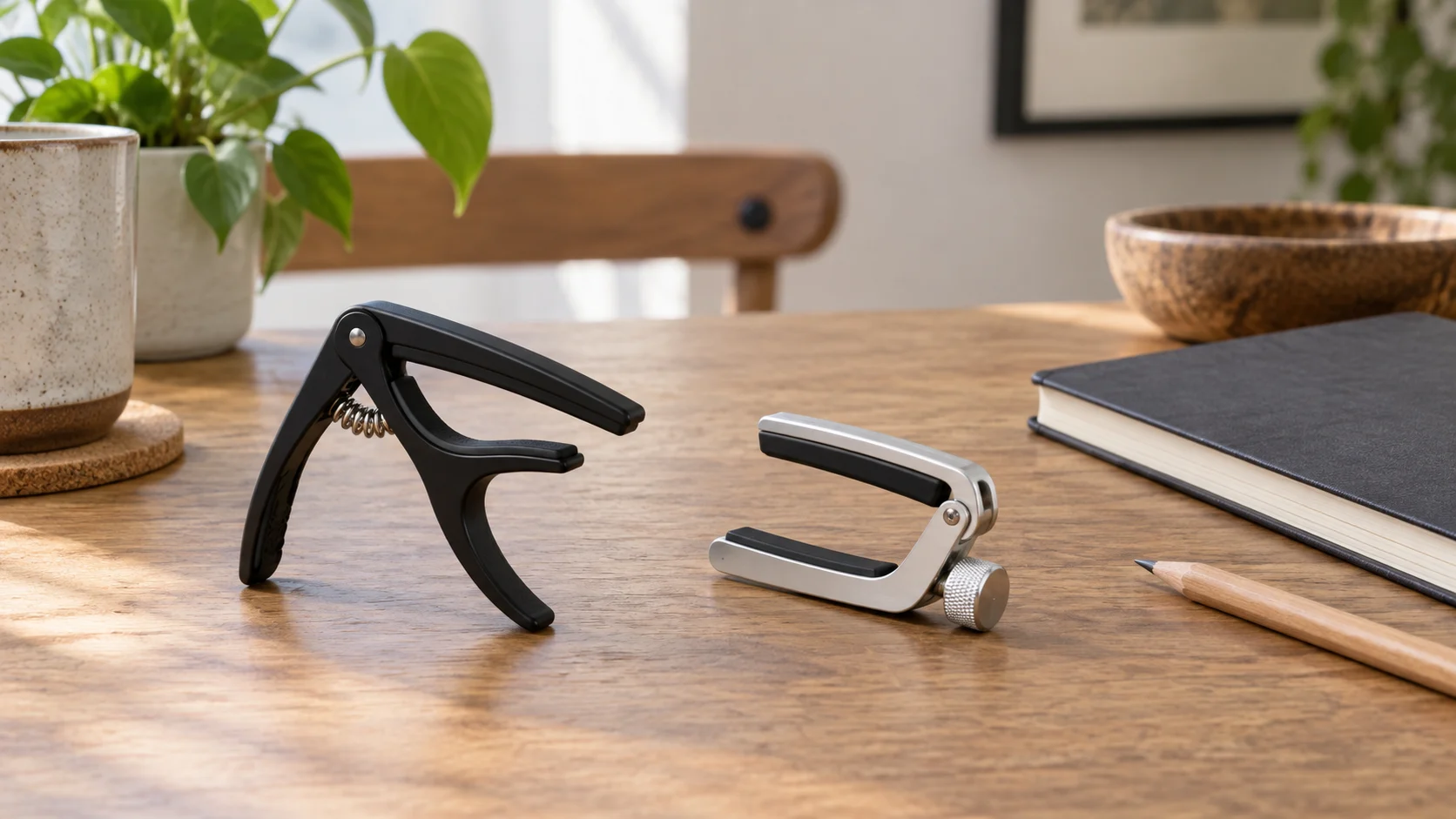
Conceptual classical guitar capo buzz scene with two whole generic uninstalled accessories; no exact retail model, fitted position, pressure setting or playing result is demonstrated.