Writing & Documents
Cinema character after the credits: an original story
An original gentle fantasy: Nell meets a screen character who wants to read beyond her represented moment and chooses a chair facing away from the auditorium.
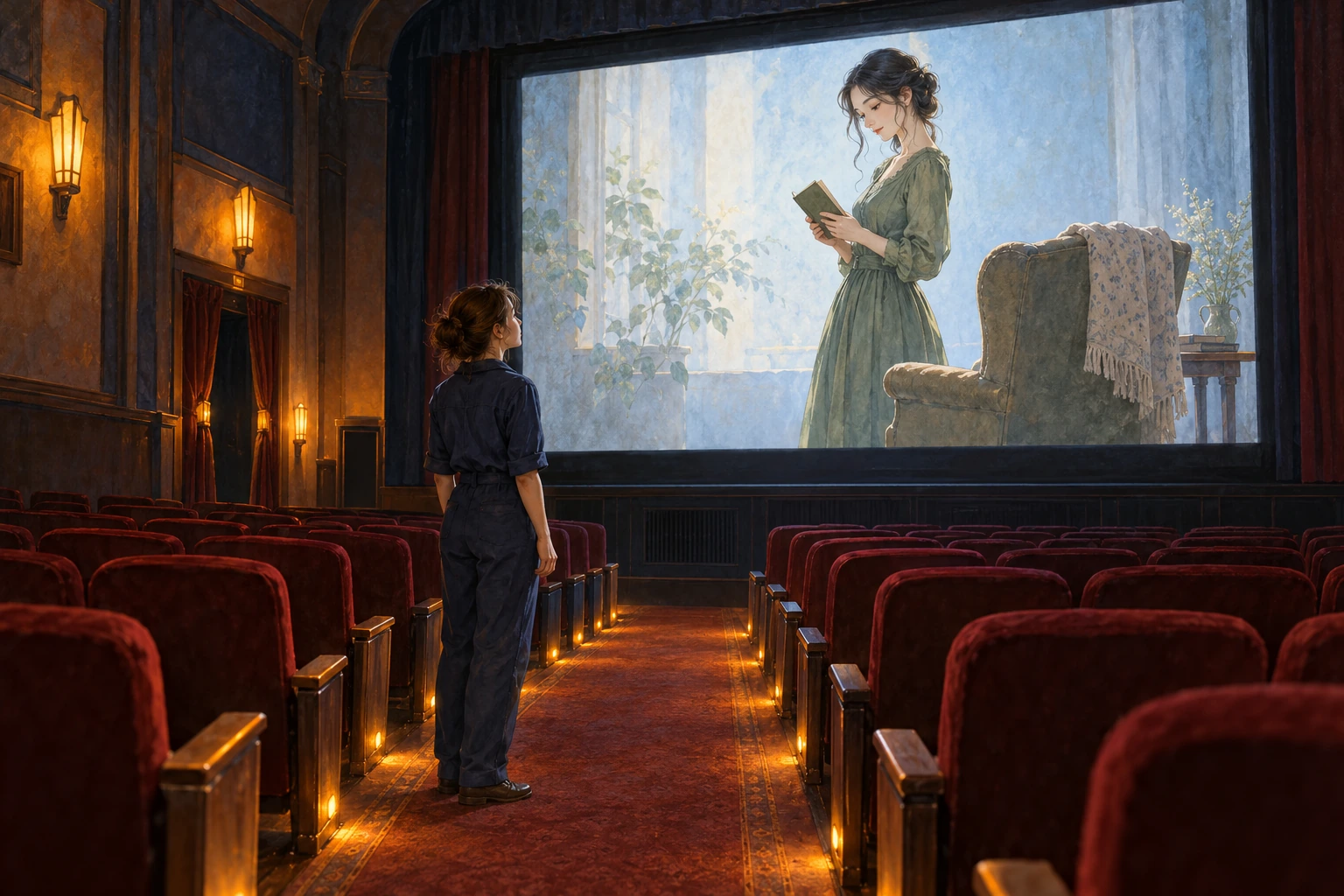
Cinema character after the credits is an original gentle fantasy. Nell, Rin, the cinema and the unnamed film are invented. A character crosses the boundary of a picture because this story allows that impossible event, not because it describes a projection effect or a real encounter. There is no actual actor, quoted screenplay or equipment procedure behind the tale. The retail candle holders after the ending are separate objects, with no identified part in the fictional auditorium.
The woman who remained
Nell waited until the last person had gone before walking down the aisle. Someone had left a folded programme beneath a seat. She picked it up, straightened the corner and carried it toward the front. The film had ended. On the screen, however, the woman beside the reading chair had not left. She was still holding the small book Nell had watched her open earlier that evening.
This was not the final picture Nell remembered. The film usually left an empty room, with light across the back of the chair. She stopped beside the first row. The woman looked toward her, closed the book over one finger and said, “Could you wait a moment?” Nell glanced behind her. There was nobody else in the auditorium, and the voice had not asked the empty seats.
“The showing is over,” Nell said. The woman nodded. Nell knew the shape of that nod from the film, though it had never before been directed at her. The book remained partly open. Behind the woman stood a painted door that nobody used during the story. Nell had once wondered where it would lead. Now she found herself looking at the woman’s finger between the pages instead.
A page beyond the picture
The woman said her name was Rin. Nell told her that she knew. Rin looked down at the book. “You know when I open this too.” Nell admitted that she did. It happened near the beginning, while somebody else spoke in another room. Rin sat, opened the cover and looked at the first page. The film then went elsewhere. It never returned to show her turning a leaf.
“I would like to get past that part,” Rin said. Nell asked whether she meant the first page or the room. Rin considered the painted door. “The page, to begin with.” She lifted the book a little, as though Nell could inspect it from the aisle. Its cover had no title that Nell could read. She had never noticed a title, on the first night or any showing since.
Nell still had the programme in her hand. She folded it along its old crease and put it in her pocket. She had questions about the room, the unused door and the voice that had reached her. None seemed to be the question Rin was asking. “What stops you?” she said. Rin looked toward the rows of empty seats. “I keep being the woman who has just begun.”
Nell sat at the end of the front row. It put the screen above her, where it had always been when she watched from a seat. Rin moved closer to its lower edge. For a moment, Nell expected the room behind her to become larger. Instead, Rin placed one foot into the aisle. The movement was ordinary enough to make the boundary around it look newly impossible.
The aisle between two rooms
Rin stood beside the first row with the book against her side. She was neither transparent nor a reflection on the seat backs. Nell could see the empty chair remaining in the picture behind her. Nothing in the auditorium explained her arrival away. She looked down at the carpet, then along the narrow route toward the doors. “You can go somewhere from here,” she said.
Nell told her that the doors led to the foyer and then the street. Rin asked whether Nell went through them every evening. Most evenings, Nell said. There had been nights when she stayed to help with something, and mornings when she came in before the others. Rin looked back at the painted door. She had been beside it through all the visits Nell had made to this cinema.
“Would you like to see the foyer?” Nell asked. Rin ran a thumb along the closed edge of the book. She said she might, but not tonight. Nell let the offer rest there. She asked whether the street looked different at night. Nell said most of the shops closed before the film finished. The pictured chair was still waiting at the front of that room.
They stood without speaking while a small sound came from beyond the auditorium doors. Nell knew that someone was gathering cups in the foyer. She did not ask Rin to identify the sound or turn it into another part of the film. Rin listened, then looked at the book again. “If I read here,” she said, “would you keep watching to see what happens?”
What Nell had expected to see
Nell had been preparing to do exactly that. She wanted to know whether Rin would reach the next page and whether the unused door would open once she did. It occurred to her that she had taken the empty auditorium for permission to watch more closely. She looked toward the screen, where the chair remained presented at the same angle as every other evening.
“I don’t have to,” she said. Rin did not thank her immediately. She asked whether Nell wanted to know what the book was about. Nell said that she was curious. Rin smiled at the plainness of the answer. “So am I.” She had seen enough of its first page to recognise the beginning, but the story had never given her a finished reading to remember.
Nell could have asked her to read aloud. She did not. That would have supplied the auditorium with another performance, and Rin had not come into the aisle to offer one. Nell rested a hand on the end of the seat beside her. There was no ticket in it, no visitor waiting to be shown a place. The empty rows could stay empty while the conversation found its end.
Rin opened the book where her finger had been. Nell looked toward the back doors instead of trying to read over her shoulder. She could see the short strip of light beneath them. Somebody passed beyond it, interrupting the light, then moved on. When Nell looked back, Rin had closed the book again. She was looking at the chair rather than at Nell.
Turn the chair away
“I think I could change that,” Rin said. Nell followed her glance. “The chair?” Rin nodded. It stood at an angle that gave the auditorium a clear view of the sitter’s hands and face. Even without a person in it, the furniture seemed prepared to show somebody beginning to read. Nell had never thought of its direction as a choice anybody inside the picture could make.
Rin stepped back across the screen’s lower boundary. The room received her without becoming a different room. She put the book on the chair, took hold of its back and turned it toward the painted door. Its rear now faced the auditorium. Nell could still see the plain wooden bars, one chair leg and the corner of the book resting on the seat. She could no longer see the place where Rin’s face would be.
“Does that leave enough light?” Nell asked. Rin looked toward a window beyond the edge of the picture. “For me,” she said. Nell accepted the answer as part of Rin’s room. She did not need to rearrange it from the aisle or find another chair whose angle would be easier to see. The change had already been made by the person who meant to sit there.
Rin picked up the book and sat. For a moment, the top of her head remained visible above the chair back. Then she settled farther down, and Nell saw only a small movement near one side. It might have been a page turning. Nell did not go closer to decide. She said goodnight from the end of the first row, and Rin answered without standing.
The foyer light
Nell walked up the aisle. At the doors, she turned once, then stopped herself before making the glance into an inspection. The chair was still facing away. The room had not vanished because its reader’s face was out of view. Nothing called Nell back to explain the painted door or announce what lay on the next page. She pushed the auditorium door and went into the foyer.
A colleague stood beside a tray of gathered cups. He asked whether she had found the programme somebody mentioned. Nell took it from her pocket and laid it flat on the counter. One edge had bent again while she carried it. She smoothed it with her hand. The colleague turned the tray and moved toward the small room behind the counter, leaving Nell beside the ordinary notices on the wall.
She did not add Rin to those notices. There was no extra performance to announce and no new ending to print beneath the film’s name. She picked up her own bag, waited while her colleague returned for his coat and followed him toward the street. When he asked whether she was ready, she said she was. She had not brought the book out of the picture.
Inside the auditorium, beyond the closed door, the chair remained turned away. Nell’s evening ends outside the cinema, with the programme returned and her bag over one shoulder. The room in the picture keeps its door, its light and a reader who is no longer obliged to begin for the seats.
Actual holders outside the cinema
The amber votive-holder account describes 48 holders. Its sole image shows an embossed amber cup and a matching 48pcs label, with staged candles, another decorative holder, flowers, books and a wooden slice. Those surrounding objects do not establish supplied goods. Printed size and candle-fit wording, material, heat safety and lighting performance are not authenticated here. No actual delivered inventory is verified.
The Richland silver-dotted holder account names a Small set of 72. Its sole image shows three complete dotted cup examples without a conflicting package-count label. Those examples do not independently count the supplied set. No printed maker or model plate is visible. Size, material, candle compatibility, heat, lighting and durability remain untested. Neither retail offer identifies an object in the invented cinema.
Keep the neighboring fantasies distinct
The winter window story corrects a narrator’s mistaken reflected visitor. Rin’s crossing is an openly impossible event within this fantasy, with no optical explanation replacing it at the end.
The snow-stair winter story follows a journey to retrieve fictional light and a completed descent. Nell’s local encounter retrieves no object. Rin turns her own chair away, and the book stays inside her picture.
Read any separate purchase terms directly
If you plan to purchase an item on republeq.com, check the particular offer and current checkout before ordering. This story does not establish that any cryptocurrency payment option is available. If USDT is offered for the intended order, verify the requested asset, network, amount, receiving destination and order reference with the responsible service before authorizing a transfer. Review the actual product identity, selected variant, quantity, delivery details, total charge and applicable terms. Use the confirmed order details when checking the payment instructions. Confirm any fee, conversion term or exchange rate from the current transaction information. Determine the applicable cancellation, return and refund process, including how a refund would be handled for the selected payment method. Keep the relevant instructions and transaction records, with dates and confirmed references. If essential instructions change, ask the responsible service to confirm the change against the exact order. An acknowledgement should identify the order and the agreed details; it does not replace checking whether the selected product is the one you intended to buy. If payment or order status remains uncertain, reconcile that status before considering another transfer. Do not treat an unresolved transaction as evidence that nothing happened. This article supplies no wallet address, transfer guarantee, recovery procedure or assessment of a counterparty. A product enquiry does not authorize a payment or resolve an uncertain order. If support provides an answer, retain the exact question and response so a later reviewer can understand what was confirmed. Decide whether to proceed only when the conditions of the particular transaction are clear, and retain the confirmed transaction information with the exact order.