Holiday Decorations
Plan Christmas table runner length for a shared meal
Plan runner length, width and overhang for a Christmas table that still works for guests and shared dishes.
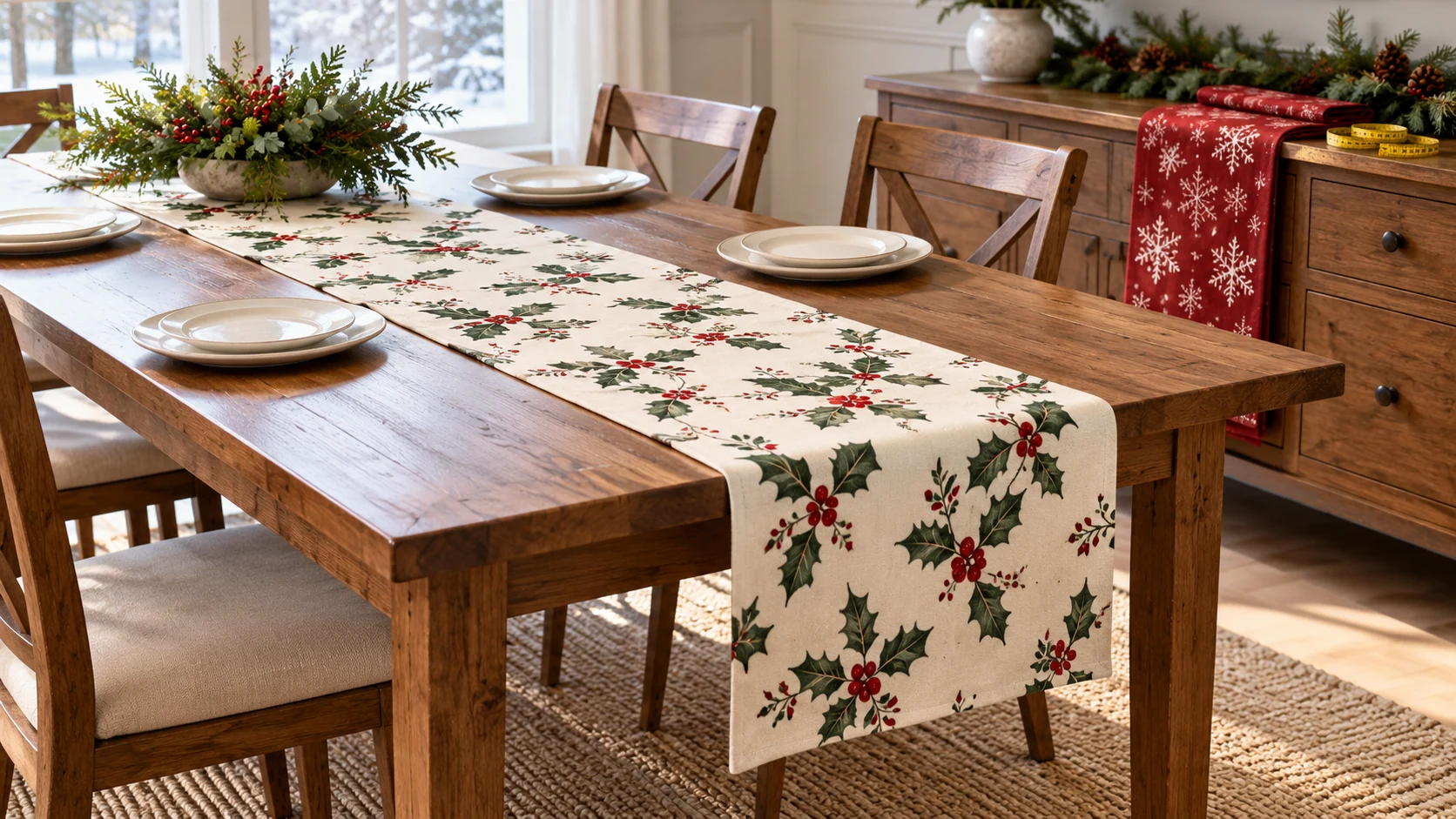
Christmas table runner length matters most when the table is ready for people, not when the cloth lies alone on an empty surface. A runner can stop within the tabletop, reach close to both ends, or hang over them. Each choice changes how much space remains for plates, serving dishes, and a centerpiece. Decide the kind of gathering first, then measure the table and test the runner's proposed position on paper.
The Fennco Styles Holly Berry Wreath runner listing identifies a 16-inch-wide, 70-inch-long rectangular runner with holly leaves, berries and snowflakes on a natural background. Its stated woven fabric is 80% polyester and 20% linen. The red snowflake runner listing names separate 13-by-36, 13-by-72 and 13-by-108-inch sizes. These listings give actual examples of size choices. They do not tell you how much overhang looks right on your table or how either fabric will behave after care.
Measure the table you will use
Measure the tabletop from one short edge to the other along the centerline where the runner would lie. If the table has extension leaves, measure it in the configuration planned for the meal. Write down the width as well; a runner that looks narrow in a catalog image may occupy more of a small table than expected. Note whether the table has a rounded or beveled edge, because the point at which fabric begins to hang may not be the same as the outermost dimension.
Check the table at the time you expect to use it. A temporary leaf, attached bench, or chair pulled close to an end changes how an overhang will be experienced even though the runner's own size is fixed. Note which end faces a walkway and which faces a wall. If guests will pass behind an end chair, a cloth that hangs safely in an empty dining room may become awkward when the chair is occupied. Mark those constraints alongside the dimensions rather than treating them as decoration decisions to make later.
Next, list what will sit on the tabletop. Plates, glasses and shared serving dishes need space; so do hands passing food. If you expect a central bowl or arrangement, mark its footprint rather than assuming it can sit on top of any cloth without shifting. A runner is a visual layer, not a substitute for table clearance or a protective surface for hot dishes. Follow the care and heat guidance for the exact textile and table finish.
Sketch the table as a rectangle and mark each seat. Put a line down the middle for the runner. This simple drawing makes it obvious where the cloth meets place settings or where a long end might brush a chair. It also lets you test more than one length without repeatedly resetting the table. Keep the plan focused on fabric placement; the dinner-table centerpiece guide handles the separate choice of what the center object should do for the shared meal.
Choose between an on-table end and an overhang
For an on-table look, subtract the chosen runner length from the table length. Divide the remainder by two to see how much bare tabletop would appear at each end if the runner is centered. For an overhang, subtract table length from runner length and divide by two for an approximate drop at each end. These are planning numbers, not a promise of a perfectly straight drape. Fabric thickness, edge shape and how you place the cloth can change the visual result.
Suppose a hypothetical table is 72 inches long. The 70-inch Fennco listing would leave about one inch of tabletop at each end if centered flat. That is a very short visible margin, and the printed motif may draw attention near the edge. A 72-inch size from the red snowflake listing would approximately meet the ends of that same table. Its 108-inch option would extend far beyond them. Measure your actual table before choosing a size; this example illustrates the calculation, not a recommendation for a particular purchase.
Do not assume a longer option is always more festive. A long drop can become a path for someone to pull the cloth accidentally, especially around young children, pets or chairs close to the ends. A very short runner may leave no room for a centered object or may look like a mat rather than a lengthwise layer. Both can be valid effects when chosen deliberately. Set a practical boundary first: the cloth should not interfere with seated guests or the way dishes move around the table.
When you compare lengths, write the numbers in one row: table length, runner length, and resulting difference. A positive remainder means exposed tabletop when centered; a negative remainder means an approximate total overhang. Divide that difference evenly only as a first sketch. You may later shift the runner slightly because a sideboard, doorway or chair makes one end more visible than the other. The arithmetic helps narrow options, while the actual placement decides whether the result feels balanced and usable.
For a table with leaves that may be added or removed during the season, choose the configuration that matters most. You may use a shorter runner for daily display and a longer one for a large dinner, rather than expecting one length to do both jobs. Write the measured table length next to each configuration in your notes. This prevents the common confusion of remembering a size that belonged to last year's extended table.
Use the listed width, not just the length
Width affects the remaining tabletop on both sides of the runner. On a narrow dining table, a 16-inch strip can reach toward plates or leave little exposed wood. A 13-inch strip may provide more side space, but whether that difference matters depends on the table width and the place settings. Center the proposed width on your sketch, then measure the remaining space on each side. Do not infer a product's exact border, seam allowance or usable printed area from the width alone.
The Fennco example is 16 inches wide. The red snowflake listing names 13-inch-wide options in several lengths. That comparison is useful for a real decision only when paired with your table width. A narrower runner is not automatically better for a busy meal, nor is a wider runner automatically better for a display. Ask what should remain visible: the table surface, the holiday pattern, or the plates and centerpiece that will share the middle area.
Try the table setting with ordinary objects before buying. Put a tape or folded plain cloth along the proposed runner width, then set one plate and glass at a typical seat. Move a serving bowl through the path you expect during the meal. This is a low-stakes way to see whether the textile would crowd the working space. Remove the mock-up and note which width and end treatment felt comfortable.
Include the edge seats in that trial. A place setting near the short end may be the first to compete with an end motif or draped fabric, especially on a compact table. Check that a person can sit, pull in the chair, and reach the table without brushing the runner. If you need to move the cloth to make the edge seats work, record the new position and recheck both ends. A centered measurement is useful, but a comfortable meal has priority over strict symmetry.
Let the motif support the occasion
Holly, berries and snowflakes communicate a different visual rhythm from a repeated red snowflake pattern. The first listing describes an off-white natural background with several seasonal motifs; the second identifies a red snowflake design. The choice is about the specific table and occasion, not a claim that either pattern has an inherent quality advantage. Consider what guests will see from a seated position and whether the motif remains legible once dishes are in place.
A runner can carry the seasonal cue by itself. You do not have to place a tall or crowded arrangement on it for the table to feel prepared. If a centerpiece is planned, decide whether the runner forms a quiet base or the main visual element. Keep sightlines and serving access open. Avoid putting open flames or hot cookware directly on fabric unless the exact product and tabletop instructions permit the arrangement; the saved listings do not establish that they do.
Named seats are another separate choice. The Christmas dinner place-card guide helps prepare where people will sit. Once seats are settled, look again at the runner ends: a long drop beside a closely pulled chair may be inconvenient even if the tabletop calculation looked balanced. Make the table comfortable for the people using it, then adjust the decoration.
Do a full-size placement test
If you already own a runner, lay it on the intended table before the gathering. Smooth it gently according to its care instructions and center it by eye, not by a number alone. Open the extension leaves if they will be used. Pull out each chair and walk around the table. Check whether the ends hang clear of knees, chair arms and the floor, and whether the width leaves enough room for the planned settings.
For a new purchase, use a strip of paper or an older cloth to represent the length and width in your plan. This cannot show exactly how a woven material will drape, but it can expose obvious fit problems. Record the table measurement, intended overhang or bare margin, and planned serving layout together. If the final textile differs from its listing dimensions or the edges do not lie as expected, adjust the placement rather than assuming your table must match a catalog photograph.
Take one photograph of the mock-up from the seat or doorway where people will first see the table. It can reveal that the proposed runner stops in an odd place or that the center pattern will be mostly hidden by dishes. Compare that picture with your sketch, then change only one variable at a time: length, width, or centerpiece position. This avoids buying a second size to solve a problem actually caused by the table setting. Share the picture with anyone else preparing the meal if the table will be used jointly.
Keep the product's care details with the runner for the next season. The Fennco listing names a polyester-linen blend, but the saved description does not give a complete washing or ironing procedure. The red snowflake listing identifies color and sizes without supplying a full care method in the captured description. Check the current label or maker guidance before laundering, pressing, storing or using stain treatments. A good seasonal setup is one you can repeat without guessing at care.
Finish with the practical question: will this length and width leave a comfortable table after guests, dishes and chairs are added? If the answer is uncertain, measure again with the real table configuration and try a full-size mock-up. The two saved listings provide dimensions and motifs; your room and meal determine the useful placement.