Home & Living
Christmas ornament storage box size guide: check cells and shelf fit
Check internal compartment and tray clearance against real ornaments, then match the full box to the shelf and access space.
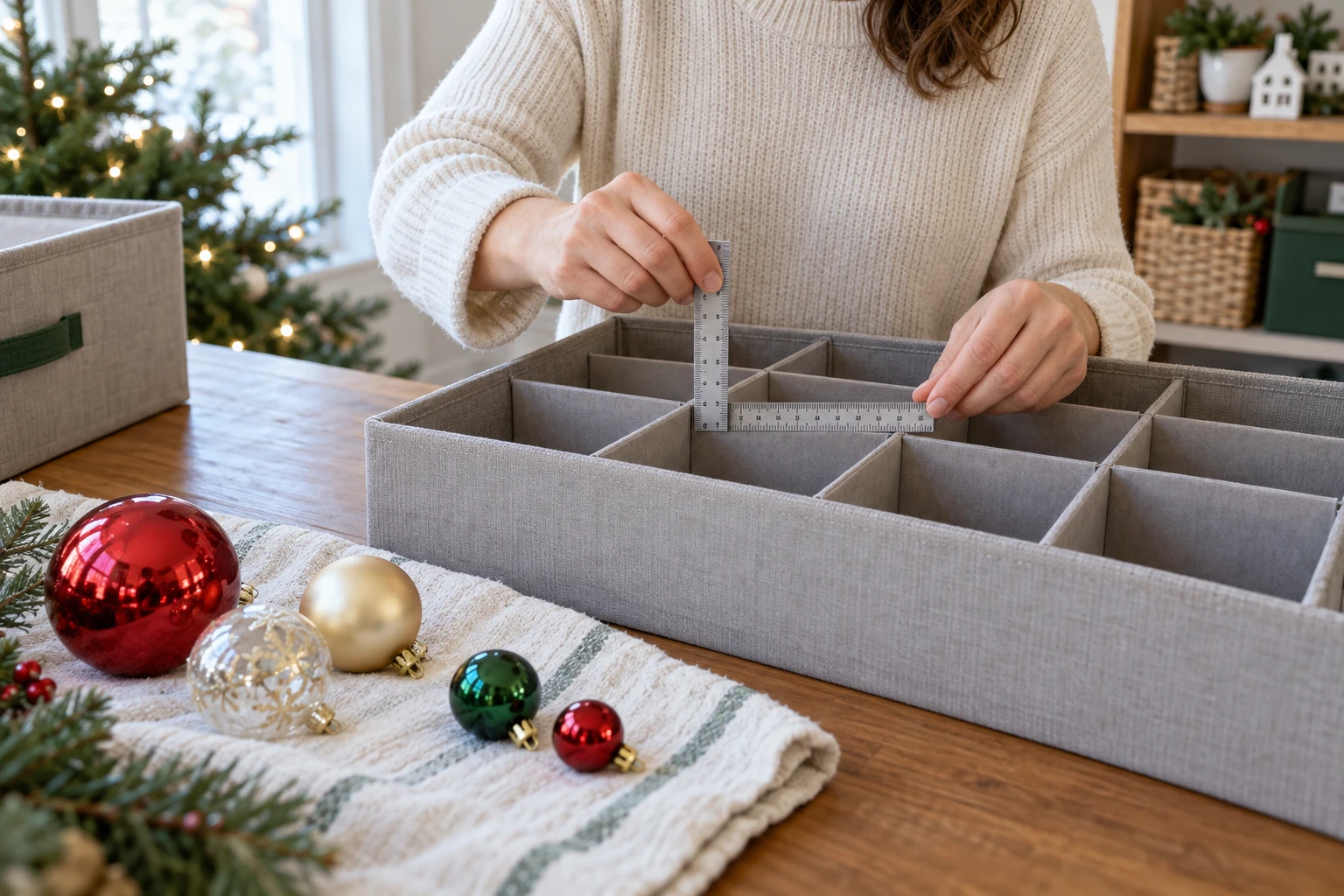
Before buying an ornament storage box, measure the ornaments and the space where the filled box will live. A printed capacity such as 27 or 72 tells you how many cells a seller intends, not whether your widest keepsake, raised cap, or tall finial fits a cell. The useful purchase decision is whether the dividers, trays, opening, handles and outside footprint work for your actual collection. This is a Christmas ornament storage box size guide for that fit decision, before seasonal packing begins.
The after-holiday ornament storage guide covers sorting fragile sets and packing them after the holiday. Use that procedure when you are ready to put the ornaments away. Here, take a small representative sample and the available shelf measurements to the buying decision. The wreath storage container guide addresses a different decoration shape whose diameter and depth create a different fit problem. Do not treat a wreath container's advertised capacity as an ornament-cell specification.
Measure the ornament, including its cap
Choose examples of the shapes you intend to store: an ordinary round ornament, the largest round one, a long drop, a finial, and an irregular or sentimental piece if you have them. Measure each at its widest point and along its tallest axis. Include a projecting hanging cap, hook attachment, decorative ridge or other fixed protrusion. A nominal ball diameter can understate the space needed when a cap stands above it. Do not force a delicate object into a measuring ring; a ruler or tape held beside it is enough for a buying estimate.
Record the dimensions in a simple list with quantity. For example, six round ornaments may share one size range, while two tall ones need a separate arrangement. Count the ornaments that can realistically use standard square cells and those that need an adjustable divider, an empty neighboring cell, or another container. This is an inventory for matching geometry, not a promise that every ornament must occupy one advertised compartment. A fragile ornament's eventual wrapping can add width, so leave room for the packing method you already use.
A square cell needs more than the stated diameter of a spherical ornament. Check usable width and depth between dividers, then usable height beneath the lid or tray above. The divider's own thickness consumes some of the outside box dimensions. If a product shows only an exterior size and a count, you cannot calculate a reliable cell clearance from those numbers alone. Ask for the internal compartment dimensions or a diagram of the assembled divider layout before assuming the fit.
Compare the layout with your actual size groups
The 27-ornament HomBine box listing describes adjustable dividers, two handles, a zippered top, a transparent window and a fold-flat structure. Those details suggest a flexible single-box layout, but the listing does not establish the internal width or height of a particular divider arrangement. Ask how many cells remain when a divider is moved to fit a wide ornament. A claimed 27-piece capacity can shrink if two ordinary cells must become one larger space.
The 72-ornament tray box listing describes three removable, stackable trays, adjustable cardboard dividers, a front opening and rope side handles. Its exterior dimensions are listed as 19.5 inches wide, 13.5 inches deep and 9.5 inches high. Those outside measurements help test a shelf opening, but they do not establish each tray's internal height after the tray walls, dividers and lid are accounted for. Request the usable cell and tray clearances for your tallest ornament.
That second listing is internally inconsistent about ornament size. Its title says the box holds 4-inch ornaments, while the description says 3-inch ornaments. Do not resolve the conflict by choosing whichever number makes the purchase convenient. Get the current assembled cell dimensions and a clear statement of which variant the seller will ship. If the internal measurements remain unavailable, treat either advertised diameter as unconfirmed and choose a box with documented clearance instead.
Removable trays are useful only if you can lift and handle them where the box will be stored. A tray filled with ornaments needs enough vertical room to clear the shelf above it, and a front-opening panel needs space in front of the box. If the box will be tightly stacked behind other bins, a convenient front access feature may never be accessible. A top-zippered design has the opposite constraint: you need overhead room to open it without pulling the whole box from its shelf.
Check the storage-space footprint
Measure the actual shelf or closet opening, including its usable width, depth and height. Note door hinges, a lip at the front, wall trim and any sloping ceiling that reduces clearance. Compare these with a box's assembled exterior dimensions rather than its folded shipping size. Leave a little hand room to lift the box without dragging the fabric or crushing its corners. The exact allowance depends on your shelf and grip; measure that space rather than relying on a universal clearance figure.
For the 72-ornament listing, mark a rectangle 19.5 by 13.5 inches on the proposed shelf and check the 9.5-inch height against the opening. That is only an exterior footprint check. It does not prove the lid can open, the trays can be removed, or the intended ornaments fit inside. If the seller confirms different dimensions for the current variant, use those current numbers. A tape outline can expose a door swing or neighboring bin conflict before a bulky organizer arrives.
The 27-ornament listing says its box can fold flat when empty. That matters if the container is stored without ornaments for part of the year. It does not reduce the space required while full. Check the filled configuration and the location where it will remain for most of the year. If several boxes will be stacked, verify whether their maker permits a loaded stack and what supports the weight; soft-sided walls can bow under a bin above them.
Consider the route to the shelf as well as the final opening. A full box may have to pass through a closet door, around a stair turn or onto an upper shelf. Two handles or rope handles make a box easier to grasp but do not state a safe load. Ask the seller for any loaded-weight guidance and avoid carrying a heavy, full organizer by a handle whose attachment seems weak. If you cannot lift the filled container comfortably, dividing the collection between smaller boxes may be a better fit even if one large box has enough cells.
Match divider flexibility to awkward shapes
Adjustable dividers are most valuable when they can form a larger usable compartment without leaving an unstable neighboring grid. Look at the assembly diagram: can one divider be removed, or do several pieces interlock so that removing one weakens a whole tray? Check whether the divider reaches high enough to separate the ornaments as you intend. A low divider can still let a tall item lean into another cell. Capacity claims usually assume the standard divider configuration, so sketch your own arrangement using the seller's actual dimensions.
Some ornaments are wide at only one point or have protruding loops. Rotate the item in your hand while measuring; the widest safe orientation may determine whether it can enter the cell and whether the lid closes without pressure. Do not rely on a box fitting a bare ornament if your planned wrapping or original small carton adds bulk. It is reasonable to reserve larger open space for a keepsake while using standard cells for regular round ornaments. The advertised count then becomes a ceiling, not your expected filled count.
Check what the dividers are made of and whether they arrive assembled. The 72-piece listing calls its dividers cardboard and describes them as acid-free. That is the seller's description, not an independent preservation certification. For a particularly valuable or delicate ornament, follow the object maker's care advice and consider materials known to be suitable for that object. The fit question still comes first: even a protective divider cannot prevent pressure damage if the item is taller than the tray clearance.
Inspect photos for tray edges, seams and closure paths, but do not infer hidden dimensions from perspective. A photographed round ornament may be a prop or a different size from yours. If the listing has a measurement graphic, check that it refers to the assembled product and its current variant. Ask whether the stated number of compartments is fixed or changes when dividers are repositioned. Save the response and dimensions with your shopping notes so you can check the delivered box against the selection you made.
Decide which opening works at home
A top-opening box can be straightforward when it sits on an open shelf with free space above. The 27-piece listing's window may help identify contents from outside, but confirm where the window is positioned relative to how you will store the box. A window facing the wall offers little benefit. A zippered lid also requires a clear path for the zipper and enough room to fold back the top. If the zipper catches on a nearby shelf, you may have to move the whole box each time.
A front-opening design can expose trays while the box stays on a shelf, but only if the front remains unobstructed and the trays can slide or lift clear. Check whether the opening is tall enough to remove a loaded tray without tilting it. If it is not, the box may need to come off the shelf anyway. Compare that action with how often you expect to access the ornaments and how high the shelf is. The best layout is one you can use without squeezing or tipping delicate contents.
Labels can help distinguish several similar bins. The 72-piece listing mentions an identification card slot; the 27-piece listing mentions a window. Neither substitutes for checking cell sizes. A label may name the collection, season or room, while an interior sketch can show which larger pieces require extra cells. Keep the sketch as a buying and future-use aid. The detailed sorting and packing sequence belongs to the separate after-holiday guide, after you have a container that fits.
Make the purchase decision from confirmed dimensions
Create two columns before checkout: required interior clearance for your largest representative ornaments, and required exterior clearance for your storage location. Put uncertain listing details in a third column rather than filling them with guesses. For each candidate box, note its usable cell width, depth and height; how many cells remain in the layout you need; outside width, depth and height; how its opening works; and whether you can lift it where it will sit. A product passes only when the measurements are confirmed for the variant you will receive.
If the seller cannot resolve the 3-inch versus 4-inch conflict in the 72-piece listing, the safe decision is to leave that fit unresolved. A 3.5-inch ornament does not become compatible because the title displays a larger number. Likewise, the 27-piece option's adjustable divider claim does not prove that an oversized finial can fit beneath its lid. Ask for the dimensions that govern those items. A return policy may soften a poor purchase, but it is not an interior measurement.
For a mixed collection, you may find that one compact grid works for standard ornaments while another container is needed for tall or unusually shaped pieces. That is a valid result of the fit check. Do not force every item into a capacity figure selected for convenience. If the largest keepsakes have their original fitted packaging, compare that package's dimensions with the available shelf space too. The goal is a workable stored arrangement, not the highest cell count on a retail page.
After a box arrives, compare its actual assembled divider and tray dimensions with the seller's current specification before loading delicate items. Check the opening, handles and shelf fit empty. If the delivered variant differs from the one you evaluated, resolve that mismatch before using it. Then follow the separate fragile-set sorting and packing procedure when the holiday season ends. A Christmas ornament storage box size guide succeeds when the chosen organizer fits both the ornaments and the place they will stay.