Holiday Decorations
After-holiday ornament storage: sort fragile sets before boxing
Sort fragile ornaments into understandable groups before choosing compartments and closing the holiday storage case.
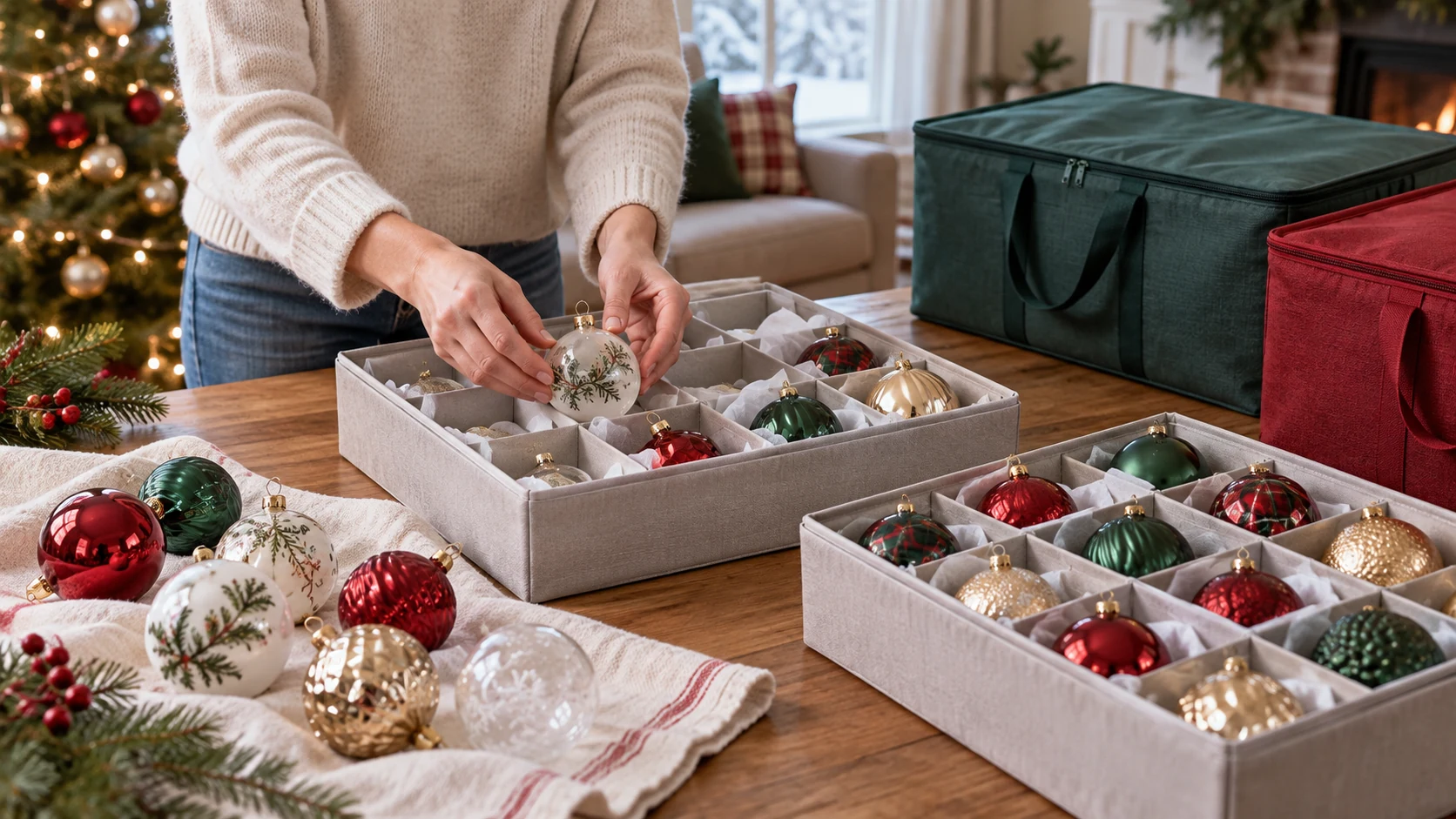
After-holiday ornament storage is easier when you separate fragile pieces before filling a box. The Hold N’ Storage ornament box and the four-tray ornament organizer show two compartment layouts. Neither advertised capacity tells you whether your actual ornaments, hooks and unusual shapes will fit. Sort the collection first, then choose the compartments around it.
Make a landing space before taking down the tree
Make a landing space on a stable table or counter and cover it with a soft, clean cloth. Bring only a manageable section of the tree or display to the table at one time. A hurried pile makes it difficult to distinguish pieces that can share a compartment from those that need separate protection. Remove hanging hardware carefully and keep hooks or ribbons with the ornament they belong to when that matters. If a piece is damaged, set it aside instead of placing it in a tray where someone might reach for it later without noticing the problem.
Put out a few temporary groups: delicate glass or ceramic pieces, sturdy small pieces, long or irregular shapes, and ornaments that form a named set. This is a sorting tool, not a permanent ranking of what deserves to return next year. The immediate question is how each item can travel into storage without being squeezed or forgotten. A set that decorates one small tree together may be more useful as one accessible group than as scattered pieces mixed by color across several containers.
Keep display choices separate from the packing decision
The ornament color-and-accent planning guide addresses how a display gets its visual balance. Packing has another job: preserve the pieces and make the next setup understandable. You can place a coordinated set in adjacent compartments without deciding now that every item must appear on the next tree. Label a tray with the set name or room where it was used, then make the new display decision when the season returns. This avoids storing by a color scheme that may change.
Notice whether an ornament is part of a pair or series. Small differences can disappear in a box full of similar finishes, especially when several people helped decorate. A brief note beside the group can say “entry shelf pair” or “children’s tree set,” using your household’s own names. Avoid a detailed inventory that no one will maintain. The label only has to help the person opening the box understand why those pieces were kept together and where to look first.
Compare the two tray layouts to real ornaments
The Hold N’ Storage page shows a low red soft-sided case with removable compartment trays and side areas for longer items. Its title describes room for up to 72 ornaments of a stated size. That is a layout clue, not a promise that 72 mixed ornaments will fit. A large finial or projecting ribbon can consume more than one nominal cell. Measure your largest ordinary ornament across its widest point and height, then compare that with the current compartment details.
The four-tray page shows a taller case with separate stacked trays and cardboard dividers. Its title describes 64 ornament slots. This layout may suit a collection opened one layer at a time, provided the actual tray depth and divider openings fit your pieces. Look at how you would lift out a loaded tray and where it could rest while you decorate. The product photos illustrate the tray concept; they do not verify your ornament dimensions.
Compare the tray layouts with your storage shelf as well as your ornaments. A long, low case might fit under a bed or across a broad shelf; a taller stacked case needs vertical clearance and a stable place to set removed trays. Measure the intended storage space before shopping. Include the handle, lid and room needed to slide the case out. A container that technically fits a shelf but cannot be opened or carried safely in that space does not solve the storage problem.
Protect the pieces that do not match a standard cell
Keep long figures, dangling details and oversized ornaments out of a tight square just because the case has an empty opening. Compare their full shape, including a protruding hook, loop or base, with the available compartment. If a piece cannot lie or stand without pressure from a divider, give it a different position. Wrap it individually in a suitable clean material if its finish requires protection, and avoid using an abrasive or adhesive contact that could damage it. The exact material depends on the ornament; follow any maker care instructions you have.
Put the most delicate pieces where they will not carry the weight of other trays or loose objects. A divider keeps neighboring ornaments apart only if the pieces stay within their cells and the loaded tray remains supported. Do not fill every opening to make a capacity figure come true. Leave a cell empty when a nearby item needs breathing room. Before closing a lid, look across the top of the loaded tray for parts projecting above the divider line. A lid should close without pushing down on a fragile cap or decoration.
Small hooks, replacement strings and ornament hangers need their own home. Put them in a closed pouch or other contained pocket, then place that pouch where it cannot spill into an ornament cell. An open handful of hooks among glass pieces makes unpacking unpleasant and can scratch or snag finishes. If hooks are already attached to individual ornaments, secure loose ends so they do not catch on adjacent pieces. Keep a note of which decorations need fresh hanging hardware next year rather than leaving that discovery for decorating day.
Give wreaths and other large decorations another route
An ornament case is for pieces that work in its compartments. A wreath can be crushed by the wrong container even when its diameter appears to fit the overall case. The wreath storage guide covers that separate shape-preservation problem. Likewise, a long garland or a tall tree topper may need its own package. Do not count such items as unused “ornament capacity” just because they belong to the same holiday display. Give each a route that respects its shape.
For loose decorations that cannot use these two cases, keep the packing logic consistent. Group by where the item is displayed, how fragile it is and what must be unpacked first. A separate carton can still carry a concise label and a quick contents note. Avoid making one mystery container of all the pieces that did not fit elsewhere. That container becomes the hardest to move and the first one tipped over when someone searches for a single ornament.
Pack for the next opening, not only the current closing
Arrange a tray as the next decorator would encounter it. Place sets used early in decorating where they can be reached first; place optional accents lower or in a later tray. If several rooms have their own decorations, keep their groups visible through a label or divider. The order need not be perfect. Its purpose is to prevent someone from emptying every case to find the one small set needed for a mantel. A quick photo of the filled trays can help if the compartments look similar once closed.
Write the contents on the case in ordinary language: “living-room glass ornaments,” “small tree set,” or whatever makes sense at home. Add “fragile” only where the handling truly warrants it. A label should identify contents without claiming the case is weatherproof or crushproof. Product-page terms for fabric, zipper or protective padding are not a substitute for suitable indoor storage and careful carrying. Keep the case away from avoidable moisture and heavy objects that could press on the contents.
Ask who will move the container. A case that one person can lift when empty may feel different when all trays are loaded. Test the weight gradually as you pack, and divide the collection if moving it becomes awkward. If a case has a handle, use it as designed and support the bottom when appropriate. Do not assume a photographed handle removes the need to carry carefully. Position the heaviest ordinary ornaments low enough that a tray remains manageable and does not tip unexpectedly when lifted out.
Use a closing check that catches the ordinary mistakes
For a closing check before zipping the case, count the groups rather than every ornament. Is the delicate set in its own area? Did any long piece land across a divider? Are loose hooks contained? Can each tray be lifted without dislodging its neighbor? Is the top clear of the lid? These checks take less time than repacking after a decoration breaks. If something has no safe place, keep it out and choose a better container instead of forcing the existing one to accept it.
Walk the filled container to its intended shelf while it is still easy to adjust. Check that the path has no pinch point at a doorway or tight shelf corner. Set it down flat and note whether another container will sit on top; avoid a stack that presses on a soft-sided lid. If you will store several cases together, place labels where they remain readable. A neat closet photograph is less useful than a layout that lets the family find the right case without lifting every box.
When the holiday returns, open one group at a time and see whether the stored labels still make sense. Repair the system gently: move a set to a more useful tray, replace a worn divider, or separate a delicate piece that proved too tight. The storage plan does not have to stay fixed forever. It should make the next setup calmer while protecting the ornaments you chose to keep. The right case is the one whose real compartments and handling fit that collection, not the one with the largest advertised number.
Leave one short note for the next person who closes the decorations. If a favorite ornament was too large for its usual cell, note its new location. If a set has a missing member, say so rather than leaving the next decorator to search every tray. These small observations save more time than a perfect-looking arrangement with no explanation. A household may change where it displays a set, but it can still preserve the relationship among pieces that belong together. That is the point of sorting before boxing: the collection stays understandable when the season, the room and the person unpacking it have changed.
Make that note easy to revise. A card tucked into the case or a removable label can change as ornaments are added, handed down or retired. Keep the wording concrete enough that another person can follow it without remembering the previous year’s decorating plan. If storage space changes, move the group label with the group so the explanation does not stay on an empty box.