Home & Living
Christmas house projector lights: choose stars or picture slides
Choose a red-and-green star field or recognizable Christmas slides for a house wall, then test the actual placement and instructions.
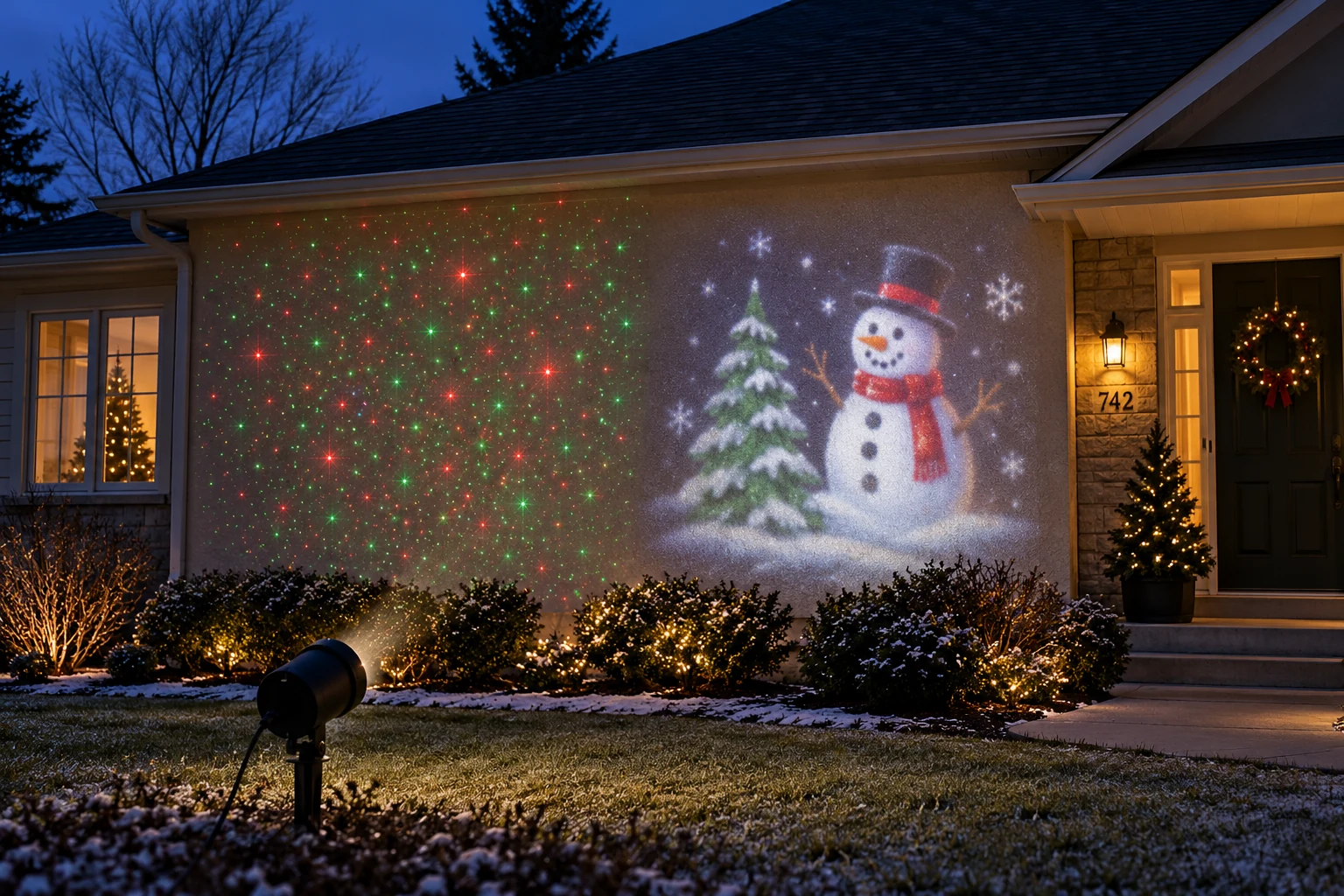
A Christmas projection can turn a blank house wall into part of the holiday display. The first decision is what you want to see there each night. A red-and-green star field makes a repeating texture; a slide projector puts recognizable pictures, such as Santa or a snowman, on the surface. Both need a suitable wall, a supported place for the unit and a real test after dark. Product photographs cannot tell you how either one will look on your siding at the distance your yard allows.
These Christmas house projector lights illustrate the two approaches. The BLOFUN red-and-green starlight projector is presented as a moving or stationary field of colored light. The Morfone slide projector is described as a unit with interchangeable themed slides. Their native listings and galleries show different effects and controls, but neither is a measured demonstration on your house. Use the comparison to choose a type of display, then confirm the exact model, supplied parts and instructions before installation.
Start with the wall you actually have
Pick one wall section before choosing a pattern. Look at it from the place where visitors first see the house and from the spot where you normally enter. Note windows, house numbers, the door, a porch light and any wall fixtures that need to remain visible. A projected picture that crosses a window or swallows the address may look striking in a promotional image and still make a poor display at home. Sketch a loose boundary for the effect rather than planning to cover the entire facade.
Wall color and texture matter. A pale, plain surface may show lines and color differently from dark brick or rough siding. Trees, shrubs, railings and parked cars can interrupt the line from the projector to the wall. A front yard with no stable, permitted place for a projector may rule out one or both options. Do a trial in the intended location after dark, with the usual exterior lights on, and watch the entire effect rather than judging one still frame. If the light crosses a neighbor's window, a road, a person's face or the sky, redirect it or abandon that position.
Keep the scope of this decision narrow. The published guide to small porch snowflake projector ideas addresses a compact entry, a clear arrival path and a controlled snowflake patch. Here the question is which kind of Christmas image belongs on a selected house wall. A porch can be part of the wall scene, but this comparison does not replace that smaller entry-planning guide or the delivered product instructions.
What the star-field listing supports
The BLOFUN page names a red-and-green starlight projector. Its description says the colors can appear separately or together, and that the effect can move at selected speeds or stay stationary. It also describes remote control and timer choices. The four-image gallery shows the unit and promotional house scenes, including diagrams about placement and weather. Those diagrams are seller material. They do not establish that the beam will cover your wall, keep a crisp shape at a particular distance or withstand your local conditions.
Think of this option as a field of points rather than a picture with a character or greeting. A field can sit behind a wreath or across a plain section of siding without requiring a viewer to recognize a particular motif. Its appeal depends on the actual color, density and motion you see in place. A moving pattern may make a busy wall feel more crowded; a still setting may let existing trim carry the scene. The listing gives you controls to check, not a promise that any one setting will suit a given wall.
Before choosing it, ask how you would repeat the setup on an ordinary evening. Which color mode would you use? Would the effect move? Where would the projector sit so the star field remains inside your intended boundary? If a branch breaks up the field, does that improve the look or create scattered light where you do not want it? These are observations to make during a test. Do not select a yard position from a printed coverage number or a photo of a much larger house.
What the slide listing supports
The Morfone native page identifies model 01TYDCGBH-2 and describes 16 slides with 64 patterns across 11 themes. The gallery shows Christmas motifs including a tree, Santa, a snowman, stockings, bells and a sleigh scene, alongside designs for other holidays. The listing describes a remote and timer, a ground stake, a flat base and a wall-mount option. Confirm that the exact package you receive contains the claimed slides, mount and controls. A photograph of several motifs floating over a house is a promotional composite, not proof that one slide displays every pictured motif at once.
This type makes sense when you want guests to read a specific Christmas picture on the wall. It also creates a choice you do not have with a single star texture: which slide should be in place tonight? Check the actual slide sheet for the Christmas images you want. A set advertised for many holidays may be attractive if you intend to use it later, but the total theme count should not decide a Christmas-only purchase. The relevant question is whether the particular Christmas images fit your wall and the display you already own.
The Morfone gallery includes charts for timer, remote and placement, plus promotional claims about projection distance and outdoor conditions. Treat all of those as manufacturer or seller representations. A diagram drawn at 16 or 26 feet cannot predict image size and clarity on your own surface. The weather graphic likewise does not settle where the power supply or connections may go. Read the delivered manual for each component and test the actual image before committing to a mount or cable route.
Compare a texture with a picture
Imagine your wall at the usual viewing distance. A star field contributes color and movement while leaving the wall's shape visible. A Christmas slide asks viewers to recognize a character or symbol. On a broad uninterrupted wall, either might be readable. On a wall divided by windows, shutters and a door, a large Santa could land in pieces while scattered stars still read as a texture. The opposite can happen on a small plain panel: a single defined picture may make better use of the space than light points that spread beyond it.
Try a paper mockup before buying or mounting. Mark the wall's usable rectangle on a sketch and place the main fixtures inside it. For a slide, draw one simple Christmas motif inside the rectangle. For stars, shade the area where you would accept the moving field. This does not predict optical performance. It exposes conflicts early, such as a central window occupying the place where a character's face would appear or a house number inside the proposed beam. Leave extra room in the plan because the real effect may have a different edge than the seller photo suggests.
Think about the rest of the decorations too. A wreath and warm doorway lights may need only a modest star texture nearby. A largely bare wall could carry a distinct Christmas slide. If you already run colored lights across the roofline, check whether another moving field makes the scene hard to read. Turn those ordinary lights on during the projection test. You can then choose a quieter mode or a smaller intended area, if the actual controls allow it, instead of planning from an isolated product shot.
A porch railing is a separate surface with different routing and power questions. The published comparison of solar Christmas lights for a porch railing covers a C6 string and a rope outline on that rail. A projector aimed at the house wall does not solve the rail's attachment, handhold or solar-panel placement. If you use both, judge whether the wall image and railing line are legible together while keeping the route to the door usable.
Test the actual position and controls
Choose a plausible supported position for the unit, then check the delivered instructions before placing it. The Morfone page describes a stake, base and wall mount; the BLOFUN page shows its own arrangement. Their hardware, power parts and operating limits are model-specific. Do not copy a mounting method from one listing to the other or assume a decorative garden bed will hold a stake steadily. If the chosen surface, cable path or power connection does not match the maker's instructions and local rules, find another location or choose a different display.
During a test, begin with the beam aimed at the center of the intended wall section. Walk to the street-facing view and back to the entrance. See whether a slide remains recognizable and whether a star field stays within the area you planned. Look through the interior windows that face the effect, if possible. Check the full motion cycle and every mode you intend to use; a moving effect can travel outside the boundary visible in one moment. If the unit cannot keep the effect on the intended surface, do not treat a timer as the fix.
Use the supplied controls according to their manual. The BLOFUN description lists color, speed and timer options; the Morfone description and gallery show slide effects, remote controls and timer settings. Confirm what the exact remote changes and whether the chosen timer behaves as expected on the unit in hand. Set an operating period that suits the household and neighbors, then observe an ordinary night's start and shutoff. A promotional remote-range claim does not tell you whether the control will work from your preferred doorway.
Weather and electrical details deserve a component-by-component check. Both listings use outdoor language, and their galleries include water or temperature claims. These are not a substitute for the delivered manual's instructions for the light head, adapter, cord and connections. Keep power arrangements within the maker's directions and applicable local requirements. Do not infer that a pictured projector standing in snow makes every part of the kit suitable for snow or standing water. If a required instruction is missing or unclear, settle it with the maker before outdoor use.
Choose the display you will actually maintain
After the test, write down the one configuration you would happily repeat: product and exact model, chosen wall, projector position, selected mode or Christmas slide, aim and timer. Mark where the unit and its supplied parts can be stored together. A projection that takes continual adjustment may be a poor fit even if one photograph looks good. If the setup works only when another decoration is turned off, include that fact in the note so a later evening does not become a guessing exercise.
Choose the star field when a red-and-green texture suits the wall and the actual unit can keep it inside your intended area. Choose the slide projector when a specific Christmas motif is the point of the display and the delivered slides remain readable on your wall. If neither passes the real placement and instruction check, leave the wall unprojected. The house, sightlines and available supported position have the final say.