Crypto Commerce
ChenL ANNI five-inch CCTV tester vs Laiye ANNI CCTV Camera Testers
Compare ChenL ANNI five-inch CCTV tester by signal support, display, power, and diagnostics.
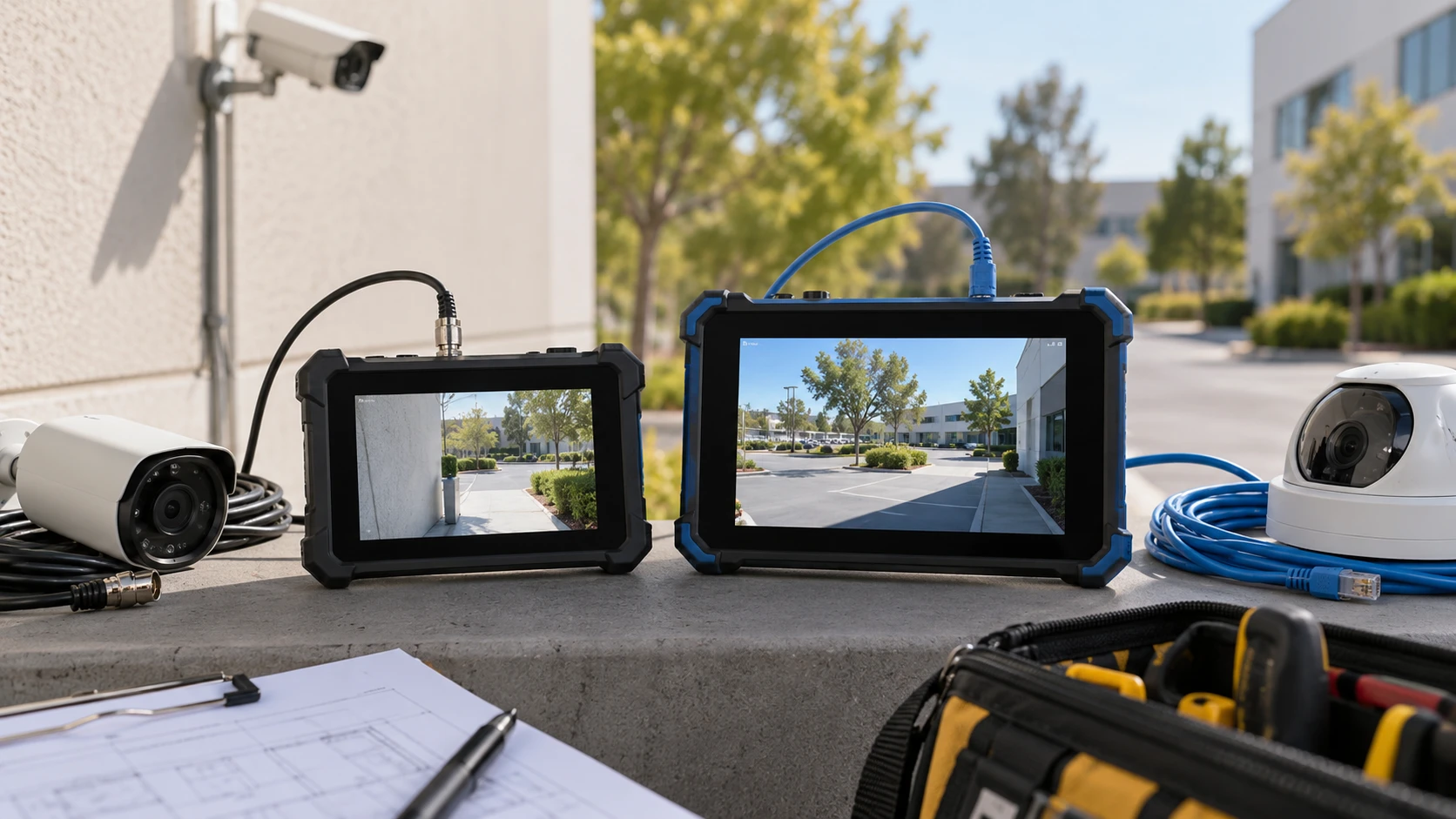
A camera tester earns its place in an installer’s bag when it answers a question at the camera, before a cable is pulled back through the building or a ladder is put away. The ChenL ANNI five-inch tester is described mainly around coaxial analog formats: AHD, TVI, and CVI. The Laiye ANNI seven-inch tester adds network-camera functions, PoE input and output, and a higher-resolution screen. The right one depends on the signals already in the installation and the checks a technician must complete on site.
The saved catalog rows do not include a complete port diagram, accessory list, or independent field test. Both products should be matched to the exact camera models and power arrangements in a job specification. A tester that can display a picture is useful, but it does not by itself prove that every recording, network, or cable requirement has been met.
Start with the camera signal — camera tester display and input guide
The ChenL ANNI five-inch CCTV tester is listed as a portable four-in-one HD monitor tester for coaxial analog cameras. The saved row names AHD, TVI, and CVI and says it handles PAL and NTSC signals. That makes it a candidate for an installer who needs to align and check cameras on existing coax runs. Before choosing it, identify the format each camera actually outputs. Similar-looking BNC connections can carry different signals, and a camera may need a setting changed before the tester displays it.
For TVI, the ChenL row lists 720p at 25, 30, 50, or 60 frames per second and 1080p at 25 or 30 frames per second, along with 5 MP and 8 MP image testing. For AHD, it lists 720p and 1080p at 25 or 30 frames per second plus 5 MP and 8 MP compatibility. Its CVI list includes 720p and 1080p at 25 or 30 frames per second, with 4 MP and 5 MP images. These details are more useful than the broad "four-in-one" phrase. Put the camera’s exact output format, resolution, and frame rate beside the tester’s stated list before dispatching a technician.
The Laiye ANNI row names coaxial HD 4.0 support for TVI, CVI, and AHD at 8 MP. It also names H.265 decoding and 4K main-stream checks for network cameras. That broader mix may suit a service team visiting both coax and IP sites. The saved description does not enumerate every coaxial frame rate or network protocol. Ask for the current compatibility chart if the site includes an unusual camera mode, and verify whether the tester can change the camera’s settings or only view the resulting feed.
Laiye says its PoE input and output can support showing a network camera feed and an analog camera feed together on one screen. That sounds useful when replacing part of an older installation, but the row does not state PoE standards, available power budget, or how both feeds are connected at once. Draw the intended hookup and check the manual before relying on a single tester to power and display both cameras. Do not connect equipment based on a generic PoE label alone.
What the screen can tell you — Laiye ANNI seven-inch CCTV tester
ChenL specifies an 800 by 480 pixel wide-viewing-angle display at five inches. Laiye specifies a seven-inch IPS display at 1920 by 1200 pixels. The larger, denser Laiye screen can make focus and framing checks easier to inspect at the tester, especially when a technician is working with a high-resolution camera. But the pixels on the tester are not the same as the pixels in the camera’s recorded file. A five-inch screen can still be enough to confirm that a view is present and roughly aimed.
The distinction matters with an 8 MP or 4K camera. A tester can accept a high-resolution input and scale it to its own display. That does not mean every fine detail is visible at a glance. Zoom into the live image if the tester supports it, check focus at the intended subject distance, and inspect a captured or recorded result in the actual surveillance system where possible. Neither catalog description fully explains its zoom controls or whether it saves still images of a test, so confirm those functions in the manual.
The published camera tester display and input guide addresses the same distinction between screen resolution and input support. Use it to frame the compatibility questions for this pair. The guide does not certify the particular ChenL or Laiye tester you receive, and it cannot replace a check of the exact camera’s output mode.
A bright or awkward mounting position can make any portable screen difficult to judge. Ask how the displays remain visible outdoors or under equipment-room lights, and whether viewing angle changes the appearance of the image. The ChenL row calls its display wide-angle, while the Laiye row says full-view IPS; neither provides a measured brightness figure. A technician may need to shade the screen and inspect the image from a steady position before making a focus decision.
Power and time in the field — Laiye ANNI seven-inch CCTV tester
The ChenL description names a 3.7 V, 3,000 mAh polymer lithium battery. Its runtime language is inconsistent: one part says about two to four hours per charge, while another says around six hours under normal use, excluding CCD power output. Treat this as an unresolved planning detail. Check Republeq's product page for a current runtime specification with the screen brightness and camera-power mode stated. A job that involves repeated camera adjustments should include charging or a spare power plan rather than relying on the longest number in the row.
The ChenL title mentions DC 12 V and cable testing, but the saved description does not specify output current, supported cable tests, or whether camera power is available in each test mode. Confirm voltage, connector polarity, current limit, and the exact cable function before using it to power a camera. A mistaken power assumption can interrupt the work or damage equipment. The listing’s runtime distinction between normal use and CCD power output makes this check particularly important.
The Laiye row does not give a battery capacity or runtime. Its PoE input and output capabilities also need a clear power budget. A network camera may require a particular PoE standard or draw more power when infrared lighting turns on. Check the camera’s label and the tester’s documented output, then test under the camera’s expected operating mode. The saved row alone cannot tell you how many hours a technician can run the network and screen functions without external power.
Before leaving for a site, charge the tester, verify the charger and adapters are in the case, and power on a representative camera at the shop. Record the time spent on a normal install, including walking between cameras and making adjustments. That will give a more realistic battery plan than a single brochure maximum. Both listings omit enough package detail that the current box contents should be checked against the required connectors and leads.
Diagnostics beyond a visible feed — Laiye ANNI seven-inch CCTV tester
Laiye lists lens simulation, lens focus testing, audio testing, and test-report generation. These functions could help document commissioning work if the saved output records the checks your customer requires. Ask to see a sample report and confirm what fields it contains, how it is exported, and whether the report identifies the camera and job. The row does not specify a file format or storage method. A report button is only useful when its evidence matches the handover checklist.
For a network camera, a visible stream is an early check. It does not establish recording retention, time synchronization, network security, or remote viewing. Use the tester to confirm the functions it actually supports, then finish verification in the recorder or management system. With an analog camera, a good picture beside the camera does not prove that the recorder sees the same signal after the full cable run. Check both ends when diagnosing loss or interference.
ChenL’s saved row focuses on format and image checks rather than describing report generation or network diagnostics. It may be enough for teams whose acceptance test is camera framing and the presence of a coax signal, but the catalog does not document every feature. Build a simple test sheet that records camera ID, signal format, output mode, focus, and recorder result. That record can travel with the job even if the tester itself produces no exportable report.
Neither saved description establishes that the tester performs a certified cable qualification test. The ChenL title mentions cable testing without saying which electrical values it measures; Laiye names installation tools without a cable-test specification. If a contract requires cable certification or measured attenuation, use equipment and a procedure that meet that requirement. Keep the camera-image check separate from the cable acceptance record.
Portability, price, and the practical choice — Laiye ANNI seven-inch CCTV tester
The ChenL is the smaller five-inch option. That may be easier to carry on a ladder or fit into a compact service bag, though the row does not give weight or protective-case dimensions. Laiye’s seven-inch screen gives more room for image inspection and simultaneous feeds, but may require a larger bag or a stable surface when both hands are needed to adjust a camera. Check how each tester is held or mounted during a real installation. A screen is less useful if it must be balanced where it can fall.
Both catalog records show the products as available at the snapshot time; stock and price can change. Compare the present Republeq's catalog, return policy, warranty, and replacement accessories. Include the cost of any missing adapters, cables, and charger in the decision. The saved descriptions do not give complete warranty terms, so do not infer the same support for both devices.
Choose the ChenL for a hands-on test when the job is chiefly coaxial AHD, TVI, or CVI alignment and its listed resolution and frame-rate combinations cover the cameras. Resolve its battery-runtime contradiction and DC 12 V details first. The Laiye ANNI seven-inch CCTV tester is the stronger candidate for a team that regularly handles network and coax cameras on the same visit and wants a higher-resolution screen and report functions. Confirm its PoE limits, network compatibility, and report export with the exact equipment used on site.
Make a short bench trial with one representative analog camera and one representative network camera before standardizing a tool. Record the camera modes, connections, tester power source, and what evidence the technician can actually save. That trial should settle whether either product covers the work that matters most to the team.