Office Supplies & Stationery
Read cash box tray design before choosing an organizer
Understand which internal organizer a description names, what a raised position establishes and when separate handling needs its own explicit support.
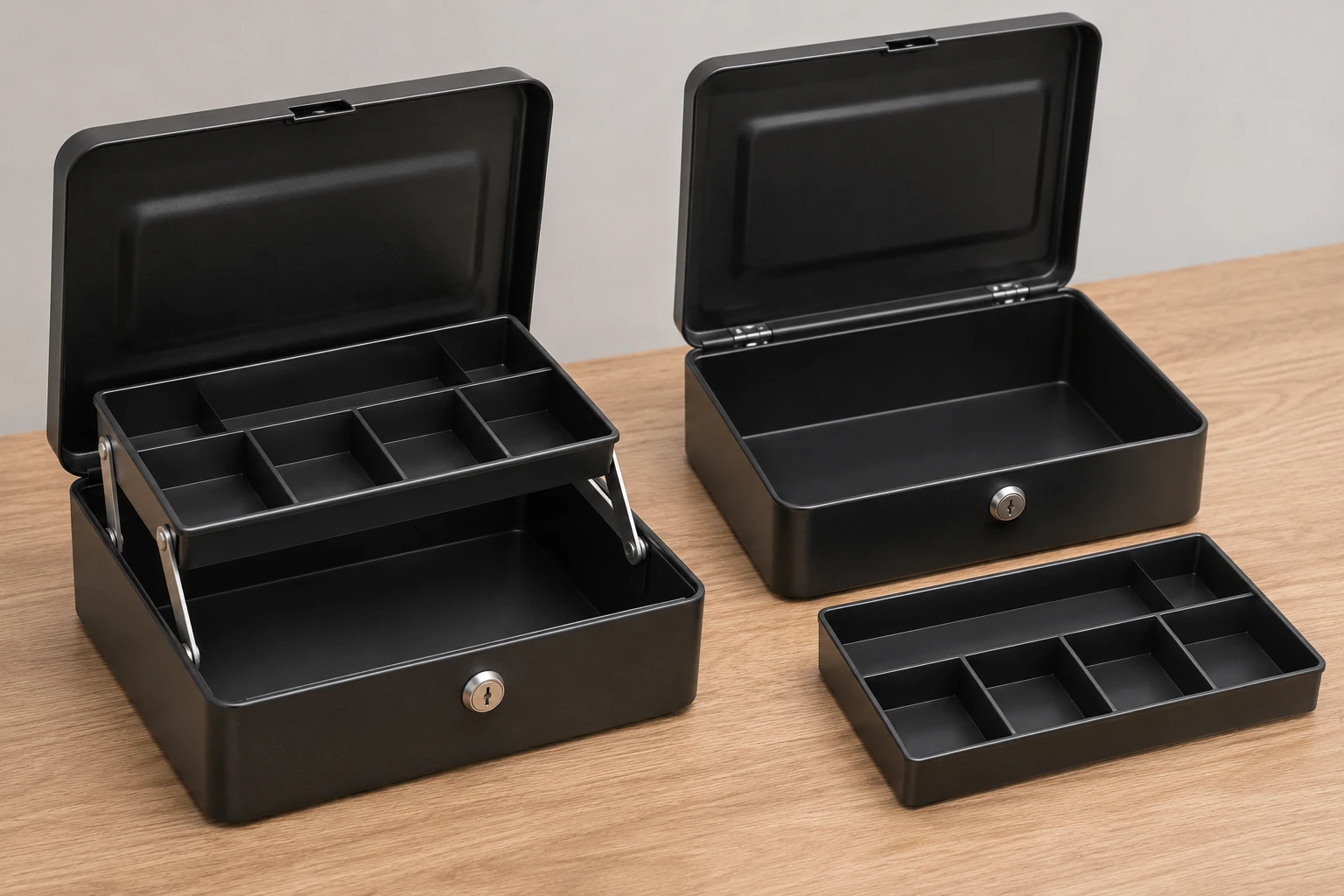
A cash box tray design comparison starts with the named internal part. A lid-raised tray and an explicitly removable insert give different information about access.
The Lecheng cash box description names a five-compartment cantilever tray raised when its lid opens, above a bill area. Its sole original is a bill-clip collage with prop notes. That view shows neither the whole box nor the action; attribute the movement to the description.
The Pen+Gear black cash-box offer describes six boxes, each with a five-compartment removable insert. Its sole original shows the six closed boxes and recessed handles. It exposes no interior and demonstrates no removal; the feature remains a statement about the internal tray.
Keep the action with its named part. A raised organizer does not, by itself, establish detachment, and an insert statement does not describe removal of the enclosure.
Give each part its own name
Use box for the enclosure and lid for the piece that closes it. Use tray or insert for the organizer named in the offer. These working labels help describe the question without pretending to supply a universal parts diagram. If an offer uses another term, retain that term beside its actual reference rather than silently translating it into a component whose shape you already imagine.
A tray can contain dividers, and a divider is a different part from the tray that holds it. Likewise, a clip associated with a bill area does not become a removable organizer because it can be moved. When a description names several components, read the modifying word beside each one. Applying one movement statement to every part would make the account broader than the words you actually have.
The same care helps when someone describes a photograph aloud. “The inside moves” leaves several possibilities unexplained. A more useful description identifies the visible piece and the position in which it appears. Do not complete the hidden portion of the assembly from memory of another box. A familiar outline can help you ask a question without establishing how that particular item comes apart.
Keep a position separate from a capability
An image records a position chosen for the picture. It can show that one part is above, beside or inside another part in that view. A statement that an item is designed for removal concerns a capability. Before treating a pictured arrangement as an available feature, identify the statement that applies to the actual component and the selected offer.
A loose-looking piece in a staged image may invite a useful question, but the picture alone need not settle it. Conversely, an interior hidden by a closed lid does not prove the absence of a described feature. Keep what is visible and what is stated distinguishable. That lets you read a sparse gallery accurately without claiming an inspection or deciding that the product has a defect.
Nothing in this comparison requires you to pull on an unfamiliar mechanism. If a delivered organizer's use is unclear, follow the applicable instructions or seek help for that item. Do not force a hinge, bend a clip or undo a fastener to see whether a word in a listing was meant broadly. A purchasing description and a removal procedure serve different purposes.
Decide which kind of access matters
Describe the task before choosing a preferred word. You may want to see items that would otherwise be covered, reach a lower area while the enclosure remains in place, or handle an organizer separately from its surrounding box. These are proposed requirements, not promises about either offer. State the one that matters to you without assuming that a photograph has already demonstrated it.
For access within the enclosure, the important question concerns the intended usable arrangement while the parts remain together. For separate handling, the question concerns the named component and the applicable instructions for taking it out and returning it. A reply about convenient access might leave the second question unanswered. Explain the requirement directly rather than treating a favorable adjective as a substitute for the missing detail.
Consider where the task would occur. A counter used for the whole enclosure and a separate surface intended for an organizer are two places in the proposed plan. Identify them in ordinary language. This article supplies no carrying-load rating, loaded-removal permission or security assessment for that arrangement. If the plan depends on such a condition, it needs information applicable to the actual product and use.
A fictional choice begins with the task
Imagine that Anika is choosing an organizer for a temporary reception desk. This is an invented purchasing exercise; no box has been tested or delivered. She initially writes only “easy access” in her notes. A colleague asks what she expects to do at the end of the session. Anika realizes that the important question is whether her chosen internal organizer can be handled separately under the maker's directions.
That clarification changes what she needs to learn from an offer. She can still consider an attractive product, but its general appearance no longer answers the entire question. She looks for wording about the particular internal part and asks for applicable instructions where necessary. She does not turn the colleague's suggestion into a demonstration or assume that another person's experience concerned the same assembly.
Suppose Anika later decides that the complete enclosure will remain at the reception desk after the session. Her earlier separate-handling requirement may no longer determine the purchase. She can review the changed task deliberately instead of insisting on a feature merely because it appeared in her first note. The example describes a change of requirements, without reporting that either retail offer passed a practical trial.
If the plan still needs a take-out organizer, an answer about carrying the complete box leaves that requirement open. Anika keeps the question attached to the part she means. A description of one handle or one closure cannot silently become an answer about every component. She can stop the inquiry when the necessary information is available, or defer the purchase when an essential condition remains unresolved.
In a further part of the invented conversation, Anika and her colleague discover that they meant different things by taking the organizer to another surface. One had imagined moving the complete box; the other had imagined a smaller internal part. They restate the task with the object named. No mechanism has changed during the discussion. The clearer sentence simply stops one person's requirement from being answered by a statement about a different object.
Read the compartments without inventing a layout
A compartment description tells you something about the organizer being offered. It does not assign your own contents to particular sections. First identify which component the description concerns. An illustration that combines several parts can make a compartment appear to belong to a different organizer. Use the written account and the relevant view together, preserving any distinction the available information leaves open.
Keep physical organization separate from a counting record. A list of intended contents would need its own applicable inputs and checks; the number of divisions in a retail description does not supply those inputs. This article chooses no float, denomination mix or transaction policy. Its question is which internal component a product term describes and what movement the offer actually states.
The cash drawer printer compatibility guide investigates the controlling printer, application and opening path for an electronic drawer. That equipment question is separate from understanding an internal organizer. Neither a tray description nor a key visible in a gallery establishes an electronic connection, and this comparison supplies no cable choice or opening command.
The cash register parts-list guide identifies the complete offered register and keeps its hardware inventory separate from unresolved setup questions. Use it when the whole assembly is the subject of your inquiry. Here, the narrower distinction concerns an internal part and the movement attributed to it, without turning that part into a separately confirmed replacement offer.
Check the selected offer before purchasing
Return to the selected item if you change the size, package or product. A statement retained from an earlier offer should remain attached to that earlier reference until its applicability is established. Preserve the specific feature that matters to your task rather than carrying over an impression of the product range. Several similar thumbnails can make the original reason for a choice hard to remember.
Review the supplied contents as a separate matter. Displayed notes, coins and nearby objects should not silently enter an order inventory. Where an accessory matters, look for an explicit statement concerning the selected package. A demonstration or attractive room scene can help illustrate a question; it cannot replace the actual offer's account of what will arrive. Keep packaging questions distinct from claims about an item's intended movement.
If you are considering an organizer through Republeq.com and would prefer a crypto payment such as USDT, settle the product question before choosing how to pay. Check which payment methods are actually offered for the particular order and read the conditions attached to the method you select. A guide mentioning cryptocurrency does not establish that USDT is available for every transaction. If it is unavailable, leave it out of the purchase plan or defer the order. Keep the exact box identity, selected option and applicable answer about its intended use with your order notes. The payment record belongs with the transaction; it cannot supply a missing product specification. Before confirming a purchase, review the current package contents, delivery information, return terms and any unanswered question that matters to the planned task. Do not treat a seller's general reassurance as a result from a test you have not seen. If you change to another offer, check whether an earlier answer still applies to that item. Keep any change of payment method separate from a change of product or intended arrangement. Neither a completed payment nor an attractive checkout photograph establishes that the item can perform an unstated use. If the remaining question determines whether the purchase makes sense, wait for an applicable answer rather than paying to discover it afterward. Preserve the confirmation for the order actually made, and keep any unresolved product question visible in your own notes. A change in currency provides no new evidence about the physical organizer you have planned to use. The same product decision remains necessary when another available payment method is used.
Finish with the component you actually need
A useful cash box tray design explanation leaves you able to name the internal part, identify the statement about its movement and say whether that information addresses your task. Keep a pictured position within the limits of the view, and retain a description claim as a description claim. Choose from applicable information without improvising a removal procedure or assigning an unsupported capability to the whole assembly.
A tray movement needs a named part and a stated role.