Crypto Commerce
Canon EOS Rebel T7 DSLR bundle Rebel T7 vs Nikon D7500 bundles for stills and video
Compare Canon EOS Rebel T7 DSLR bundle by lenses, autofocus and burst claims, video modes, storage, power planning, and included in the Republeq listing…
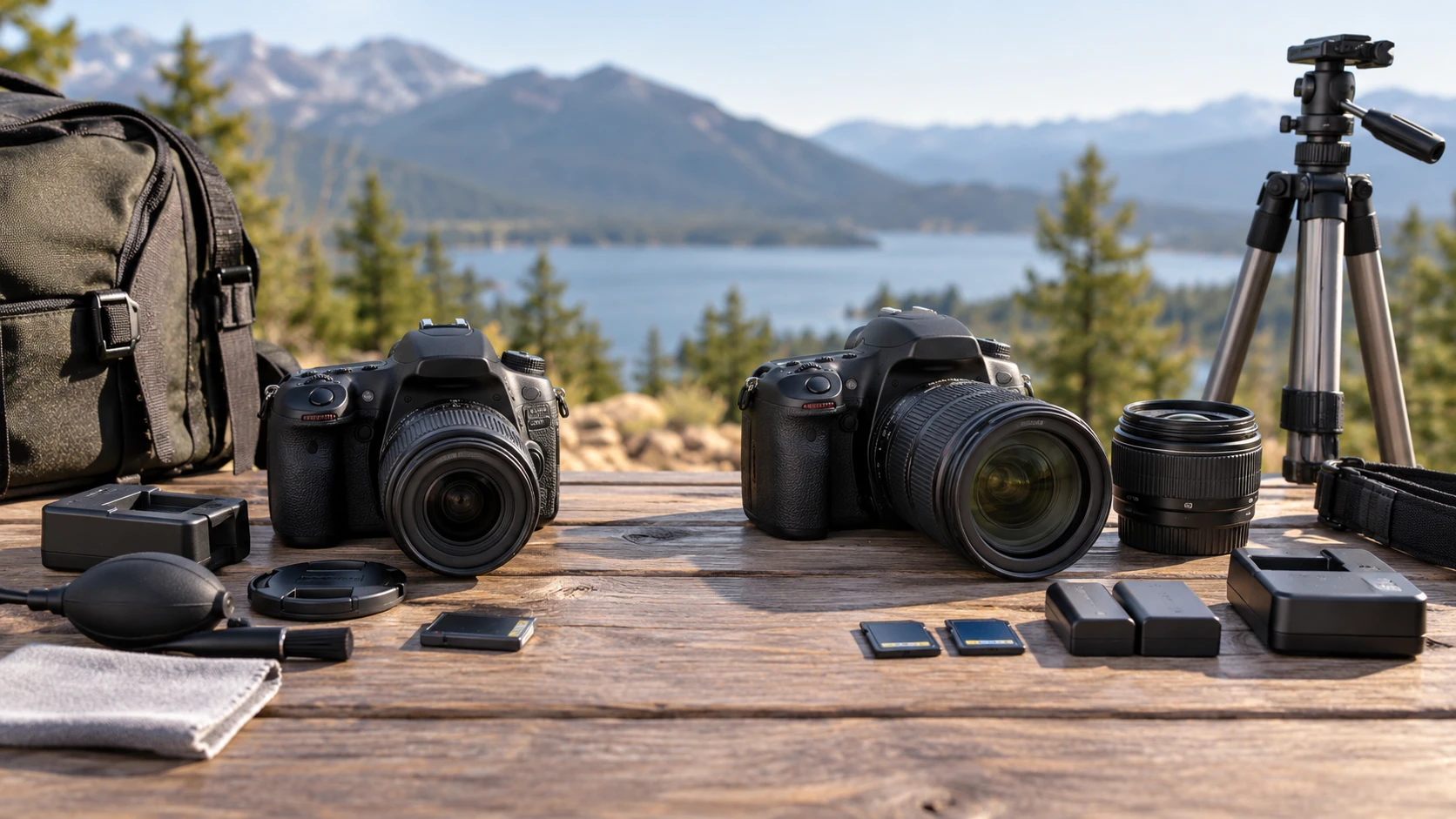
The Canon EOS Rebel T7 DSLR bundle lists a 24.1 MP APS-C body, an EF-S 18-55 mm lens, a memory card, and a broad set of starter accessories. The Zeetech-listed Nikon D7500 package lists a 20.9 MP DX body, an 18-140 mm zoom, a 50 mm lens, two memory cards, and other accessories. The camera bodies differ in autofocus, burst, and video claims. For a first outing, the lens you can use and the battery and storage you actually receive may matter as much as the body specification. Write down whether that outing is portraits, moving subjects, or video before comparing the kits.
The published guide on camera battery planning explains why a day away from charging needs a power plan. It does not test these DSLR bundles. Think about how much time the camera will be on, how often you will review images, and whether video is part of the day. The saved listings do not give comparable battery-life figures. An included battery and charger are useful, but they do not establish how many photographs or minutes of video you will get at your own settings.
Start with the lens you will carry — Nikon D7500 DSLR bundle
The Canon listing includes an EF-S 18-55 mm f/3.5-5.6 DC III zoom lens. Its source gives a 35 mm equivalent range of about 28.8 to 88 mm on the APS-C body. That covers a useful span from wider everyday views to moderate portraits, but it will not frame a distant subject as tightly as a longer lens from the same position. The Nikon bundle includes an AF-S DX 18-140 mm VR zoom, listed at about 27 to 210 mm equivalent, plus a 50 mm f/1.8 lens. That broader kit offers different framing choices, subject to confirming both lenses are present and working.
Nikon's 50 mm lens is described as F-mount/FX format, while its 18-140 mm is DX. The saved source does not explain how each behaves on every body mode, so test the exact bundle and check mount compatibility rather than treating all 50 mm lenses as interchangeable. A fixed focal length can encourage deliberate framing, while a long zoom can reduce lens changes during travel. Neither listing provides matched sharpness or distortion tests. Use photographs of your actual subjects to decide whether the extra lens is worth carrying.
A bundle with more glass also needs more space and care. Pack the body with a lens attached, then see where the second lens, cards, charger, and small accessories fit. The Canon source lists a camera bag, while the Nikon excerpt names an accessory pack but does not specify a bag. Ask for a complete contents photo before purchase. A tripod or lens hood is useful only if its mount, weight, and size work with the equipment you receive.
The Nikon 18-140 mm lens is listed with VR II stabilization, while the Canon 18-55 mm lens description does not identify stabilization. That is an equipment detail to verify on the exact lens barrel and in the manual. Stabilization may help with some hand-held stills, but it does not freeze a moving subject or replace a suitable shutter speed. Try both cameras with the focal length and light you normally face. A tripod may suit static scenes, yet it cannot follow every event; lens handling should match the subjects you expect to photograph.
Compare focus and moving subjects — Nikon D7500 DSLR bundle
Canon lists a nine-point autofocus system with a center cross-type point and shooting up to three frames per second. Its saved description says a burst can reach up to 150 consecutive JPEGs or 11 RAW frames. Nikon lists a 51-point Multi-CAM 3500FX II autofocus system, Group Area AF, and eight frames per second for up to 100 frames. Those are listing claims under unspecified settings, not a controlled test of subject tracking. If children, animals, or sports are central, try the subject's typical motion and check the proportion of sharp files, not only the largest frame-rate number.
A faster burst can create more files to review and store. Plan a card and backup routine that suits the volume you will actually shoot. Canon's package includes a Transcend 32 GB Class 10 SD card. Nikon's package lists two SanDisk 64 GB cards. Card capacities differ, but the sources do not specify the full speed ratings or measured write performance for the intended video and burst modes. Verify compatibility and format a card in the camera after saving any existing data elsewhere. Never assume an included card is sufficient for every mode.
Canon's 24.1 MP and Nikon's 20.9 MP sensors are both described in APS-C or DX terms. Pixel count alone cannot rank low-light quality, dynamic range, color, or lens performance. Nikon lists a wider native ISO range of 100 to 51,200 and an expanded setting to 1,640,000; Canon lists ISO 100 to 6,400 with expansion to 12,800. Higher selectable ISO values can be useful in a menu, but they are not proof that images at those settings are equally clean. Make a sample in the dim light you expect and view it at a realistic output size.
The viewing and control experience deserves a hands-on check. Canon names an optical viewfinder and a rear LCD, though its saved description gives conflicting LCD size references of 3.0 and 2.7 inches. Nikon names a 3.2-inch tilting touchscreen. Confirm the Canon screen size for the exact delivered body before using that difference to choose. Try reaching focus controls with the camera to your eye, then review a shot from a high or low angle. A tilting screen may help some positions, while a familiar viewfinder matters for others.
Separate the video modes — camera battery planning
Canon's source lists Full HD video at 1080/30p. Nikon lists 4K UHD at 30 fps and Full HD modes. That is a meaningful format difference if you deliver 4K or want room to crop in editing. The Nikon description also says its effective focal length increases by 1.5 times in 4K mode. A lens that looks wide for stills may frame much tighter during 4K recording. Set up a test shot at the same distance and compare the view before planning an interview or a room-wide scene.
The saved Nikon source says its DX-based Full HD movie format uses the sensor's full width, which differs from the stated 4K crop. Check the exact recording settings and lens combination before travel. Canon's 1080/30p limit in this source does not reveal every exposure or microphone control available on the camera. Neither excerpt supplies a matched autofocus, audio, heat, or continuous recording test. Record a short clip with your intended lens and inspect the file, especially when video is more than an occasional extra.
Sound may require a separate plan. The listing excerpts do not describe an external microphone input or a controlled microphone test for either camera. If clear speech matters, check the actual connectors and monitor a sample recording in the intended room or outdoor setting. A high-resolution video file does not rescue muffled dialogue. Think about where the subject stands, how close the microphone can be, and whether wind will interfere. Confirm the camera's audio options rather than assuming they match the video-resolution headline.
Nikon's source lists SnapBridge Bluetooth and Wi-Fi image transfer and remote control. Canon lists built-in Wi-Fi and NFC. These descriptions do not tell you transfer speed, current phone-app support, or whether every remote function works during video. Pair the camera with the phone you intend to use and send a sample RAW or video file. A card reader can still be useful for a large batch. The included Canon card and Nikon cards create different starting storage, but the transfer workflow should be tested separately from capacity.
Audit the bundle and Republeq's catalog terms — Nikon D7500 DSLR bundle
The Canon offer is catalogued under ALS Variety and described as an international-version body with a included in the Republeq listing one-year warranty and an 18-piece accessory bundle. The saved list includes the lens, card, filter, hood, bag, 50-inch tripod, cleaning tools, battery, charger, strap, caps, and other small parts. Check the Republeq's catalog exact count and warranty coverage for the delivered item. The Nikon offer is also described as an international package through Zeetech, but its short source does not provide equivalent warranty terms. Ask for those terms before comparing accessory counts.
Nikon lists an 18-140 mm zoom, 50 mm lens, two cards, tripod, wide-angle accessory, flash, and accessory pack. The excerpt does not detail every item in the pack or state whether a battery and charger are included. That is not proof they are absent. Get a current box inventory and confirm lens model numbers, condition, and the parts needed to shoot on arrival. A low total price can be misleading if a needed charger or compatible battery must be bought separately.
The Nikon D7500 DSLR bundle offers a longer listed zoom, a second lens, faster stated burst shooting, and 4K video with a framing crop to plan around. Canon offers a simpler listed one-lens setup, a bag and charger in the described package, and 1080p video. Try a representative photo or clip with the lens you would carry. Before buying either bundle, get a current inventory of the exact box and the warranty terms for the exact model terms; the Nikon excerpt leaves its battery and charger unclear, while Canon's stated warranty comes from its Republeq's catalog.