Educational & Explainer Articles
Brix refractometer reading: what the scale can tell you
Understand refractive index, Brix scale, mixed-solution limits and temperature compensation, keeping each refractometer offer with its actual applications.
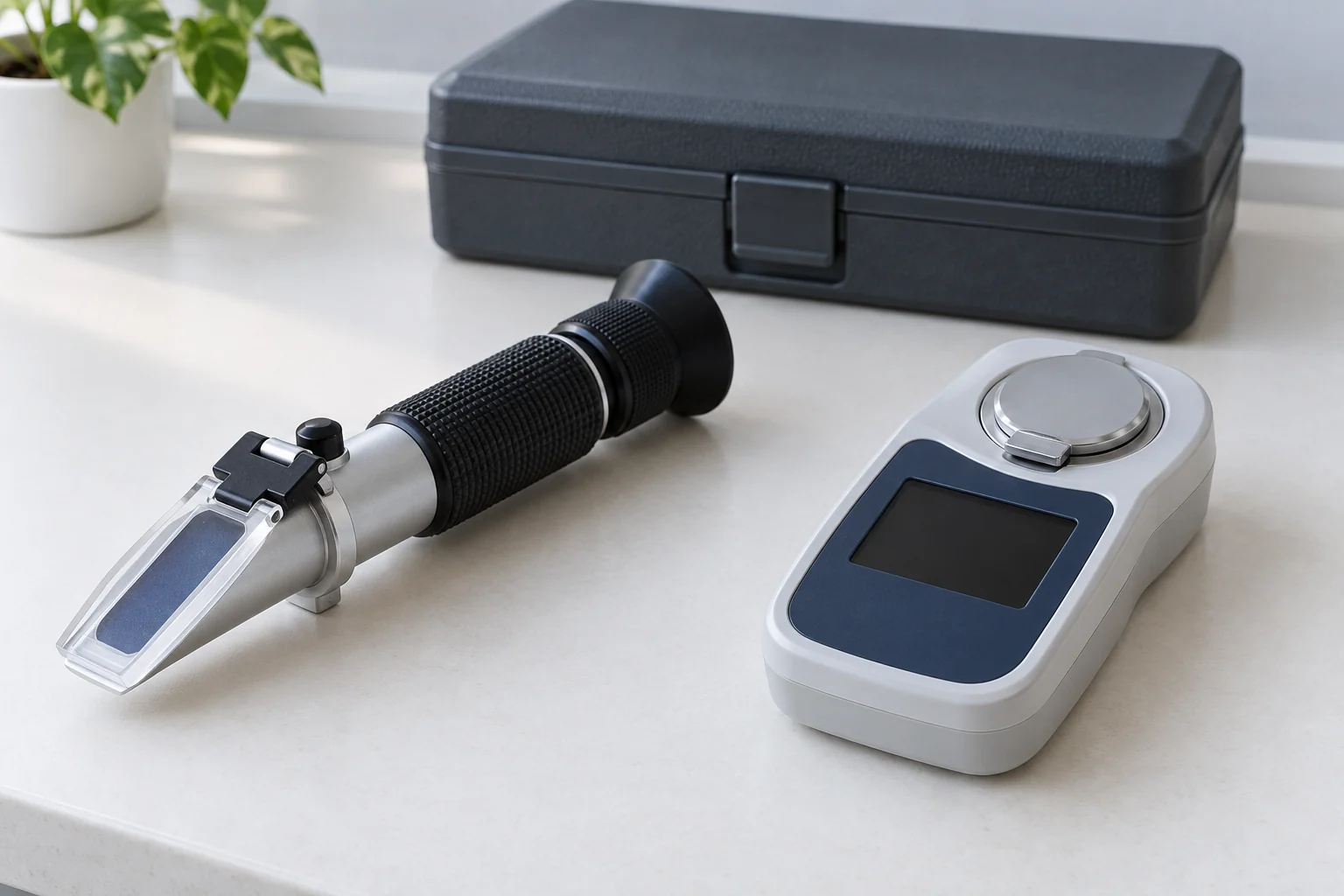
A Brix refractometer reading describes a result on a particular scale. The instrument responds to an optical property of the sample, then relates that response to its calibration. To understand the number, identify the scale, the kind of liquid it is intended to describe and the conditions that apply to the actual instrument.
This explainer uses two different offers: a Performance Tool W80158 described for several automotive fluids and a guowendianzi digital instrument described for Brix testing. Their shared instrument name does not establish interchangeable scales or applications. No fluid-testing, calibration, cleaning or handling procedure is supplied here.
Refractive index and Brix describe different parts of the measurement
For refractive index and Brix, begin with the optical response and its interpretation. Light passing through a sample behaves according to that sample's optical properties. A refractometer measures in relation to refractive index. A Brix scale expresses a corresponding result using a sucrose-based reference relationship, giving the displayed number a particular meaning.
NIST's equipment page for its Reichert AR200 provides a concrete example of those labels: it distinguishes refractive index from a solids scale identified as Brix-Sucrose. That is an account of the NIST-listed instrument. Its ranges and performance specifications do not become specifications for either selected retail offer.
Name the instrument's actual scale when asking what its reported number means. Asking for a refractometer result without naming the scale can leave out the information needed to interpret it. The same-looking numerical entry could describe a different quantity on another instrument. Keep the displayed unit or scale designation with the result when discussing what it means.
A mixed solution is more than one identified sugar
USDA's May 2025 Technical Procedures Manual explains that Brix is used for soluble solids in products such as fruit juices and canned-fruit packing liquids. Those solutions can contain different sweeteners and other substances. Fruit acids, pectin and minerals can affect the measurement, so the reading is not a separate chemical identification of each constituent.
Calling the juice reading its sugar content leaves the other soluble constituents unexplained. A sucrose-based scale gives a way to express the response. It does not independently establish that the sample contains only sucrose, identify each sugar present or supply a complete ingredient analysis. Interpret the result under the applicable method for the known product.
Imagine two explicitly hypothetical juice samples, each reported as 10.0 degrees Brix under its applicable method. The matching reported value does not establish identical ingredients, flavour or acidity. The example contains no actual test results and gives no recipe for making a sample. It illustrates how one measurement can leave other composition questions unanswered.
Likewise, a higher reported value does not identify why two known products differ. The product composition and applicable method still matter. A numerical ordering can remain true while an explanation for that ordering remains unestablished. Ask which measurement and sample information would support the particular conclusion you want to draw.
The part of a product being described matters
USDA gives canned-fruit packing liquid as a more specific example. Its final Brix depends on the incoming fruit's soluble solids, the incoming liquid, their proportions and the extent to which the finished product has equalised. These are factors in that product context, without a preparation method supplied by this guide.
A statement about the packing liquid identifies a particular part of the product. It does not by itself describe the mass of fruit in the container or give every ingredient's proportion. Keep the reported measurement attached to what the applicable method actually assessed. Say whether the number describes the packing liquid or another identified part of the product.
Imagine two fictional product descriptions reporting the same Brix value for their packing liquids. That match would not establish that the containers hold equal amounts of fruit or that the fruit pieces have the same texture. Those are different product properties. The illustration requires no actual sampling activity to show why the questions need different evidence.
For a real product decision, identify which property the relevant specification concerns. A soluble-solids requirement can remain one part of a wider assessment. When comparing product information, read the name of the assessed material as carefully as the number, especially if one account describes liquid and another describes the complete contents. The chosen method and its result should answer that defined question before a reader extends the conclusion to the entire product.
Keep the Performance Tool application account intact
The Performance Tool W80158 offer identifies SKU sku-405593776 and UPC 039564115608. It names DEF, ethylene glycol, propylene glycol, battery fluid and cleaning fluids, with fluid-dependent scale ranges and automatic temperature compensation. It describes an aluminium instrument and protective case, without supplying numerical ranges or a complete procedure here.
Keep those named applications with the actual model. The description does not provide a basis for copying the other offer's zero-to-thirty-two-percent Brix range onto this instrument. Nor does a general reference to cleaning fluids identify every mixture sold under that broad description. The exact intended fluid and applicable scale need their own supported match.
If the purchasing question concerns one of those named applications, ask which scale, range and instructions apply to that actual fluid. A supplier's answer about a different formulation or instrument should remain attached to that answer. The W80158 listing alone does not resolve a procedure for an unidentified liquid.
Read the digital Brix offer as its own instrument
The guowendianzi digital Brix offer states a zero-to-thirty-two-percent Brix range, 0.1-percent resolution and a claimed plus-or-minus-0.1-percent Brix accuracy. It names a backlit LCD and automatic temperature compensation. These are retail specifications and claims, without an independent performance comparison with the W80158.
The actual catalogue brand is guowendianzi. Retain it when identifying the offer instead of substituting a familiar laboratory brand. A similar housing, a shared Brix label or a comparable numerical range does not independently establish that two products are the same model or have the same documented requirements.
The selected range gives one boundary for the purchasing question. It does not tell you how the instrument responds outside that range or supply permission to adapt an out-of-range sample. If the intended application needs a different range or method, obtain the appropriate instrument information rather than inventing a correction from the headline figures.
Refractometer temperature compensation has a defined job
For refractometer temperature compensation, keep temperature effects separate from composition. USDA's manual explains that temperature influences the reading and discusses correction to an instrument's standard temperature. Its methods distinguish instruments that provide the applicable automatic correction from those requiring the appropriate correction information.
Automatic compensation addresses that temperature-related measurement issue within its applicable conditions. It does not identify an unknown fluid, determine which scale should be used or make every liquid follow the same reference relationship. Knowing that an offer names ATC leaves those sample and application questions to be answered separately.
The standard temperature and permitted operating conditions are also different concepts. A reference temperature tells you the conditions to which a result is related under a method. It does not by itself establish the full temperature range the particular device can tolerate. Obtain the actual instrument's instructions for its limits and use.
Do not apply a correction chart from a different instrument or method merely because it mentions Brix. USDA's own text distinguishes relevant instrument conditions and discusses product-specific corrections. This guide supplies no correction table or conversion procedure for either selected offer. The educational point is understanding which condition a correction addresses.
Display resolution does not establish the complete uncertainty
A display increment tells you how the reported number changes in its available steps. An accuracy claim concerns its relationship to the applicable reference under stated conditions. Those are different specifications even when their numerical labels look similar. A display can show a fine step without independently proving an equally small measurement error.
In the digital offer, keep the stated 0.1-percent resolution beside the stated accuracy claim as separate entries. This article does not verify either through a reference comparison. A shopper can ask for the conditions supporting the accuracy specification while still recognising the described display increment.
Suppose an explicitly fictional display reports 12.3 on its Brix scale. The decimal place shows the form of that reported value. It does not identify the sample's individual ingredients or demonstrate that a laboratory comparison would reproduce the same result. The illustration gives no actual device reading or recommended test point.
The caliper zero and measurement-error guide makes a related distinction between an indication and the reference comparison needed for a wider accuracy claim. Its Westward and Moore & Wright offers concern lengths. Their ranges, readouts and measuring faces supply no refractometer specification.
Keep the sample question with the instrument question
Before choosing an instrument, state what you need to learn about the identified product or fluid. A soluble-solids estimate, a specified automotive-fluid application and an unknown-substance identification are different questions. The word refractometer does not turn one of them into the others. Choose from information that addresses the actual measurement purpose.
If a method applies to a known product, retain that product identity while interpreting its result. An account describing one juice should not quietly become evidence about another formulation. A scale-based number gains meaning from the applicable measurement relationship; removing the sample context can make a correct numerical entry answer the wrong question.
USDA's manual also distinguishes handheld estimates for fresh fruit from the instruments and procedures required for certain laboratory purposes. That is a reminder to match the method to the intended decision. A retail device's portability does not establish that it fulfils a particular official inspection requirement.
The relative humidity and temperature guide keeps an air-moisture value with its temperature context. Its TP50 and PCE-555BT details belong to those humidity instruments. The connection here is preserving the conditions that make a measurement intelligible while leaving each instrument's sensing method and specifications separate.
Ask for the information that would settle the intended use
A precise purchasing enquiry can name the actual instrument, the known application and the quantity you need reported. Ask which documented scale and range apply, what conditions support the stated accuracy and which instructions govern the intended use. Send that enquiry with the exact offer reference so the reply can address the instrument you intend to buy.
Record which part of the application question the supplier has actually answered. A reply confirming the presence of ATC may settle a feature question while leaving the application unanswered. A reply identifying a range may still omit the conditions behind an accuracy claim. Retain each confirmed part without expanding it into a complete suitability finding.
A Brix refractometer reading needs its scale, identified sample context and applicable conditions before it can answer the intended measurement question. The optical measurement provides a particular response; its scale supplies the interpretation the instrument and method support. Choose and discuss the device on that basis, without turning the number into an unperformed chemical analysis.
Conceptual Brix refractometer reading cover with two generic inactive dry instruments; no exact models, sample, calibration or measurement result is shown.