Problem-Solving Articles
Books won't fit between bookends: check the usable space
Identify the changed book row and its actual width, depth and support before replacing decorative bookends, keeping pair dimensions and footprints distinct.
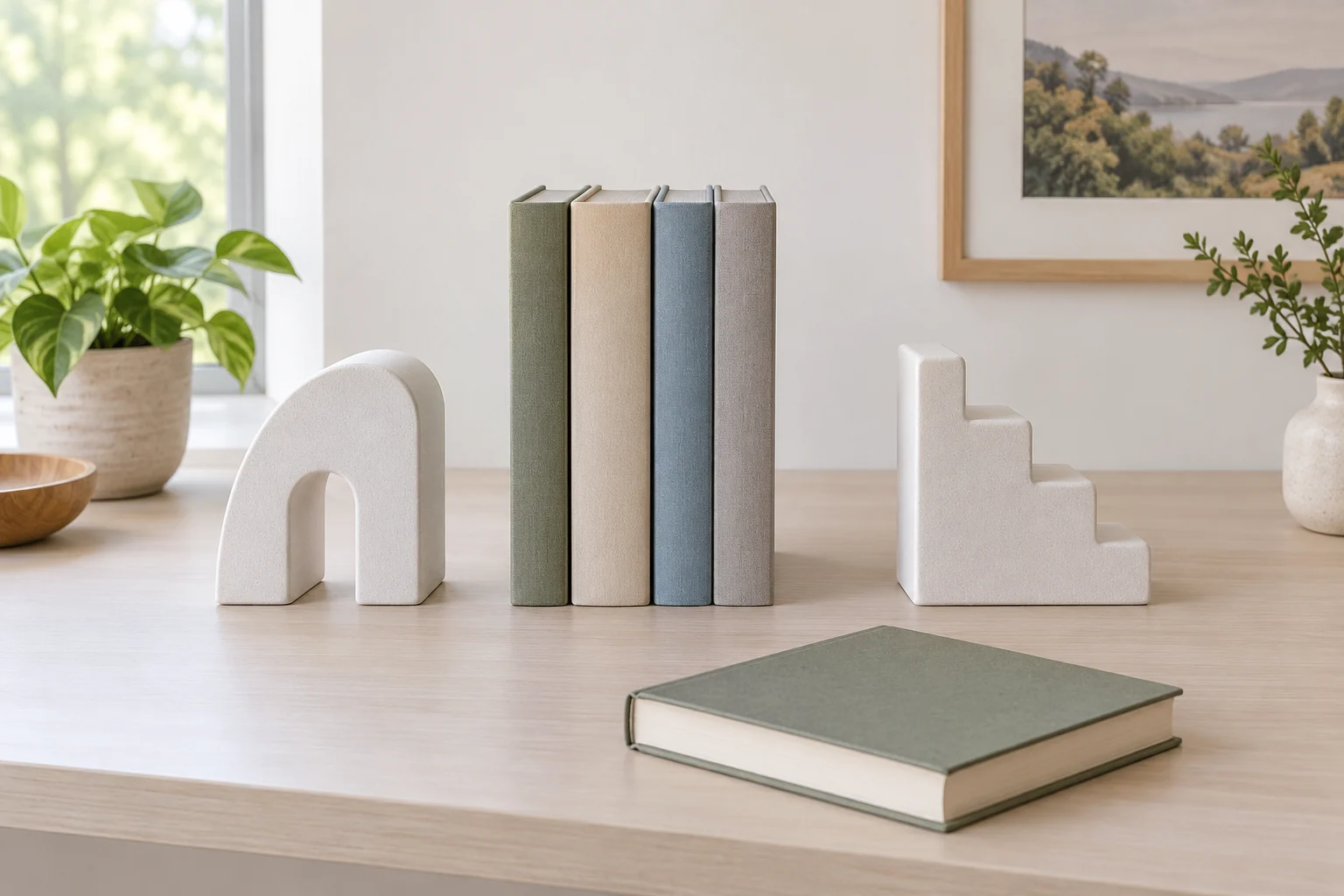
If books won't fit between bookends after you add a volume, check what changed in the actual row. A wider book, a different position for a decorative end or another object on the shelf can change the usable space. Buying a different ornament will help only if it addresses the particular space requirement you identify.
Begin with ordinary books and the support arrangement you actually have. This guide concerns the fit question before another purchase. It supplies no shelf load rating, bookend holding-capacity test or method for forcing books into a smaller gap. Valuable, fragile or damaged volumes may need more appropriate individual care than a household layout check.
Describe which part no longer fits
State whether the problem is the row's total width, a book's height or its front-to-back support. Those are different dimensions. A book that reaches beyond the supporting surface presents a different question from one that is too tall for the opening above it. Name the height, along-row thickness or front-to-back extent that no longer suits the space.
Also identify what happened immediately before the problem appeared. You may have added a thick volume, moved the row to another shelf or placed a decorative object beside it. Retain that actual event in the description. It gives you something specific to compare with the earlier arrangement without proving that an accessory is defective.
If someone else rearranged the shelf, ask what they moved. An end may have been brought inward to leave space for another object, or books from two different groups may have been combined. Resolve that basic arrangement question before treating the apparent gap as an unchanged feature of the shelf.
A wide cover and a thick volume affect different directions
For a conventional upright row with spines facing outward, each closed book's thickness contributes along the row. The width across its front cover instead extends from the spine toward the back of the supporting area. A description such as a wider book can conceal those two different observations. State the direction you actually mean.
Consider an explicitly fictional row containing three closed books with thicknesses of two, three and four centimetres. Their thicknesses total nine centimetres before considering the actual support arrangement and handling room. A fourteen-centimetre cover width on one of those books would concern another direction. These invented figures explain orientation; they are not measurements of a selected bookend or a recommended tightly packed arrangement.
Adding a thin book with a broad cover may therefore raise a depth or support question even when little changes along the row. Adding a thick volume may create the opposite emphasis. Identify the actual shape of the new volume before deciding that both situations require the same replacement accessory.
If you want a front-facing display instead of a spine-facing row, assess that proposed orientation separately. The ordinary row example no longer describes the same layout. Keep the book's actual supporting needs and the space you intend it to occupy together in the plan, without rotating it merely to make an unsuitable gap appear usable.
Usable shelf width concerns the actual book space
For usable shelf width, identify the space the books can actually occupy in the intended arrangement. The furniture's overall width may include sides or sections outside that space. Decorative ends and other objects can also affect the layout. Keep the supporting surface and any required access visible in the question.
Do not subtract every advertised bookend width automatically. A product's base shape may place part of it beneath the books, outside the row or in another relationship the short description has not established. Determine the actual geometry from the particular item and its applicable information. A photograph's apparent shape is not a measured usable span.
A useful enquiry can ask for the complete bookend dimensions and a diagram or clear account of how its base relates to the books. If a listing gives pair dimensions, ask which figures describe each individual piece. This lets you evaluate the actual proposed arrangement without silently assigning a whole-set measurement to both ends.
Keep the changed group of books identifiable
Consider the row you intend to keep, including the newly added volume. A temporary arrangement that leaves that volume elsewhere has not answered whether the complete chosen group fits. It can still help you identify the change: the old group may remain suitable while the intended new group needs another place or a revised selection.
For a small reading group, choose which books you actually want within reach now. An unread gift, a current novel and a borrowed reference book may have different reasons for being there. You can select a smaller group without treating the remaining books as unwanted. Their storage question remains separate from the size of this particular row.
The Library of Congress recommends keeping shelved books upright and supporting them as needed, grouping similar sizes where practical. It also describes full support for large books stored horizontally. Use appropriate support for the actual volumes; a decorative arrangement does not establish that a projecting book or a leaning row is suitably stored.
The holiday reading-shelf guide develops the broader storage and handling questions around an actual seasonal selection. Its A&B Home elephant and Bey-Berk eagle bookends are different offers. Their dimensions and package information supply no missing measurement for the two products discussed here.
Read MyGift's compact wording without inventing a dimension
The MyGift birds-and-books offer describes a set of two resin bookends with a vintage white finish. It calls the design compact and proposes shelves, desks and other display places. The supplied description gives no numerical dimensions or load rating.
Compact is therefore not a usable-width specification. If you are considering this set because another pair occupies too much space, ask for the actual geometry needed to compare the arrangements. The confirmed pair tells you how many pieces the package describes; ask separately for their footprint and supporting relationship.
Choose whether you want the birds-and-books design beside the actual books you intend to keep there. Keep that decorative preference beside the unresolved fit question. A motif that suits the room should not become evidence that the complete intended row fits between the actual pieces. Obtain the information that would address the particular space problem.
Bookend footprint and book space need clear dimension labels
For bookend footprint and book space, the CosmoLiving by Cosmopolitan offer describes solid marble, a smooth white finish and gold line accents. Its colour field says Gold and its size field reads “PR 5"W, 5"H.” It identifies SKU sku-1721696727 and UPC 196094020083.
Keep that size wording intact when asking what it measures. The description does not establish here whether the stated width applies to an individual piece, the pair or another listed arrangement. It also leaves the usable relationship between the base and books unresolved. Do not announce that each end consumes five inches of the row.
The stated height answers a different dimension question from the width. Neither label alone specifies the total span available to your books on your shelf. Ask for the missing depth and relevant base geometry if they affect the proposed position. The selected marble material supplies no numerical holding capacity or shelf allowance.
If the reply concerns a different CosmoLiving model, retain that difference. A familiar brand and white-and-gold appearance do not establish that the answer covers the exact SKU. Keep the actual offer reference attached to the dimensional enquiry until you have an answer for the item you intend to buy.
Check whether decoration or storage is the adjustable part
Once you have identified the actual arrangement, decide which part you are willing to change. The book selection may be fixed because you need those volumes together. The decorative choice may be flexible. Another household may prefer to keep a particular pair of bookends and find a different suitable place for some books.
Say whether you want to keep the chosen books together or retain the particular decorative ends when comparing options. Replacing an ornament can address a confirmed footprint difference. Moving the selected group to an appropriate larger supporting area can address a different limitation. Neither decision requires declaring the existing bookend faulty when the actual issue is the new arrangement's space requirement.
A seasonal decoration placed beside the row may also be optional. Consider whether it needs that exact position before changing the book support. You may enjoy it elsewhere and keep the books accessible. This is a room-layout choice, without a new claim about the strength of the shelf or either selected retail product.
Do not make a temporary display consume space needed for ordinary retrieval. Library of Congress handling guidance recommends preparing a clean, unobstructed landing area before taking out a book. Keeping the reading task practical can help you choose between two arrangements that both look appealing in a photograph.
Test the complete idea with information appropriate to the task
A household layout review can show whether the ordinary books and existing pieces you actually handled occupy the intended space. Describe the result at that scope. It does not establish dimensions for an unhandled retail product or certify the capacity of the supporting furniture.
If a proposed new end has no confirmed footprint, leave its fit unresolved while you ask for the missing information. A rough sketch can preserve the intended row and identify the gap in the product account. It cannot manufacture a dimension from a photograph or turn the word compact into a number.
Keep width questions separate from a sliding or stability symptom. Books failing to remain upright requires its own appropriate assessment; it is not automatically solved by finding a narrower decorative piece. This article provides no loading, friction, impact or balancing experiment for bookends.
The binder-clip bundle guide similarly begins with the actual group of papers after something changes. Its Bybiment and Unbranded clip details concern paper bundles. Use that bundle check when describing which books were added, while keeping every clip measurement and holding claim with the paper supplies it describes.
Finish with the space question actually answered
Identify the selected books, the usable supporting area and the actual bookend arrangement an answer covers. Keep any remaining package, depth or base-shape question open. A reply about overall decorative dimensions can be correct while still leaving the span at book level unanswered.
If the chosen group remains too large, revise the arrangement or find an appropriate place for part of it. Leave enough room for ordinary handling and proper support. A narrower accessory can remain a possible purchase only after its actual dimensions address the particular gap you identified.
When books won't fit between bookends, keep the changed row and its available space in view. Resolve which dimension no longer works, then choose the change that answers it. Choose the decorative style after the actual width, depth and supporting arrangement have answered the fit question for your books.
Conceptual books won't fit between bookends cover with generic static supports and separate plain books; no exact retail models or verified fit or holding result is shown.