Seasonal & Holiday Content
Birdhouse nesting season planning: assess the house and site
Assess a proposed nesting house against the intended birds and site before spring, keeping decorative appeal separate from confirmed nesting suitability.
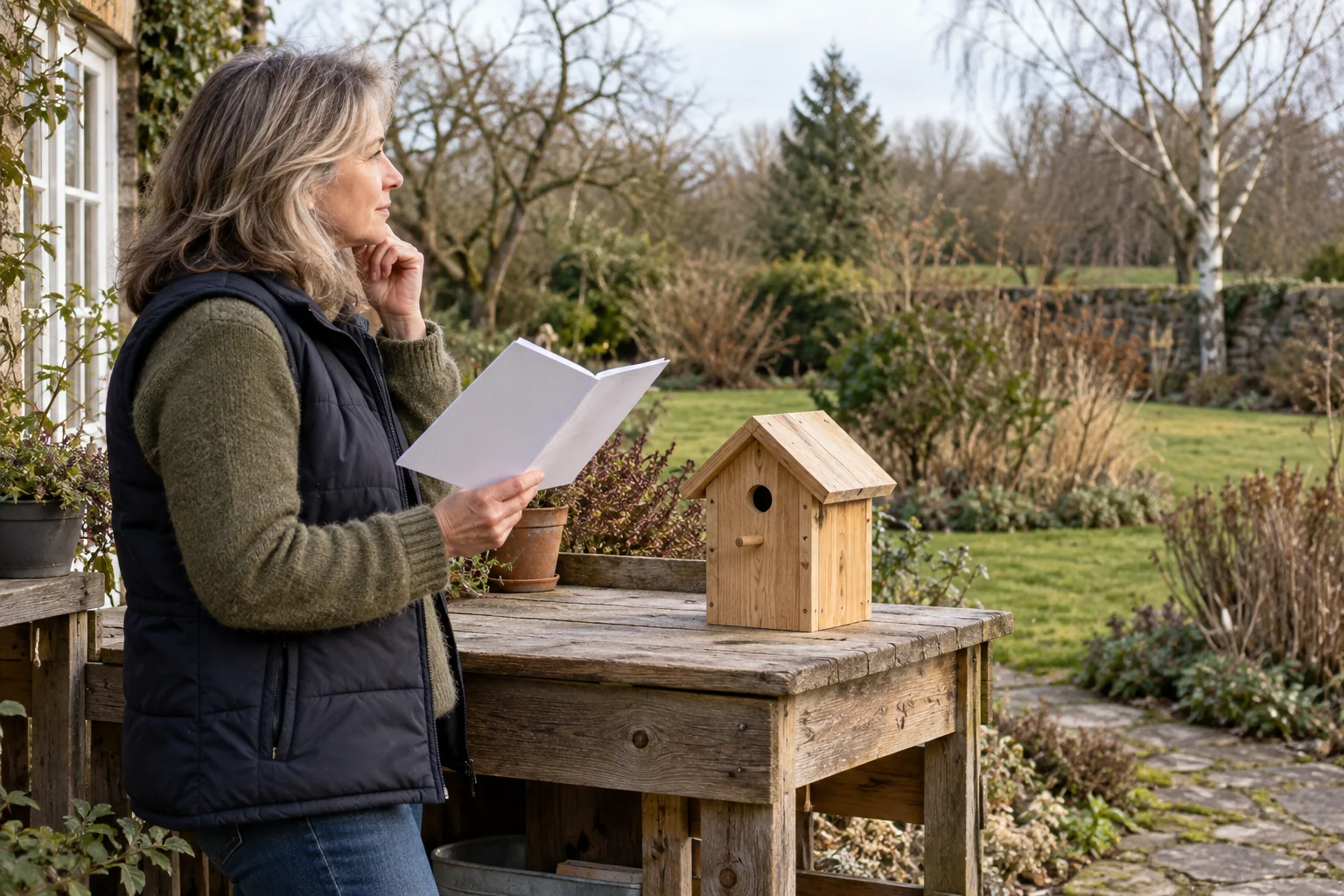
Birdhouse nesting season planning starts before you choose the house that will appear in the garden. A decorative roof can help you decide what you like looking at. Preparing housing for nesting requires a separate decision about the birds, the proposed site and the actual structure. Use winter to investigate those requirements while there is time to change the purchase. The two houses below are concrete offers to examine, with several important suitability questions still open.
This guide concerns selecting new housing ahead of the local breeding season. It gives no prediction that birds will occupy either product. Existing boxes may already have activity or need care; those require their own appropriate guidance. Here, the useful result is a proposed nesting arrangement whose requirements you can explain, or a decision that neither offer has enough confirmed information for that purpose.
Begin nest box site assessment with the birds and habitat
For a nest box site assessment, start with your region and the habitat around the proposed location. Cornell Lab's NestWatch uses those two selections in its Right Bird, Right House resource to identify birds for which a nest box or nesting structure can be considered. That gives you a research starting point. The shape of a miniature building in a shop photograph does not identify the bird you are preparing for.
Keep an uncertain identification uncertain. If you cannot name the bird you hope to accommodate, investigate that before shopping around a presumed entrance size. An observation in your garden may prompt the question without answering it. You can also ask an appropriate local bird organisation about which nesting-housing projects suit the area and your kind of site. A product described simply as a birdhouse leaves that question unresolved.
Imagine a fictional buyer, Ari, who likes the look of a white house beside a garden path. Ari has not selected a target species or assessed that part of the garden for nesting. The picture is an appearance preference, so the first task is to investigate the site and birds. Ordering the house immediately would leave the same questions to answer after delivery, with a particular object already chosen.
Work back from the local breeding season
NestWatch advises installing boxes well before breeding begins. Its United States placement guidance distinguishes a February target in the south from mid-to-late March in northern regions. Those regional references are not a worldwide timetable. Establish the guidance that applies to your location and intended birds before choosing a project date. The resource also warns that birds may take time to discover a box; installation does not promise immediate nesting.
Your preparation period needs room for questions whose answers might change the proposal. A missing entrance measurement may lead you to another house. A site assessment may rule out the place you first imagined. If either happens, revise the plan while the purchase is still under consideration. Avoid using an approaching calendar date as a reason to accept unconfirmed suitability or improvise a mounting arrangement.
For Ari, winter research has a definite purpose: decide whether the proposed nesting project can be properly specified before the relevant season. Ari can finish that research with an alternative model, another suitable location or no new housing. None of those outcomes needs a claim that a nest was created. The seasonal task concerns preparing a defensible arrangement, with actual bird use left to observation later.
Keep birdhouse entrance dimensions separate from overall size
Birdhouse entrance dimensions describe the actual opening, while overall height and width describe the object. NestWatch's placement resource lists different entrance requirements and habitats for different species. Its good-birdhouse guidance also treats access, drainage, ventilation and construction as features to examine. A photograph of a dark opening cannot supply its measurement, and a product's outside dimensions do not establish its internal chamber size.
Ask for the exact opening shape and measurements for the model being offered. Keep the answer with that model rather than transferring it from a similar-looking house. If the description mentions several compartments, ask about the actual arrangement and dimensions that matter to your intended use. A count of compartments does not establish that each one meets the requirements you are investigating, or that every compartment will be occupied.
Ari can make an unresolved entry question explicit: the offer identifies the house, but the opening has not been confirmed against the intended bird's requirements. That is enough to keep the nesting-use decision open. There is no need to estimate the hole from a photograph or convert a decorative feature into a functional specification. Request the information that would answer the question before deciding whether this model belongs in the project.
Examine the Good Directions house as a complete offer
The Good Directions Dovecote Manor bird house describes a pure copper roof and white-painted hardwood base, with eight compartments over two stories. Its stated size is 27 inches tall and 18 inches in diameter. The description names vents, drainage holes and removable access, and says the 4-by-4 post is sold separately. Those details identify the offer without establishing species suitability.
Read the stated access and openings alongside the questions still unanswered. The selected description does not supply the entry measurements or a complete chamber specification for the proposed nesting use. Its appearance and compartment count cannot fill those gaps. Nor does a removable roof statement provide a complete operating method. Obtain the applicable product information before treating the house as an accepted part of the arrangement.
The painted body and elaborate roof are also reasons to compare the actual design carefully with relevant nesting guidance. This article does not certify the finish or construction against a particular bird's requirements. If a general recommendation and a product statement point toward different arrangements, investigate that difference. Do not choose whichever statement makes the purchase easiest to complete or assume that an attractive display establishes an appropriate nesting structure.
Give the FeedingTime model its own investigation
The FeedingTime Club House birdhouse identifies model FE2422997 and SKU 1884911810, with stated dimensions of 11 inches high, 12 inches wide and 12 inches deep. The selected description supplies no entrance measurement, chamber specification or mounting procedure. Its photographed house and support do not establish the contents of an eventual parcel. Ask about this exact model before assigning it a nesting role.
Keep that investigation separate from the Good Directions offer. One house's stated post reference cannot explain the other's photographed support. Likewise, information about removable access on one design cannot supply an opening method for the other. If a supplier sends instructions, check that they identify FE2422997 or otherwise clearly apply to the selected item. A document for a neighbouring model leaves the original question unanswered.
Both offers can remain possible garden purchases while their nesting use remains unconfirmed. If your purpose is principally architectural decoration, describe that purpose honestly when comparing them. If your purpose is nesting housing, continue with the requirements for the intended birds and site. A decorative preference does not require an occupancy claim, and a functional nesting project needs more information than an appealing roofline.
Resolve the support arrangement before treating a site as ready
The house, its support and the location need to work as an actual arrangement. NestWatch's placement guidance discusses secure mounting and recommends freestanding poles or pipes for small boxes. That general advice does not establish a mounting method for either selected architectural house. In particular, a manufacturer's post reference and general small-box guidance must be reconciled for the actual design rather than combined into an improvised installation.
Ask for the model's applicable mounting instructions and identify any separate components. An image of an installed house can leave fasteners and support details hidden. It can also show surroundings that have no place in the parcel. Until the arrangement is established, keep the proposed location provisional. This guide supplies no digging depth, foundation, pole diameter, fastening sequence or structural load calculation for either offer.
In Ari's fictional project, the preferred spot can be recorded as a candidate without marking it ready for installation. The missing support information is then a reason to seek an answer about that arrangement. If the supported method does not suit the site, Ari can examine another properly assessed location or another housing design. Changing the plan is more useful than inventing a connection between mismatched instructions.
Use existing-housing care guidance for its own task
The winter birdhouse preparation guide covers existing housing, distinguishing winter shelter from nesting and keeping activity, care and model-specific conversion questions separate. Read it when the garden already contains a box that needs attention. Its Woodlink and Panacea Audubon details do not answer the new-housing specification questions for Good Directions or FeedingTime.
Buying a new house also does not settle what should happen to an existing one. Keep any occupied or uncertain housing outside an improvised installation project and seek applicable guidance for its actual status. This article gives no cleaning, nest-removal or conversion method. That boundary lets the prospective purchase be researched without turning a winter shopping decision into unplanned work on housing already in use.
Keep an observation separate from a housing verdict
The window birdwatching note guide focuses on recording one visible detail from an existing suitable household window, retaining uncertainty about what was seen. It is relevant when a garden observation starts your interest in bird housing. The observation can prompt further research; the guide's feeder examples supply no nesting specification or placement approval for either house here.
A bird seen near the proposed site does not supply the missing product measurements. Conversely, obtaining those measurements would not establish that a particular bird has selected the house. Keep those questions distinct as the project develops. Ari's planning notes can therefore finish with a researched proposal while a later observation remains simply an observation, without being used to certify the shopping decision after the fact.
Finish with a supported nesting proposal or an open question
Before committing to a nesting-use purchase, explain which birds and site the arrangement is intended for, what information supports the selected housing and how its applicable installation requirements will be met. Preserve any unresolved specification as unresolved. If a model cannot be assessed from the available information, choose a better documented option or continue the investigation. You do not need to award either linked house a place in the plan.
Birdhouse nesting season planning can end with the practical decision to leave a decorative house as a decorative purchase and select different housing for the birds. It can also end with a supported model and site ready for the appropriate next step. Keep the seasonal timetable attached to that researched arrangement. The eventual presence of a nest remains something to establish through appropriate observation, never something the purchase itself guarantees.