Lifestyle & Inspiration
A window birdwatching note starts with one detail
Watch a bird from an existing household window, describe one visible size, shape or action, and keep uncertainty in a personal note you can choose to share.
A window birdwatching note can begin with a single moment: a bird lands within your existing view, stays briefly and leaves. You do not have to identify it before writing something useful about what you saw. Choose one visible detail and describe it in words you would understand when you return to the page.
This is an activity for an adult using an already suitable household window. It does not require putting out food or installing a feeder. The two feeder listings discussed below provide specific shopping context if those products are already part of your interest; neither establishes that a particular bird will visit your home.
Choose a view you already have
Start with a place where you can comfortably see an outdoor area from indoors. That might be a view across a garden or toward a tree beside the building. Use the available view without leaning outside, moving into an awkward position or treating an obstructed angle as something you must overcome to finish the activity.
Decide what you can actually watch from there. A branch partly hidden by leaves offers a different view from a clear stretch of fence. Note that difference before trying to describe a bird's whole outline. You may see a head and body while the tail stays behind a leaf; the missing part belongs in the account as unseen.
Keep a piece of paper nearby if you want to write. Use a simple page with room for the detail you notice. You are making a personal record of an occasion, with the limits of that particular view, rather than claiming a complete record of the birds around the property.
Start by noticing bird size and shape
Cornell Lab's Bird Academy written transcript for Inside Birding: Size & Shape emphasizes overall appearance before fine details. Its presenters discuss comparisons with familiar birds and comparisons between parts of the same bird, including the head, bill, wings and tail. They also explain that size and shape alone may not identify every bird in every situation.
Use that idea for noticing bird size and shape without forcing a species name. If another familiar bird is absent, describe proportions you can see within this bird: a short-looking bill beside the head, for example, or how far the visible tail extends behind the body. Leave uncertain proportions uncertain when the viewing angle changes.
Do not invent a numerical measurement from the window. A bird farther away can look smaller than another closer to you. If you cannot make a useful size comparison, record an outline or posture instead. A note that says the bird looked rounded while perched describes your view without pretending you measured its body.
Let one action complete the observation
Watch what happens while the bird remains visible. Perhaps it turns its head, shifts along a branch or flies away. Choose an action you actually see rather than assigning a reason for it. A turn toward the house does not establish that the bird noticed you, and a departure does not tell you where it went afterward.
For a fictional example, imagine writing: “A bird sat on the left end of the fence, with its tail pointing down. It turned sideways once and then left behind the hedge.” Those are proposed observation words, not a report of a real sighting. Leave the species name unwritten if you do not know it.
If two birds appear, avoid combining their details into one description. You might follow the nearer bird while briefly noting that another was present. If they move out of view and return, say that you cannot tell whether they are the same individuals. Record the two appearances separately when you cannot tell.
Give the moment a place on the page
Write the day and approximate time if you know them, then identify the view in ordinary words. “Kitchen window, fence beside the shrub” may be enough for your own later reading. Avoid precision you did not record. If the time is remembered afterward, call it approximate rather than adding an exact minute to make the entry look complete.
Keep conditions separate from the bird description. You might write that the branch moved in the wind if you saw it move, without claiming a wind speed. If you also consult a household display, the guide to weather station readings explains why a measurement, a reporting period and a forecast mean different things.
A forecast read later cannot establish what happened during the sighting. Likewise, a display's supported range does not tell you the actual temperature at that moment. You can leave the weather line blank. The observation remains your description of the visible bird, even when you have no measured conditions to accompany it.
Keep a feeder listing in its proper role
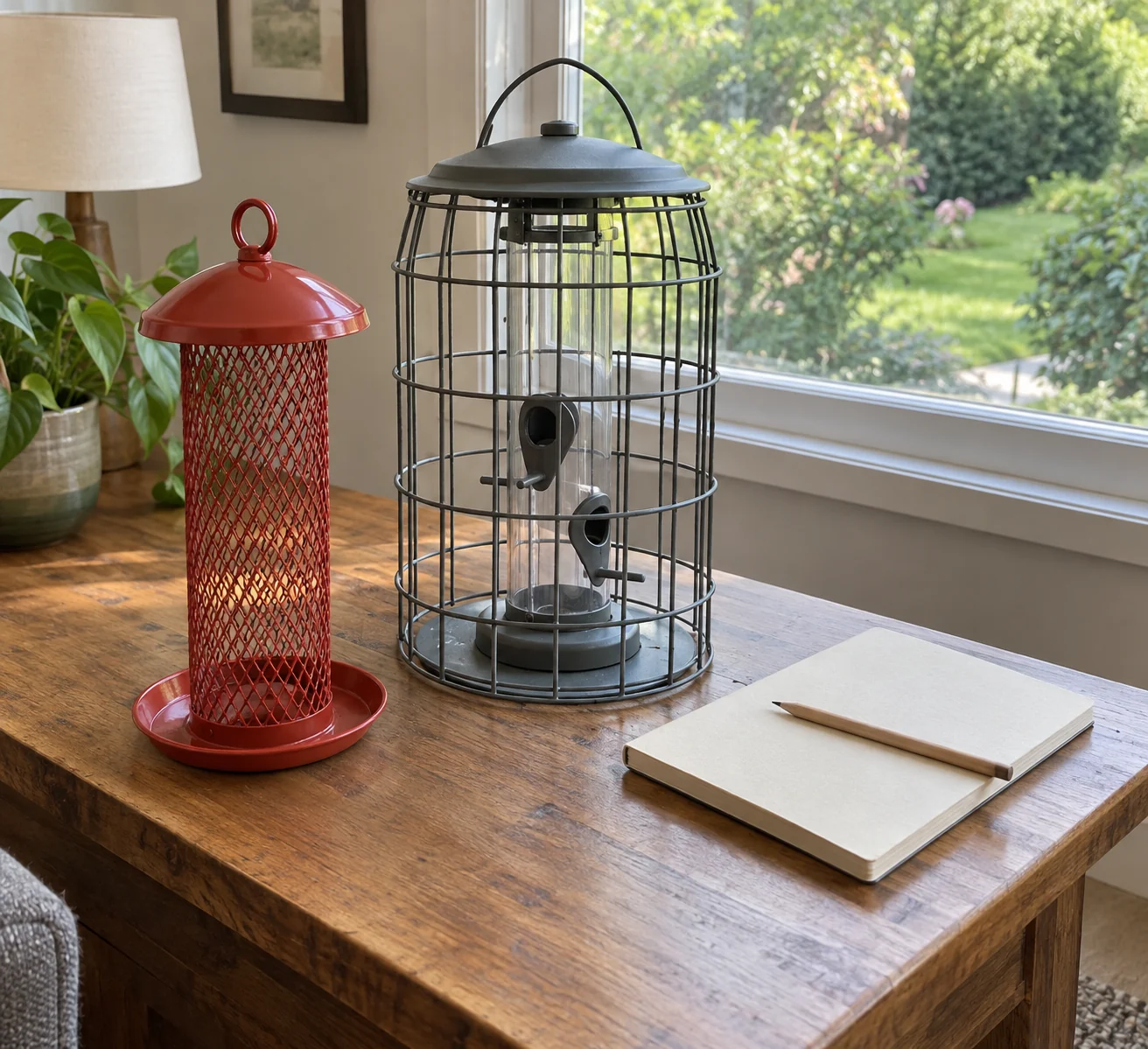
The Perky-Pet C00322 Red No/No feeder listing identifies a three-pack and describes attracting clinging and perching birds. That is the seller's product account. “Cardinal” in the product name does not identify a bird outside your window, and the pack quantity does not predict how many birds you will see.
If a feeder is already visible in your household view, describe the action you witness there. A bird holding onto a visible surface and a bird standing on a perch are observations you may be able to distinguish. The listing's general attraction claim cannot fill in an action hidden by the feeder or by the window frame.
A bird's absence is equally possible during the time you choose to watch. Do not turn a quiet session into a product failure or a claim that the surrounding area has no birds. Your entry can simply say that no bird came into your view while you were there. It records a limited occasion.
Separate quantities from the visiting bird
The WoodLink Gray Caged Tube feeder listing uses Audubon Wild Bird wording and describes gray plastic and wire construction, a capacity of 1.25 pounds and four feeding ports. Those quantities concern the offered feeder. They do not establish a feeding rate, a number of visitors or four simultaneous birds.
Neither selected listing supplies a rule for identifying whatever enters your window view. Their different names and descriptions should stay attached to the actual offers. Do not carry the Perky-Pet three-pack quantity into the WoodLink account or assume a gray caged tube shares the other listing's described attraction claim.
If you are thinking about a purchase, keep that decision outside the observation entry. Questions about the actual item, its suitability and its instructions need answers for that selected offer. This activity does not provide feeder placement, assembly, food selection or care instructions. You can continue watching from indoors while those separate questions remain unanswered.
Write what you remember before filling gaps
After the bird leaves, write the detail that stayed clearest. The outline of the bill may be vivid while the wing color is uncertain. Put the clear observation first, then name what you could not see. Avoid adding a color from an illustration just because the drawing seems similar to the bird you remember.
If you later consult an identification reference, add that work as a later note. Preserve the first description so a possible name does not replace the original observation. You might write “possible match, not confirmed” beside a candidate. There is no requirement to turn every brief window visit into a finished identification.
A rough sketch can accompany your words if you enjoy drawing, but label an imagined or reconstructed feature honestly. A tail drawn from memory after the sighting has a different status from a shape traced while it was visible. Keep the sketch beside the words explaining which parts you reconstructed afterward.
Keep a second look separate from the first
Suppose the first view shows only the bird's front, while a later turn reveals the tail. Add the newly visible part to that same entry only while you can still follow the bird. If it disappears behind the hedge and a bird appears elsewhere, start a second description unless you can actually establish the connection.
Use position words that describe your window view. “Left of the branch fork” is clearer than “over there” when you reread the page indoors later. A simple branch sketch can hold that position. It does not need an invented compass direction or a guessed distance from the house to explain the place you watched.
When another person joins you, ask what they can see before merging accounts. Their seat might reveal the tail you could not see, or hide the bill that was clear from yours. Record their contribution as theirs. A difference between two descriptions may come from the different views, without either observer having to replace an honest note.
If the second person suggests a name, keep the suggestion alongside the observed features. You can enjoy the shared moment while leaving the identification open. Their familiarity with a similar bird elsewhere does not establish that this one is the same species, and the feeder's retail name cannot resolve the question for either of you.
Try writing a birdwatching note to someone
For writing a birdwatching note that you might share, choose a person who would enjoy that small detail. Explain where you were and what caught your attention. “I thought of your garden when I saw a bird turn along our fence” can open a personal message without claiming that the two places attract the same species.
The postcard writing afternoon guide develops a personal message around a specific person and shared detail. That guide discusses Compulabel and Avery card offers in the context of a personal message. Use the writing idea if it fits the recipient; keep any choice of card, envelope or postal service separate from the bird observation.
You can also keep the entry for yourself. Sharing is optional, and another person does not need to solve the identification before responding. A short reply about their own window view can become a conversation. Leave room for the original moment to be interesting without turning the exchange into a quiz.
Return when another moment interests you
At a later visit to the same window, begin with what is actually there. Do not copy yesterday's bird into today's account because the scene looks familiar. A different outline, another perch or no visible bird can all make a separate entry. Similar weather does not prove that the same individual has returned.
If you compare entries, compare the words you recorded. One may describe a long visible tail while another leaves the tail unseen. That difference concerns your views as well as the birds. Keep both accounts intact rather than smoothing them into a stronger claim about a repeated visitor or a change in local bird numbers.
Window birdwatching can leave you with one well-described moment: where the bird appeared, a visible proportion or action, and what remained uncertain. Put the page away after recording the detail and the limits of your view. If another bird arrives later, you can decide whether to watch again or let that moment pass without an entry.
Window birdwatching can begin with an existing indoor view and a personal note; this conceptual cover shows generic inactive feeder props beside a notebook, without a live bird or installation example.