Furniture & Home Organization
bedside drawer organization: a practical reset
Empty and sort one bedside drawer, keep daily essentials accessible, then test and maintain the arrangement in the real room.
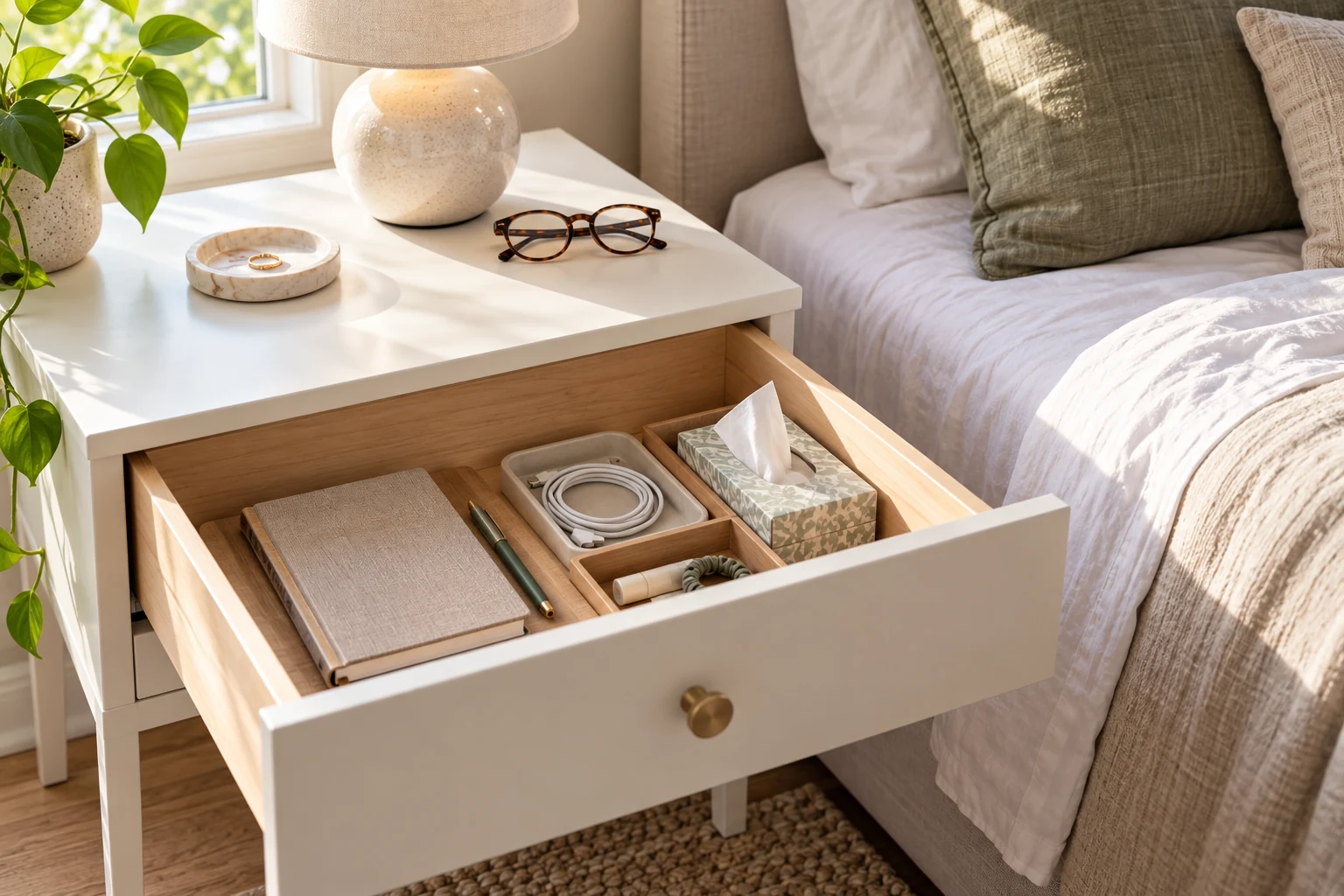
A bedside drawer can become a quiet catchall. Receipts, loose cables, pens, spare batteries, and objects with no other home collect beside the things you reach for every night. A bedside drawer organization reset starts by deciding what truly needs to be within arm’s reach. The goal is not a perfect display. It is a drawer that opens smoothly, lets you find the item you came for, and leaves enough clear space on top for the things you use before sleep.
Set aside a short period when you can remove everything from one drawer. Put a cloth or tray on the bed to protect the bedding from dusty objects. Keep a small bag nearby for rubbish and another place for items that belong in another room. Do not begin by buying inserts. You cannot choose a useful divider until you know the drawer’s usable depth, what has to return, and whether the furniture is still comfortable beside the bed.
Empty the drawer and choose what belongs
Take every item out and wipe the empty drawer according to the furniture finish and care instructions. Check the corners for old paper, broken packaging, and loose parts. Do not force a sticky drawer or overload it while testing. If it binds, look for an object caught behind it and follow the furniture’s instructions before continuing. This reset should improve access, not turn a small organizing job into a repair that damages the furniture.
Sort items by what you actually use at the bedside. One group might contain glasses, a notebook, and a pen. Another might contain a cable that is used with a device already in the room. Put medicines and other items with storage or access requirements where their own instructions and your household needs dictate; a bedside drawer is not automatically the right place. Move general household supplies, old receipts, and duplicate cables to their proper homes.
Hold each object briefly and ask when you last reached for it while in bed. Keep an item here because this location makes the routine easier, not because there is a little space left. A bedside drawer should not become the overflow for a desk, kitchen counter, or entryway. If you share the bed or furniture, agree whose items use this drawer before assigning sections. The simplest system is one that both occupants understand without a label on every compartment.
Give everyday items a place
Measure the inside of the drawer, including any shallow space below the drawer front. Check how far it can open with the bed, rug, and nearby furniture in their usual positions. A divider that fits the empty drawer may be too tall to close or too wide to lift out for cleaning. Use a small existing box or tray first if it suits the space. Keep an open area for an item that changes from week to week rather than filling every inch.
The white side table with a drawer provides one enclosed storage space below its top. Its listing identifies the drawer, but it does not tell you how your personal objects will fit or whether the drawer clears your bed frame. If you use a one-drawer piece, divide the contents by frequency rather than building stacks: the objects reached for most often should be visible when the drawer opens. Test the real piece before choosing inserts or assuming a product photograph proves usable capacity.
The white two-drawer nightstand offers a different layout with two separate drawers. That separation may let someone keep daily items in one and less frequent bedside items in the other. It does not double the useful space in every bedroom, and the listing does not establish a load limit or a universal interior dimension. Use the actual opening and drawer depth as your guide. Avoid packing either drawer so tightly that retrieving one item disturbs everything else.
Put small items in shallow groups that can be seen at a glance. A notebook can lie flat; a pen can have a defined place beside it. Coil a spare cable loosely and keep it separate from papers rather than creating a tangle. If a charging device remains plugged in, follow its manufacturer’s instructions and keep it where cords do not cross a walkway or pinch in a drawer. The organizing decision is about finding things easily; it does not create an electrical-safety approval for a particular furniture setup.
Return the selected objects one group at a time. Close and reopen the drawer after each group. If it becomes difficult to move or you cannot see the lower layer, remove something rather than adding another organizer. A successful drawer has unused space. That space lets you pick up glasses without nudging a stack of papers and makes it obvious when unrelated objects begin to accumulate again.
Keep the top usable
A drawer reset can fail if everything removed from it simply lands on the nightstand top. Choose what must remain visible, such as a lamp that already works in the room or a place to set glasses before sleep. Give the remaining surface back to normal use. A top crowded with boxes, spare chargers, and decorative objects makes the drawer harder to reach and gives the next loose object nowhere sensible to go.
If your main problem is quiet light placement for reading beside another sleeper, the shared-bedroom reading light guide covers that separate routine. This drawer tutorial stays with sorting and retrieval. A person can have a good reading-light arrangement and still lose a pen under a pile of receipts. Do the drawer reset on its own terms, then adjust the top only enough to keep the drawer usable.
Avoid moving the furniture just to make an organizer look tidy. Check that the nightstand remains stable and that its drawer opens fully from its real bedside position. If a rug catches the drawer or the bed blocks your hand, an empty drawer will not solve the access problem. You may need to shift an existing item or choose a smaller tray. Do not assume a certain drawer height is comfortable for everyone; test it from the side of the bed you actually use.
Test the drawer in the room
Sit or lie where you normally reach for bedside items and open the drawer once. Can you see and lift the object you need without standing up or moving another item? Can you close it without trapping a cable or brushing the bedding? Then stand beside the bed and repeat. The two positions reveal different issues. A neatly arranged drawer that is awkward from the bed may need a simpler layout, fewer items, or a different location for the object.
Try the routine at the time it usually happens. In the evening, find glasses or a notebook without searching through a dark drawer. In the morning, put them back without balancing other things on the top. If someone else shares the furniture, ask whether the sections make sense to them. The arrangement should support a repeated action, not just look organized in daylight during the first five minutes after cleaning.
An overnight visitor needs a different handoff: a clear surface and explicit permission about any drawer offered to them. The guest nightstand setup guide covers that temporary arrangement. This article concerns the regular occupant’s own everyday drawer. Do not leave private papers or routine essentials in a drawer you plan to offer to a guest later; prepare that guest space as a separate task.
Give paper its own decision during the reset. A small note used tonight can stay with the notebook; an old receipt needs filing or disposal according to your usual recordkeeping. If personal information is on a paper, handle it in a way appropriate for that information rather than leaving it accessible in a shared drawer. Avoid keeping a thick stack under the notebook simply because it lies flat. Flat clutter still hides the item you reach for. This distinction helps keep the nightstand a place for current bedside actions instead of long-term storage.
If you use a tray or small box, lift it out once and put it back. Can you do that without snagging the drawer sides? Can you clean beneath it? An insert that only works when perfectly positioned will probably be pushed out of place in everyday use. Put soft or fragile items where they will not be pressed against a hard edge when the drawer closes. The layout can be modest: a few visible groups and enough empty room to move your hand. Ease of use matters more than symmetry.
Maintain the arrangement
Choose a brief weekly reset rather than waiting until the drawer jams again. Remove stray receipts and objects that migrated in from other rooms. Check that the small categories still fit, and take out anything that has not earned its bedside place. Wipe the drawer when needed according to the furniture’s finish. The maintenance step should take less effort than the first empty-and-sort session because each object already has a reason to be there.
When the routine changes, change the drawer. A new device, a different bedtime habit, or a partner using the other side of the bed may make an old arrangement unhelpful. Re-sort before buying more containers. A larger organizer cannot compensate for keeping too many unrelated things within a small piece of furniture. If the drawer repeatedly overflows, that is useful evidence that some items belong elsewhere.
Take one final look at the items you removed. A receipt may need filing, a broken cable may need appropriate disposal, and a borrowed object should go back to its owner. This outside-the-drawer step matters because a clear drawer does little good if the displaced pile remains on the bed or floor. Finish the entire small loop before you call the reset done. If you cannot decide where an object belongs, place it in a temporary sorting spot and set a specific time to resolve it instead of returning it to the nightstand by default.
Bedside drawer organization works when the storage follows the actual routine: empty the drawer, keep only relevant items, assign simple places, test retrieval from the bed, and clear the top after sorting. One-drawer and two-drawer nightstands provide different layouts, but neither determines the right contents for you. The useful result is that you can reach a needed item, return it easily, and notice when clutter starts to come back.