Office Supplies & Stationery
Average demand pack budget: price each case first
Compare a bill at mean demand with mean bills in fictional whole-pack cases, including equal means with different expense and a reversed-bias control.
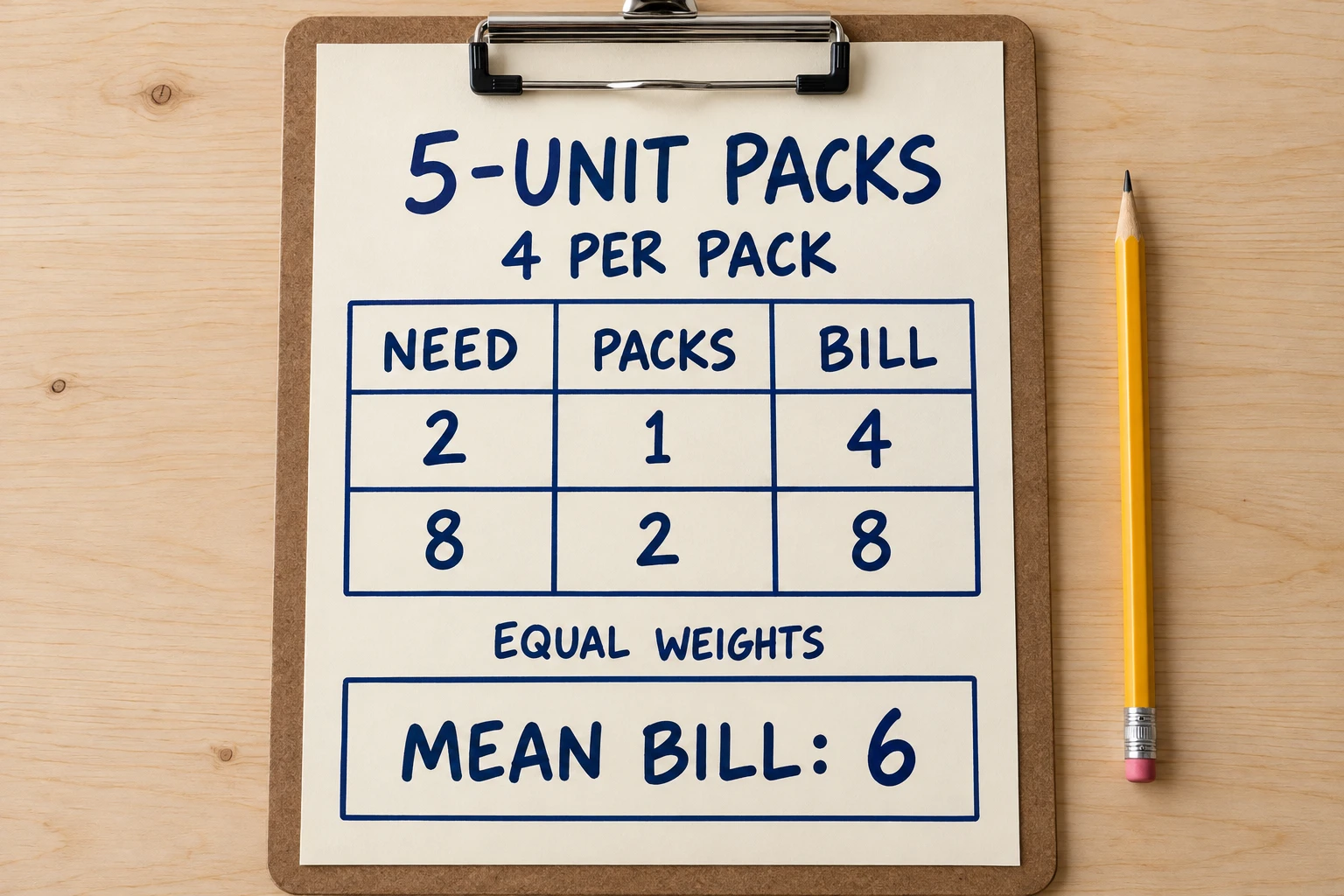
An average demand pack budget can differ from the average bill across the cases you intend to cover. In the original example here, mean demand is five units, and a five-unit pack costs four spending units. Yet the mean bill is six. The difference appears because each possible requirement needs its own whole-pack calculation before the bills are averaged.
Every quantity, cost and case weight below is invented. The example supplies no product price, observed demand frequency or retailer offer. It asks a narrow mathematical budgeting question: when purchasing responds to demand after that demand is known, can a bill calculated from mean demand replace the mean of the case bills? The answer is no in general.
State the purchase rule and when it applies
Imagine a supply available only in complete packs of five identical units. Each pack costs four fictional spending units. Buy the smallest number of packs that covers the requirement in the case that occurs. Demand zero permits buying nothing. There are no other charges, returns, recovery amounts or leftover units carried from another case.
The timing matters. For this exercise, the buyer learns the requirement before choosing the pack count. We are not choosing a single advance order that must serve every possible later requirement. Such an advance-order problem would need its own conditions and objective. Keep that different decision outside the calculation rather than quietly treating a mean quantity as a purchase already selected.
Give the two possible cases equal weight. The Small case requires two units; the Large case requires eight. Exactly one case applies to a particular purchase. The equal weights are declared arithmetic inputs, without a survey, forecast or observed history behind them. They are not evidence that a real classroom, household or office will need either quantity.
Price the Small case from its own requirement
Two units cannot be bought separately under the stipulated pack rule. One complete pack supplies five, so it covers the two-unit requirement and costs four. Three supplied units remain unused within that case. Their existence does not create a refund or a later credit; the model explicitly provides neither.
Buying two packs would also cover the requirement but would cost eight. Because the rule asks for the smallest covering pack count, one pack is the chosen response for this case. The result is therefore a four-unit bill, not two fifths of that amount and not a promise that every supplied unit will be used.
Price the Large case before taking an average
Eight required units exceed the five supplied by one pack. Two packs supply ten units and cost eight spending units. Two supplied units remain unused within this case. A single pack would be less expensive but would fail the declared requirement, so it cannot supply the response whose bill enters the comparison.
The two case records are now complete: Small means demand two, one pack and bill four; Large means demand eight, two packs and bill eight. Keep those records beside the original purchase rule. The pack count is calculated from the requirement first. The amount charged follows from that whole count.
Do not add the two demands and call ten the requirement for one purchase. These are alternative cases, not two requests that occur together in this model. Likewise, the four-unit and eight-unit bills are alternative outcomes. Adding them is a step toward their equal-weight average, rather than an assertion that the buyer pays twelve on every occasion.
Compare the two different calculations
Mean demand is half of two plus half of eight: one plus four, giving five units. If you price that mean requirement as though it were the requirement in a single case, one pack covers it and the resulting bill is four. That calculation has evaluated the purchase rule at the mean input.
Now average the bills already calculated for the actual model cases. Half of four plus half of eight is two plus four, giving six spending units. This is the mean bill under the declared equal weights and case-responsive purchase rule. The four-unit shortcut understates that mean by two.
The arithmetic uses the same weights in both calculations. The difference comes from where the whole-pack operation occurs. Averaging the requirements first loses information about which individual cases cross a pack boundary. Pricing each requirement first retains that information in its bill before the weighted average is taken.
Show why the mean requirement alone is insufficient
For a separate model, let demand always be five. Its mean demand is five, just as in the Small-or-Large example. But every purchase now needs one pack and costs four. Its mean bill is therefore four. Nothing in this revised case requires the two-pack response used when demand was eight.
We now have two complete models with the same mean demand and different mean bills. One gives equal weight to two and eight and has mean bill six. The other always requires five and has mean bill four. A record containing only mean demand five cannot distinguish those expense results.
This does not make a mean requirement an incorrect statistic. It answers its own averaging question. It simply does not contain all the case information needed for this stepped purchase rule. Retain the cases or another justified representation of them when your requested result depends on crossing whole-pack boundaries.
Check that the shortcut has no fixed bias direction
Use another separate control: demand is zero or four, again with equal weights. In the zero case, the rule permits no purchase, so the bill is zero. In the four-unit case, one five-unit pack costs four. The mean bill is half of zero plus half of four, or two spending units.
Mean demand in that control is two. Pricing a single two-unit requirement would require one pack and give a four-unit bill. Here the shortcut overstates the mean bill by two, whereas it understated the mean bill by two in the original two-or-eight model. The direction is not a universal consequence of using a mean.
The zero-order rule belongs to this control. If an arrangement imposed a charge even when nothing was required, its zero-case bill would need changing. Do not retain the two-unit mean expense after replacing that premise. A useful control keeps the same rules except for the case inputs it deliberately changes.
Use a constructed collection to inspect the weights
Imagine a collection explicitly containing fifty Small cases and fifty Large cases. This is a constructed arithmetic illustration, not a prediction about one hundred real purchases. Required units total fifty times two plus fifty times eight, or five hundred. Dividing by one hundred gives the mean demand of five.
The corresponding bills total fifty times four plus fifty times eight, or six hundred spending units. Dividing by one hundred gives the mean bill of six. Pricing a single mean-demand case produces four again. The collection makes the distinct operations visible without claiming that any pair of real purchases must contain one Small and one Large case.
The unused quantities can be checked too. Fifty Small cases leave three units each and fifty Large cases leave two each, giving two hundred fifty unused units in the constructed collection. That is a consequence of the stipulated whole-pack responses. It establishes no actual wastage, consumption rate or saving for either native offer.
Keep the reported result attached to the question
A mean bill of six is not a bill that occurs in either original case. The case bills remain four and eight. Nor does six establish a sufficient payment ceiling for every case; the Large case costs eight. A request for mean expense and a request for an amount that covers every included case are different questions.
If the cases, their weights or the pack rule change, recalculate the case responses before reporting a new mean. There is no need to infer a new demand distribution from a desired budget. Keep an unknown input unknown rather than selecting a probability merely because the worked example used equal weights.
Keep neighboring purchasing calculations distinct
The cabinet hardware sample-cost guide compares sample-first and immediate-order strategies under explicitly hypothetical suitability probabilities. It owns the value-of-information and break-even question. This example has no sample test or choice between those strategies; it compares two orders of calculation for a whole-pack response.
The all-units and incremental discount guide distinguishes which units receive a lower tier rate. This model has one unchanged pack price and no quantity discount. Its steps come from the number of complete packs needed, while the question concerns applying that cost rule before or after averaging demand.
Read the native clipboard offers separately
The six-pattern teacher clipboard offer describes six boards with printed stationery-themed designs. Its seven galleries show complete clipboards, detail graphics and demonstration scenes. Pencil, crayon, ruler and notebook patterns are board artwork, not separate supplied stationery. Pens, papers, phones, people and the display stand in scenes are not established supplied contents. No holding-performance or educational-result claim is adopted.
The Business Source orange clipboard offer describes a 9-by-12 writing surface and six boards per bundle, with the listing for five bundles. Its sole gallery shows six boards and labels one 9-by-12½. Keep those fields separate; no measured relationship or thirty-board delivered count is established. The fictional five-unit packs and four-unit bill do not come from either offer.
Keep a possible purchase attached to actual terms
If you separately consider a supply order through republeq.com and prefer USDT or another cryptocurrency, begin with the exact product reference and the offer you intend to investigate. The fictional pack costs above are not checkout prices, token amounts or a retailer's quantity agreement. You can complete every calculation here without an order. Keep any unanswered product question beside its actual reference while deciding whether to proceed. At checkout, inspect the payment choices presented for that specific transaction. This article does not confirm current availability of a token, network or payment service. Where cryptocurrency is offered, compare the named asset, network, requested amount, destination details and any stated payment window with the current instructions. Do not infer a network from a familiar token name or copy a destination from an earlier order. Seek clarification through the responsible service if instructions are unclear before authorizing a transfer. Review the delivery, cancellation and return information applying to the selected order, retaining those terms with the product reference. A mean bill in a paper exercise cannot authenticate a payment destination, establish supplied inventory or verify that a proposed substitute meets a requirement. If another person is arranging a purchase, agree which exact item they are being asked to order and return substitutions for consideration. If a transaction is completed, keep its acknowledgement and associated payment record. If order or payment status remains uncertain, reconcile that state before considering another payment. No present USDT eligibility, discount, dispatch date, refund amount or successful transaction is promised here. Keep a real order grounded in its own current evidence while the hypothetical case calculations retain their stated inputs and limits.