Writing & Documents
An artwork attribution that keeps owner and maker distinct
Vera owns a drawing Celia made and gave her. When Finn mistakes ownership for authorship, Vera names the actual maker while continuing to enjoy the gift.
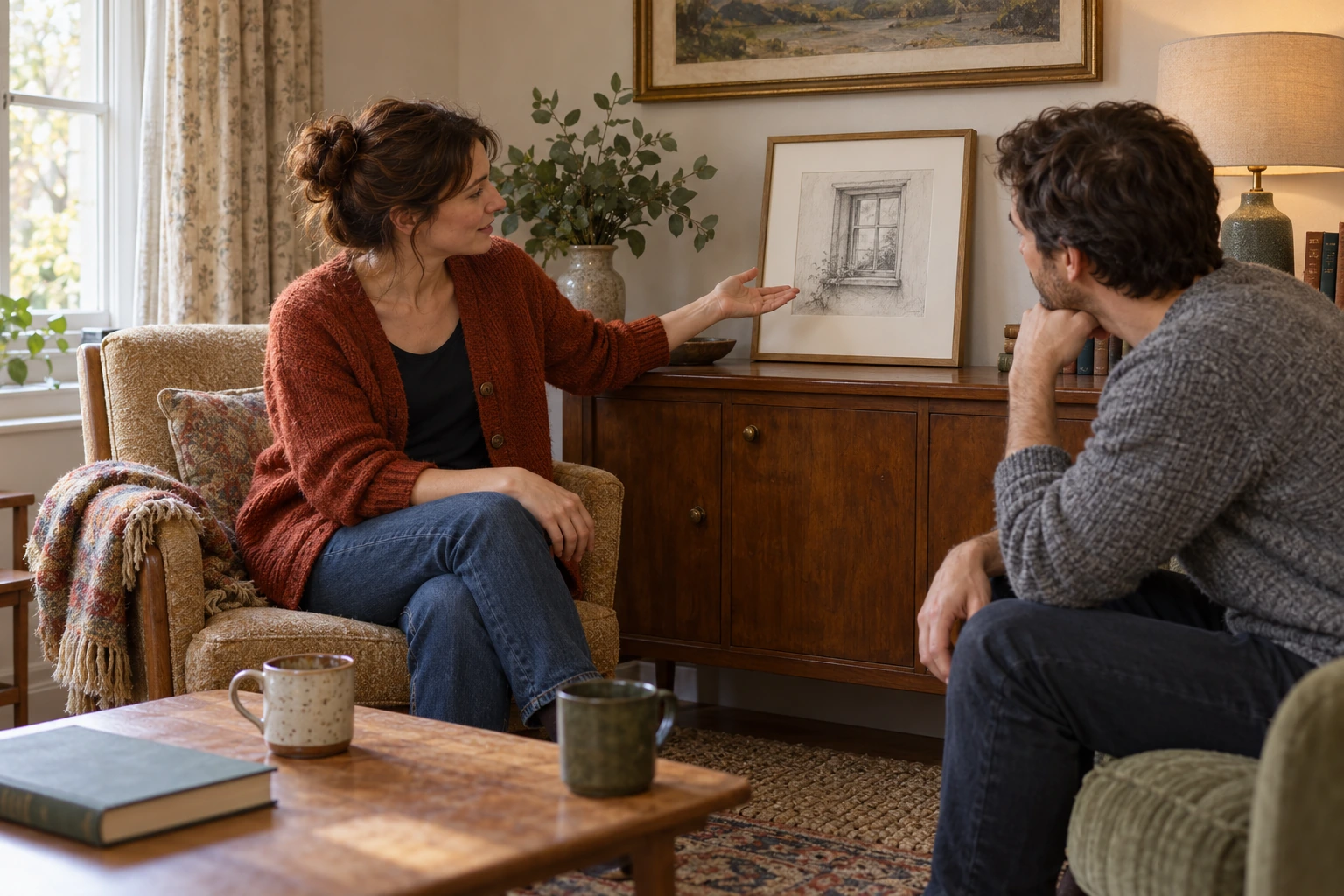
This artwork attribution story is original fiction. Vera owns a drawing that her absent friend Celia made and gave her. Vera did not draw it, add to it or make any part of the image. When Finn visits, he assumes the work is hers. Their conversation follows that mistaken assumption and Vera's answer. The people, gift, picture and visit are invented, with no claim about an actual artist, legal authorship, permission to reproduce art or the way other people should respond to praise.
The drawing shows a small window with a sill and part of a wall. Its frame rests on Vera's sideboard. The story gives Celia sole credit for making the drawing and Vera possession of the gift. Those facts remain separate throughout the visit. Vera can be pleased that someone likes a picture in her room without becoming the person who made it.
The drawing Finn notices
Finn stopped beside the sideboard before sitting down. Vera had left a closed book at one end and put the framed drawing near the other. The space between them was just wide enough for the little dish where she kept her spare key. He leaned forward to look at the pencilled window, then straightened and turned toward her. She was moving a cup from the chair he usually chose.
"I didn't know you could draw like that," he said. He looked back at the picture. "The line beneath the sill is lovely." Vera glanced at the line he meant. It was one of the things she had noticed when Celia first showed her the page. From a distance it almost disappeared. Up close, it gave the window a shallow ledge without filling the space beneath it.
Vera was pleased he liked the drawing. For a moment she was ready to say only thank you and let him continue looking. Then she heard the first part of his sentence again. He thought she had drawn it. That was not a modest account of something she had made, nor a compliment about arranging the room. He had named a making ability she had not used to produce this picture.
The maker Vera can name
"I didn't draw it," Vera said. "Celia did. She gave it to me." She said it while he was still beside the frame, before their conversation moved elsewhere. Finn looked from the drawing to her and said he had assumed it was her work. Vera said she had thought that was what he meant. Neither of them needed to find a smaller contribution for her to claim.
She had not chosen the line beneath the sill, changed the window or helped finish the page. Celia had brought the completed drawing on an earlier visit and offered it to her. Vera had accepted it. The gift had a place in her room now, but the making remained Celia's. This is the declared history of the invented picture, rather than a provenance account established through a label, receipt or photograph.
Finn asked whether Celia drew often. Vera said she had seen a few of her pages, but did not know how often she worked. She could tell him that Celia made this one without supplying a schedule for all the others. He looked again at the frame and said he was glad Vera had told him. That was the answer he gave in this fictional visit, with no promise about another person's reaction.
A gift Vera remembers receiving
When Celia brought the drawing, Vera had been looking for a book she meant to lend her. She remembered that part clearly within the story: one shelf was too crowded, and the book had slipped behind a row she rarely moved. Celia sat at the table while she searched. The drawing lay inside a folder until Vera returned with the book and noticed the pale corner showing beneath Celia's hand.
Celia took out the page and set it on the table. Vera looked at the window first, then at the space around it. She asked whether Celia was keeping the drawing. Celia said she had brought it for her, if she wanted it. Vera said she did. There was no unfinished part assigned to Vera and no agreement that the gift would become a joint piece of work after it left Celia's folder.
Later, after Celia had gone, Vera tried the framed picture in several places. She kept returning to the sideboard because she could see it while crossing the room. That choice concerned where she wanted to live with the gift. It supplied no new pencil line and changed none of the drawing. Remembering how much she liked choosing its place did not give her a reason to accept Finn's assumption about who made it.
The window inside the picture
Finn asked whether the drawn window belonged to a place Celia knew. Vera said she had not asked. The window in the picture had a narrow sill and no view shown beyond the frame. She could describe those visible details. She could not supply an actual house, a visit Celia had made or a private reason for drawing it. The conversation could leave the subject's unwritten history alone.
"I thought it might be your old kitchen," Finn said. Vera looked at it from where he was standing. Her old kitchen window had been wider, but he had not seen that room often. She said it was not a picture she had identified as that kitchen. He nodded and stepped back. The suggestion could remain something he had imagined, rather than becoming a new fact about Celia's drawing.
They looked at the line beneath the sill again. Finn said he liked how little of the wall was drawn. Vera said that was one of the things she liked too. This time the conversation did not give the line to her as something she had made. They could have preferences about the same image while keeping its maker named. The story does not turn either preference into an account of what Celia intended everyone to notice.
Let ownership have its ordinary place
Vera moved the spare-key dish farther from the frame and returned the cup to the table. Finn sat down. From his chair he could still see the drawing, though the window was smaller at that distance. He asked how long it had been there. Vera said she had moved it to the sideboard after Celia gave it to her. She did not need to explain every other place she had considered.
The room was hers to arrange within this fiction, and the drawing was her gift to keep. Naming Celia had not taken either of those things away. Vera could say she liked seeing the picture from the doorway and that she sometimes noticed it while looking for the spare key. Those were her experiences of owning it. They did not have to become experiences of drawing it.
Finn told her about a print he had kept in a folder for months before finding a place for it. He did not compare its maker with Celia or ask Vera to make him another drawing. Their talk had moved to living with a picture. The first mistaken assumption no longer had to organize every sentence that followed. It had received an answer while the actual maker was still part of the conversation.
The book beside the frame
Vera noticed Finn looking toward the book at the other end of the sideboard. He recognized its cover and asked whether she had begun it. She had read the opening and stopped at a conversation she wanted to return to. A plain, inactive book stand sat farther along the shelf. Neither friend used or adjusted it during the visit, and the story gives it no retail identity or tested function.
She brought the closed book to the table so Finn could see which edition it was. A folded scrap fell from between the pages. It contained a note she had written about where she stopped. Finn waited while she put it back. This was something Vera had written herself, but nobody mistook the note for the book's words or the picture's lines. It had its own small job beside those other objects.
They talked for a while about whether Finn had read the same book. He remembered one person from the opening, then admitted he might be thinking of another story. Vera described only the part she had reached. The drawing stayed on the sideboard while this uncertainty remained at the table. Correcting its attribution had not made either friend responsible for producing an exact answer to every question that came afterward.
Actual book-stand accounts outside the visit
The first Hyjoy book-stand account describes a foldable support with page clips. Its single gallery shows a complete brown wood-look panel, low flat clips and a silver-coloured jointed support and base. This identifies the pictured form, without verifying material, rotation, folding, ergonomic, load or holding claims. No independent extra goods appear.
The second Hyjoy book-stand account shows a brown wood-look panel, black base, front ledge and extended wire page holders with a demonstration book. The book is a staging prop, not established supplied stock. Both accounts retain their Restored Tools category. These observations authenticate neither model identity nor practical performance, and neither retail stand is Vera's fictional object.
Keep the neighboring compliments distinct
The shared-card story begins with Theo's words and Mara's lettering already acknowledged by everyone. Luz accurately praises Mara's actual contribution, and Mara accepts that particular compliment. Vera made no part of Celia's drawing. Her visitor's mistaken creator assumption needs a correction, rather than a smaller account of work Vera really did.
The unintended spoken-cue story follows Merel reading her private reminder aloud before a visit, then talking with Sal about an unfinished drawing. Its work concerns that unplanned opening and the conversation that follows. Vera has no spoken reminder to recover from. Her answer keeps the gift's owner distinct from its sole maker.
The picture stays where Vera chose
At the door, Finn looked once more toward the sideboard. He said he liked seeing the drawing there. Vera said she did too. He had not repeated the claim that she drew it, and she did not need to rehearse the correction again. She opened the door while he found his gloves. They had no plan for a visit to Celia or a request for another picture when they said goodbye.
Vera returned to the room and put the book beside the frame. The spare key was still in its dish. She could see the little pencilled sill from the doorway, though the line beneath it nearly disappeared at that distance. Celia had drawn it. Vera had received it and found a place for it. She left the picture there as she turned back toward the table.
If you plan to purchase an item on republeq.com, check the particular offer and current checkout before ordering. This guide does not establish that any cryptocurrency payment option is available. If USDT is offered for the intended order, verify the requested asset, network, amount, receiving destination and order reference with the responsible service before authorizing a transfer. Review the actual product identity, selected variant, quantity, delivery details, total charge and applicable terms. Use the confirmed order details when checking the payment instructions. Confirm any fee, conversion term or exchange rate from the current transaction information. Determine the applicable cancellation, return and refund process, including how a refund would be handled for the selected payment method. Keep the relevant instructions and transaction records, with dates and confirmed references. If essential instructions change, ask the responsible service to confirm the change against the exact order. An acknowledgement should identify the order and the agreed details; it does not replace checking whether the selected product is the one you intended to buy. If payment or order status remains uncertain, reconcile that status before considering another transfer. Do not treat an unresolved transaction as evidence that nothing happened. This article supplies no wallet address, transfer guarantee, recovery procedure or assessment of a counterparty. A product enquiry does not authorize a payment or resolve an uncertain order. If support provides an answer, retain the exact question and response so a later reviewer can understand what was confirmed. Decide whether to proceed only when the conditions of the particular transaction are clear, and retain the confirmed transaction information with the exact order.