Crypto Commerce
AOSU four-camera solar security kit — Four outdoor cameras with different recording paths
Compare AOSU four-camera solar security kit by hub or card storage, network setup, solar planning, night alerts, and recording limits.
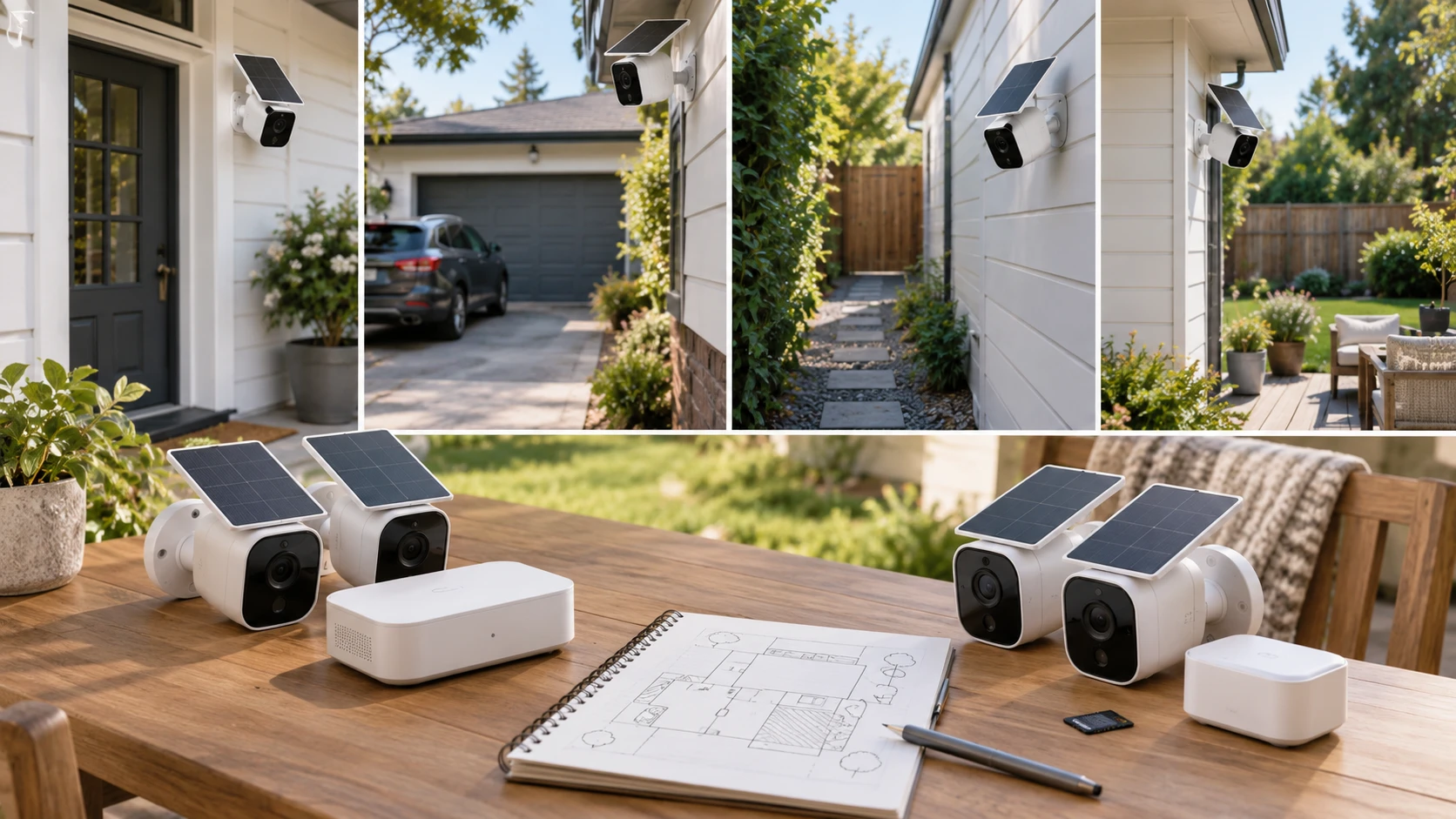
The AOSU four-camera solar security kit lists four 2K/3MP cameras and a 32GB home station for local recordings. A published guide to camera battery planning away from charging is useful when a solar camera will spend winter or several cloudy days outside, though it does not test either kit. The ARCCTV 4MP solar camera four-pack lists four cameras, Wi-Fi 6, and motion-triggered recordings to optional cloud storage or an SD card up to 128GB. The products make different storage and network claims; the saved rows contain no matched security test.
Start with the four places you want to see — ARCCTV 4MP solar camera four-pack
A four-pack is useful only if each camera has a clear job. Sketch the entry door, driveway, side path, and rear access before deciding where the units go. AOSU advertises a 166-degree view and a recommended mounting height of 6.6 to 9.8 feet. That may cover a broad area, but a wide lens can make a distant person occupy only a small part of the image. The row's six-times digital zoom enlarges captured pixels; it does not add optical detail that was never recorded.
ARCCTV describes a wide view but does not give an angle in its saved row. Its 4MP resolution label is higher than AOSU's 3MP label, yet pixels alone do not guarantee a readable face at the property line. Lens field of view, distance, lighting, compression, and mounting angle all matter. Use a site map to choose what each camera must identify, then verify sample footage at roughly that distance. Neither product listing proves recognition quality in your yard.
Home station or camera-side card storage — camera battery planning away from charging
AOSU includes a home station with 32GB local storage and claims encrypted recordings, playback, and downloads without a mandatory monthly subscription. It says optional cloud backup is available. Its Republeq's product-page text suggests up to 120 days of footage, but retention depends on motion traffic, clip length, resolution, and how the system manages a full store. Four busy views can consume storage more quickly than four quiet ones. Confirm the current recording and overwrite settings before treating a long retention figure as a promise.
ARCCTV describes cloud storage or an SD card up to 128GB, with the card not included. It says older recordings are overwritten when the card fills. The row does not clearly state whether one card is needed per camera or how footage from all four is reviewed together. Clarify those details and any cloud subscription terms for the exact offer. A locally stored clip helps only if you can find and export it after an event. Walk through that process before relying on either system for a critical incident.
Network claims need a property-specific check — ARCCTV 4MP solar camera four-pack
AOSU lists 2.4GHz and 5GHz Wi-Fi, an open-space signal range of 787 feet, and an Ethernet cable in the package for the home station. An open-space maximum is not a guarantee through walls, trees, metal siding, or a garage. Identify where the home station and router will sit, then test connectivity near each intended camera position. Check the manual for whether cameras speak to the station directly or through the home network; the saved row does not spell out every hop.
ARCCTV claims Wi-Fi 6 with dual-band 2.4GHz and 5GHz connections. It describes 5GHz as a faster option and 2.4GHz as a longer-range one. That is a general setup choice, not proof that either band reaches a distant gate. Check router compatibility, actual signal strength, and whether the app can show a connection-quality reading. A camera that streams sharply beside the router may miss an event at the final mount. Do a temporary test at each location before drilling holes.
Solar power still depends on the site — ARCCTV 4MP solar camera four-pack
AOSU's kit explicitly includes a solar panel and mounting hardware along with battery-powered cameras. Its listing says a few hours of direct sunlight can support daytime and overnight operation. That claim has no winter latitude, shade, motion-traffic, or temperature conditions attached. Check how many panels are actually in the exact kit and how they connect to the four cameras. Map the sun exposure at each planned mount at different times of day, particularly under roof eaves or trees.
ARCCTV's title calls the four-pack solar and fully wireless, but its saved description does not give a panel count, battery capacity, charging port, or runtime. Confirm the contents and power instructions before assuming each camera has an included panel. Neither saved Republeq catalog record provides a matched cloudy-day test. A battery report in the app, a reachable charging plan, and a way to move a panel if shade changes are more practical than a blanket claim of cable-free power.
Recording modes change battery and storage use — camera battery planning away from charging
AOSU lists smart recording clips of 60 seconds and power-saving clips of 20 seconds. That is an explicit tradeoff between evidence length and resources, though the row does not document exactly how soon another clip can begin. If a delivery person arrives just after a clip ends, the gap between triggers may matter. Test the motion area and review real clips rather than assuming a longer setting captures a complete visit.
ARCCTV says it records motion-triggered video and claims a response within 0.8 seconds. The saved row does not describe clip length, cooldown, or whether continuous recording is possible. A prompt notification can still be less useful if footage starts after an important action or is overwritten quickly. Configure a realistic motion zone and walk through it at different speeds. Note when the alert arrives and how much footage appears before and after movement. The listings cannot establish those results for your site.
Night video and alerts are separate choices — ARCCTV 4MP solar camera four-pack
AOSU lists white spotlights for color footage after dark and infrared LEDs for black-and-white night vision. Its row gives a stated IR distance of 22.9 feet and a PIR detection distance of 32.8 feet. Those figures describe different functions; an object detected at one distance may not be clearly visible at the other. A spotlight can improve detail while also disturbing neighbors or drawing attention. Decide where a light is appropriate before aiming a camera at shared space.
ARCCTV lists infrared LEDs, an f/1.6 aperture, a spotlight, and a siren that can be automatic or manually triggered. Its Republeq's product-page text does not provide an equivalent IR distance or a tested night-image comparison. The siren may deter someone, but an automatic alarm in a high-traffic area can become a nuisance. Test detection zones and alert sensitivity after installation. Good night coverage is a combination of the view, light, detection behavior, and the response plan when an alert arrives.
Detection labels are not recognition guarantees — ARCCTV 4MP solar camera four-pack
AOSU lists a maximum motion-tracking range of 50 feet and PIR detection to 32.8 feet. The difference underscores the need to know which function a number describes. It does not demonstrate that tracking holds a person in frame for an entire path or that the app labels every event correctly. Walk the route you care about and examine both notifications and saved clips. Repeat at night, when lighting and movement can change results.
ARCCTV says AI smart recognition identifies human movement and that configurable alarm zones reduce irrelevant notifications. Those are claims in Republeq's catalog with no false-alert rate in the saved row. Trees, pets, headlights, and passing pedestrians can all challenge a motion rule. Start with a narrow useful zone and expand it only after seeing the misses. A quieter phone is not proof of better security if the system simply ignores important movement.
Weather ratings and mounting work — ARCCTV 4MP solar camera four-pack
AOSU gives an IP65 weatherproof rating; ARCCTV lists IP66. The digits describe a stated enclosure test level, not permission to place a camera underwater or ignore the maker's installation instructions. Connectors, charging ports, panels, and wall penetrations also need weather-aware installation. Keep the chosen view clear of roof runoff and consider whether you can reach the camera safely for cleaning or charging.
AOSU enumerates mounts, USB-C charging cables, a power adapter for the home station, and an Ethernet cable. ARCCTV's saved row does not give a full package list. Confirm brackets, screws, panels, power parts, and card requirements before installation day. If a camera will be mounted high, test the app, audio, storage, and solar connection on the ground first. Reaching a ladder position repeatedly to troubleshoot an unpaired unit defeats the convenience of a wireless kit.
Access and privacy deserve deliberate setup — ARCCTV 4MP solar camera four-pack
AOSU says its home station encrypts recordings and supports no mandatory fee for local playback. ARCCTV lists multi-user sharing and remote app access. Neither saved description documents encryption details, account recovery, update policy, or how shared access is revoked. Read current vendor documentation for those controls. Give each household member only the access needed, and review who can see or download clips after someone moves out or changes role.
Both systems list two-way audio, but the rows do not provide a matched audio-range or delay test. AOSU states a 26.2-foot two-way audio range; ARCCTV gives no comparable distance. Try speaking from the phone at the places you expect to use it and check how well a visitor hears you. Point cameras at your property and respect local rules for recording people and sound. Good setup includes the people who will receive alerts, not only the electronics on the wall.
A practical choice before mounting — ARCCTV 4MP solar camera four-pack
AOSU gives a more defined local hub bundle: four cameras, a 32GB station, solar hardware, and documented clip-length choices. ARCCTV's row emphasizes 4MP cameras, Wi-Fi 6, configurable zones, and card or cloud storage, but leaves its solar package and per-camera storage layout less clear. Decide whether centralized local review or camera-side storage suits your household, then verify the exact box and app behavior.
Test one camera at every intended location before permanent installation. Check the daytime view, night view, alert timing, connection quality, power trend, and whether a saved clip can be exported. These are the conditions that determine whether either four-pack is useful. The published specifications are a starting checklist; they cannot prove coverage, retention, or uptime on your property.