Home Decor & Table Settings
Antimetabole in an original room and scene dialogue
Two fictional writers choose a reversed clause pair beside a plain alternative.
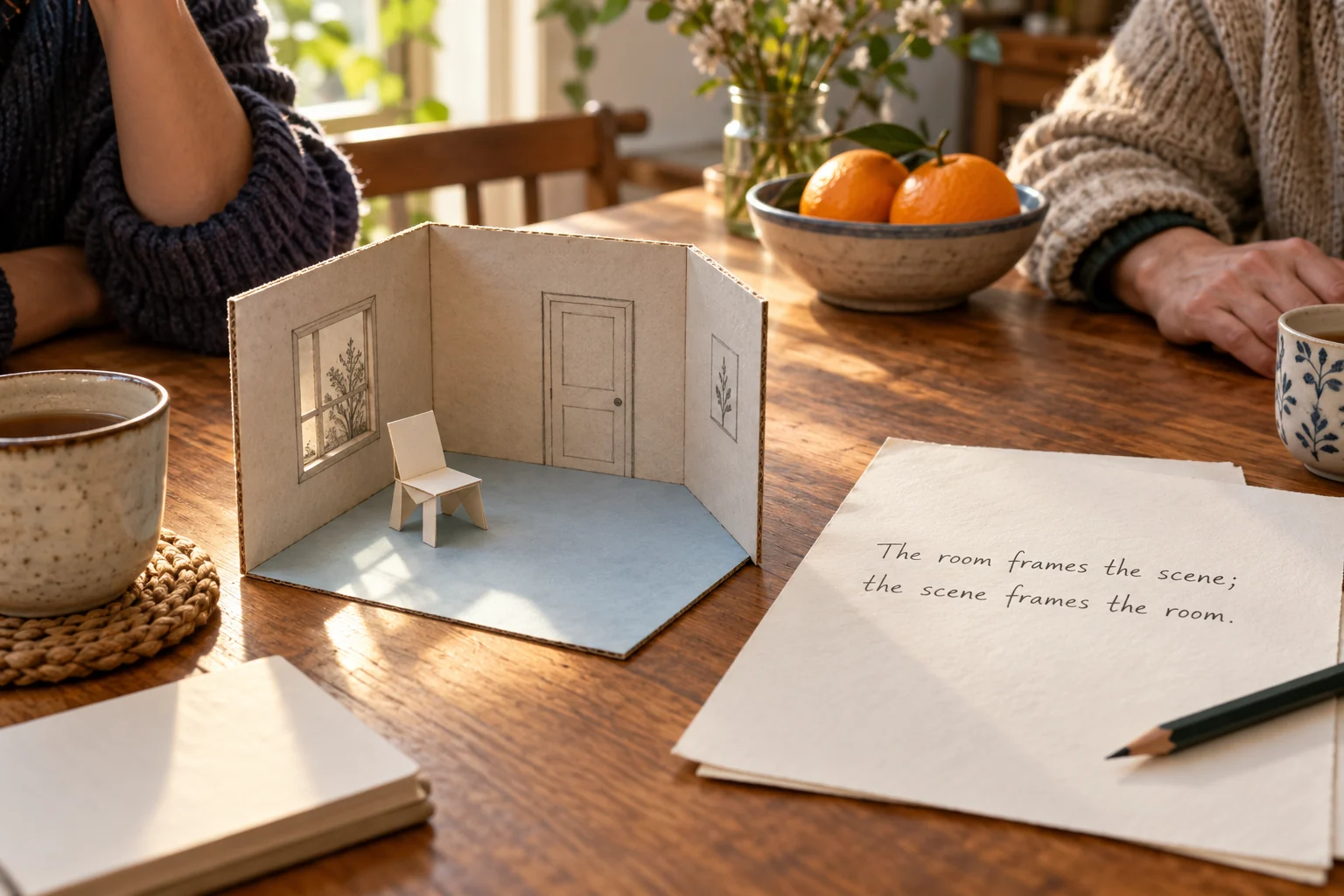
Antimetabole repeats identical words or phrases in reversed order. This original dialogue uses “The room frames the scene; the scene frames the room.” The repeated terms exchange positions.
Dena, Jori, Ada, Len and both rooms are invented. The model and the writing afternoon supply no real experience or product trial.
The room
Dena brought the little room in a shoebox, although the room itself had no roof. Three cardboard walls stood around a scrap of blue paper. A door had been drawn on the back wall with a blunt pencil. Jori lifted the box lid and asked whether the door was supposed to open.
“Only in the story,” Dena said. She put the lid beneath the box and took out a folded page. They had agreed to write a short fictional conversation that afternoon. The model had arrived afterward, an extra thing Dena wanted to bring. Nobody had agreed to build a theatre or put on a performance.
Jori cleared a place beside the bowl of oranges. He had written two names at the top of his own sheet: Ada and Len. Below them he had drawn a line, then crossed it out. Dena asked what the line had been. “A very long pause,” he said. “I decided I could leave that unwritten.”
They set the room between their sheets. Dena placed a folded paper chair near the drawn door. There was another chair in the box, but one of its legs had come loose. She put that one outside the cardboard wall. Jori asked whether a broken chair was about to become the plot. She said it could remain a broken model chair.
In the conversation they had begun imagining, Ada had come to collect a small blue dish. Len had kept it after a supper and forgotten to return it. There would be no quarrel about the dish. Dena liked beginning with an ordinary errand because she already knew what Ada could be holding when she left.
The door
Jori wanted Len to answer from another room. Dena pointed to the cardboard model and said they had only made one. He pointed to the drawn door. “That can lead somewhere,” he said. She agreed that it could. Neither of them needed to make the other room out of cardboard before a character could speak from it.
He wrote a first exchange. Ada called Len’s name. Len asked her to come through. Ada said she had come for the dish. Dena read the lines while Jori searched his page for the word he had meant to write after “through.” He found it beneath his sleeve: “kitchen.” He moved his arm and laughed.
Dena imagined Ada noticing that Len had moved his table. Jori imagined Len saying that the afternoon light had changed. They left both possibilities in their notes. The little room had no window, but the room in the conversation could have one. Dena turned the box a little and looked at its blank side wall.
“If I draw everything now, I’ll keep trying to use it,” she said. She set the pencil down without adding the window. Jori left the word in his draft. He wanted the light to belong to Len’s reply, whether or not the cardboard ever acquired a place for it to enter.
The blue dish did not exist on the table either. Dena had imagined it before she found the shoebox. She described a shallow bowl with a white mark near its rim. Jori asked whether Ada recognised the mark. Dena said yes. She had wanted that little recognition when she first thought of the errand.
The clauses
Jori looked into the model again. A room could be described before anyone entered it, he said, but he was beginning to picture this one through Ada’s errand. The drawn door now belonged to an arrival. The empty blue floor had somewhere for Len to cross with the dish. Dena listened while he tried to finish the thought.
“The room frames the scene; the scene frames the room,” she said.
He wrote the sentence on the clean part of his sheet. Then he read it back exactly as she had spoken it. Dena reached for an orange and waited. She had not meant to add the sentence to Ada’s conversation. It belonged to the two people sitting around a shoebox, considering what they were writing.
Jori drew a small rectangle around the sentence. Dena asked him to leave some paper beneath it because she wanted to try a plainer version. He slid the sheet toward her. She wrote slowly, with one hand holding the orange steady against the table, then moved the orange out of the way before finishing.
Her alternative read: “The room sets the scene around the characters, and their scene gives this room its particular story.” Jori read that aloud too. He did not erase the first or add the second to it. Dena put a small mark beside each, leaving the choice open while they returned to Ada.
Ada’s errand
They wrote Ada waiting by the doorway while Len went to find the dish. She could see a square of lighter paint where a picture had hung. Dena had no picture in the model and no wish to make one that afternoon. She wrote the square into the invented room because she wanted Ada to notice its absence.
Len returned carrying the dish in both hands. Ada touched the white mark with her thumb before taking it. He asked whether she wanted a bag. She said she had one folded in her coat pocket, then discovered she had brought a different coat. Jori stopped writing to ask whether that was enough to send her home without the dish.
Dena said she wanted her to leave with it. They gave Len a piece of wrapping paper from a drawer. Ada stood by the table while he folded it around the dish. The errand could take a little longer without becoming a second problem for them to solve. Jori wrote Len asking whether she still took the same road home.
Ada said she did. She asked about the missing picture, and Len said it was in the next room while he chose another place for it. Dena kept the answer modest. He had not sold it, lost it or discovered a secret behind it. Ada looked at the pale square again while he folded the last corner of paper.
Jori read their conversation from the beginning. His voice changed only a little between Ada and Len. Dena followed the words with her finger but did not interrupt when he reached the coat pocket. She wanted to hear whether the dish still arrived in Ada’s hands. It did. They had written the wrapping and the departure onto the same sheet.
At the table
Outside their invented conversation, the real afternoon had reached the point when Jori wanted tea. He asked Dena whether she would like some. She said yes and stayed at the table while he went to the kitchen. She moved the loose-legged chair into the shoebox lid so it would not get swept away with their notes.
When he returned, she was reading the two versions of the sentence they had set apart. The first still stood inside his rectangle. The second ran beneath it, reaching farther toward the edge of the page. She asked him which one he wanted in their account of the afternoon, rather than in Ada and Len’s dialogue.
He chose the first. Dena chose it too. She wrote “keep” beside the rectangle and left the plain alternative below it. Jori asked whether she wanted to copy the selected sentence onto a new page. She said they could keep the untidy page with both versions visible.
They returned to the little room. Jori suggested drawing a pale square on its back wall to match the place where Len’s picture had been. Dena held the pencil above the cardboard, then laid it beside the box. She wanted to leave the model as it had arrived. The square already existed in the conversation they had written.
She packed the model chairs separately so the loose leg would not rub against the floor. Jori asked whether they would write another visit to Ada’s house. Dena said she had no visit ready yet. They could begin with the page they had finished and decide another afternoon whether either character had somewhere else to go.
Jori had left a pencil inside the box, and Dena found it when she lifted the page. It was the one he had used to draw his first long pause. She handed it back. He put it in the bowl that held his other pencils, then took it out again because he wanted to write the date on their sheet.
They had not named the place where Ada and Len lived. Dena asked whether Jori wanted to put a town above their conversation. He looked at the doorway they had drawn and said he could keep it without a town for now. She agreed. Ada could take her wrapped dish down the road they had already mentioned.
Jori folded a clean piece of paper around the loose-legged chair. Dena would fix the model later if she wanted to use it again. For the journey home, the little paper packet was enough to keep the leg beside its seat. She put it into the shoebox lid, where she could find both pieces when she next opened it.
The wording
“Room” precedes “scene” in the first clause and follows it in the second. “Frames” stays between them. The plain alternative remains separate; neither version reverses the scene’s events.
Before leaving, Dena copied Ada’s last line onto the bottom of their page: “I can carry it from here.” Len had wrapped the dish, Ada had taken it, and the drawn door could remain shut on the model. Jori found his earlier crossed-out pause and decided it could stay crossed out. They had written their way past it.
Dena put the folded page on top of the shoebox. The sentence in the rectangle was still visible through the crease. Jori handed her the second orange, which she had forgotten to take. She balanced it beside the box under one arm and asked him to open the door that actually led out of his kitchen.
The fictional room accompanies a dialogue with exchanged terms.
Separate clock accounts
The Modern Style desk clock account describes a silver metallic finish and Roman-numeral face. Four original images show its front, rear and detached back cover; a rose is staging. BOND STREET LONDON appears on the face and AbadNautical in watermarks. Those labels do not authenticate a maker or establish battery contents or operation.
The Hermle table clock account, SKU 1807353045, has five original images showing mechanism details, base, dial and transparent enclosure. Its eight-day, weights, Westminster and material claims are not independently verified here. The enclosure belongs to the clock’s housing; no separate storage inventory or winding accessory is established. Neither clock supplies the fictional model.
Other writing
The reversible line poem keeps whole sentences intact while changing their line order. This dialogue exchanges terms inside adjacent clauses and keeps its events in their existing order.
The alternate middle stanza compares independently composed middles between fixed outer lines. Dena and Jori retain one short utterance beside a plain alternative; they do not replace a poem’s middle.
A separate purchase
If you plan to purchase an item on republeq.com, check the particular offer and current checkout before ordering. This guide does not establish that any cryptocurrency payment option is available. If USDT is offered for the intended order, verify the requested asset, network, amount, receiving destination and order reference with the responsible service before authorizing a transfer. Review the actual product identity, selected variant, quantity, delivery details, total charge and applicable terms. Use the confirmed order details when checking the payment instructions. Confirm any fee, conversion term or exchange rate from the current transaction information. Determine the applicable cancellation, return and refund process, including how a refund would be handled for the selected payment method. Keep the relevant instructions and transaction records, with dates and confirmed references. If essential instructions change, ask the responsible service to confirm the change against the exact order. An acknowledgement should identify the order and the agreed details; it does not replace checking whether the selected product is the one you intended to buy. If payment or order status remains uncertain, reconcile that status before considering another transfer. Do not treat an unresolved transaction as evidence that nothing happened. This article supplies no wallet address, transfer guarantee, recovery procedure or assessment of a counterparty. A product enquiry does not authorize a payment or resolve an uncertain order. If support provides an answer, retain the exact question and response so a later reviewer can understand what was confirmed. Decide whether to proceed only when the conditions of the particular transaction are clear, and retain the confirmed transaction information with the exact order.