Crypto Commerce
ANRAN four-camera solar Wi-Fi kit solar Wi-Fi vs ANNKE PoE four-camera kits for an outdoor property
Compare ANRAN four-camera solar Wi-Fi kit by mounting, network, recording, upkeep, and the cost of an installed system.
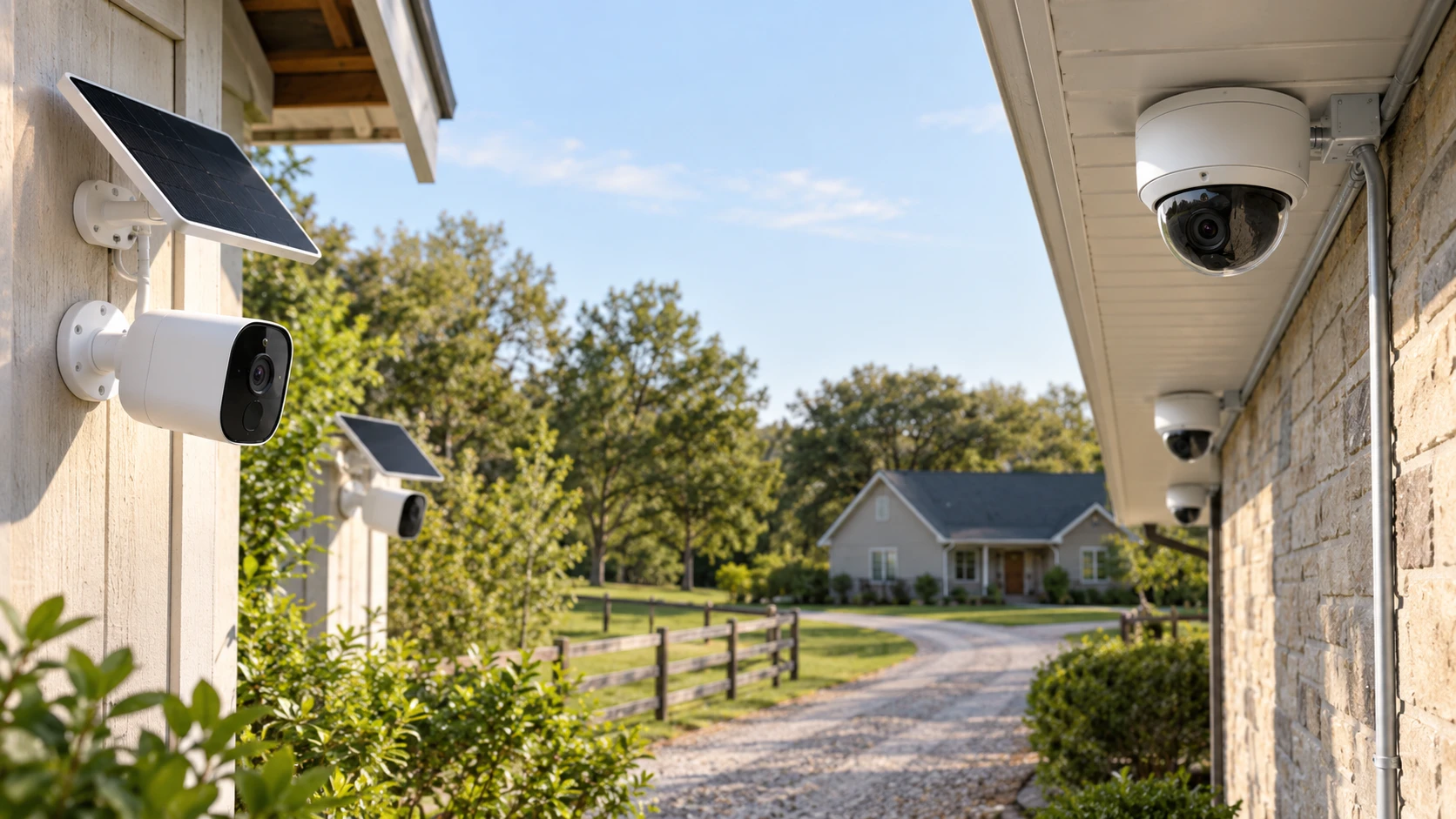
A four-camera package can look complete on a product page, yet the wiring and recording plan decide whether it will cover a property. ANRAN's listing describes four solar-assisted Wi-Fi cameras, a base station, and a memory card. ANNKE's listing describes four 4K PoE dome cameras that use Ethernet for power and data, with local card support on each camera and compatibility with an ANNKE recorder. Compare how each system reaches its mounting points, records events, and stays working through ordinary weather and maintenance.
The September 30 catalog snapshot marked both products available. It listed a minimum of $275 for ANRAN and $257.49 for ANNKE, a historical gap of $17.51. Both exact product pages and a related guide returned HTTP 200 on October 3. The link checks leave installation costs and nighttime footage quality open. Confirm the exact package and current manuals before relying on a camera count or a headline resolution.
Begin with the power and network path — ANNKE four-camera 4K PoE dome kit
The ANRAN four-camera solar Wi-Fi kit includes four cameras, each described with a 10,000 mAh battery and a 5W solar panel. The listing says the cameras use 2.4 GHz Wi-Fi and connect to an included base station or NVR. That may avoid running a power cable to every mounting point, but it still requires a workable wireless link and enough sunlight to replace the energy consumed. A shaded wall, frequent alerts, or a cold season may require more charging attention than a sunny demonstration suggests.
ANNKE's four dome cameras use Power over Ethernet. A suitable Ethernet cable carries data and power to each camera from compatible network equipment. That creates installation work along the cable route, but it avoids a battery and solar panel at each camera. Confirm what PoE switch, injector, or compatible NVR is required and whether it is included in the selected package. The pinned ANNKE description names camera compatibility with ANNKE NVRs; it does not document an included recorder, hard drive, switch, or full cabling kit.
Draw the property before buying. Mark the four views you need, the route to an indoor network point, and the places where a panel can see the sun. For ANRAN, check the wireless path from every camera to the base station. The listing gives a maximum connection distance of 300 feet in perfect conditions, not a promise through siding, brick, trees, or metal. For ANNKE, measure cable runs and plan how they will be protected and routed according to building requirements. Neither short source is an installation approval for a particular wall or conduit.
A camera can have power but still fail to send useful footage if its connection is weak. Test ANRAN signal from the planned mounting positions before drilling permanent holes. For ANNKE, check the Ethernet link and PoE budget at the switch or recorder. If the network must keep working during a power outage, the base station, router, PoE equipment, and storage may all need backup power. Solar at the camera does not keep an unpowered base station online.
Size the battery routine honestly — camera battery planning away from charging
ANRAN's claims in Republeq's catalog roughly 60 to 90 days of operation from each battery and describes fast recharging with the included panels. It does not give a complete test profile for the estimate: motion events, live-view sessions, temperature, sunlight, and recording settings all matter. A busy driveway camera may use more energy than one facing a quiet side gate. Plan access to each camera for charging and cleaning, and check the current manual for battery status alerts and safe charging steps.
The published camera battery planning away from charging guide discusses another camera, but its basic questions apply: how long must a remote camera work between visits, what will recharge it, and what happens when power is low? Use it as a checklist for the ANRAN positions, then confirm ANRAN's own instructions. ANNKE's PoE cameras do not need local battery charging, but their power path depends on the equipment supplying PoE. ANRAN needs battery and solar upkeep; ANNKE needs a dependable PoE supply.
Solar panels need placement as much as cameras do. The best camera angle might be beneath an eave while the best sun is higher and farther away. Ask about panel-cable length and permitted mounting position for the exact ANRAN kit. Avoid aiming a camera poorly merely to put the panel in sun. If a tree shades the panel in winter, estimate a charging plan for that season rather than relying on the listing's longest claimed interval.
PoE has a different upkeep pattern. Once cables are installed, check connectors and weather seals, maintain the switch or recorder, and keep firmware current. A damaged cable can take a camera offline, while a failed PoE source can affect several. Plan a way to inspect and restore each link. Neither source gives reliability statistics that would justify saying one architecture is always more dependable.
Compare what the cameras can actually record — ANNKE four-camera 4K PoE dome kit
ANRAN lists 2K or 4MP video at 25 frames per second, with pan up to 355 degrees and tilt up to 120 degrees. Its description names digital zoom, a spotlight, infrared black-and-white night viewing, and optional full-color night viewing. ANNKE lists 4K capture from a progressive-scan sensor, a fixed 4 mm lens, infrared viewing up to 100 feet, and image-processing claims. The numbers are not a same-scene quality test. Request original daytime and nighttime clips from the exact products before assigning a winner to the larger resolution label.
A moving ANRAN camera can change the direction it views, but one lens cannot watch every direction at every instant. Determine whether its automation follows motion, returns to a preset, or records only the area in frame. ANNKE's fixed domes may need more careful initial aiming, yet a fixed view can consistently cover a gate or path. Put each proposed camera on a site map and mark the field of view and blind spots. The saved sources do not provide a common measured field-of-view diagram for these kits.
Both Republeq product records make detection claims. ANRAN describes PIR detection at about five to eight meters. ANNKE describes AI classification for people and vehicles and claims 99 percent accuracy. Neither claim establishes the false-alert rate at your property or what happens with pets, foliage, shadows, or headlights. Check whether detection zones, sensitivity, and event labels can be adjusted on the exact models. Set a test period after installation and review real alerts rather than assuming a marketing percentage will transfer to every scene.
ANNKE's stated 4K resolution may make small details easier to inspect when lighting and lens placement support it. ANRAN's claimed pan and solar placement flexibility may cover a route where pulling cable is difficult. Both can still miss an event if the camera is too far from the subject or pointed against bright light. Think about the detail you need: recognizing activity, identifying a person, or reading a plate. Those are different tasks, and neither pinned listing proves success at a specific distance.
Check the recording and remote-viewing plan — ANNKE four-camera 4K PoE dome kit
ANRAN's package list names a base station or NVR and a 64 GB card. Confirm where recordings are stored, whether every camera uses the same capacity, how older events are overwritten, and what happens if the base station is offline. The title's “No Monthly Fee” wording is a claim in Republeq's catalog about the offered system, not a guarantee that every optional cloud feature or future service is free. Read the current app and storage terms before committing to a long-term security setup.
ANNKE says each dome supports local microSD storage up to 256 GB and can work with ANNKE NVRs. The pinned description does not say a card or NVR is included. Price the cards or recorder, appropriate PoE equipment, and any storage drive before comparing the kit's $257.49 saved price with ANRAN's $275. Confirm whether the desired recording schedule is motion-only or continuous and what hardware supports it. A camera's card slot alone does not establish a complete four-camera archive.
Both listings mention remote viewing or alerts through apps. ANRAN's base station and ANNKE's Vision app need network connectivity for remote access. Verify account requirements, notification settings, firmware support, and whether viewing from outside the property has a separate service cost. Keep administrator access private and follow the current manuals for security setup. A live view that works while a phone is on home Wi-Fi should also be tested from another network if remote monitoring is important.
Audio and privacy need attention. The ANNKE source focuses on video and alerts without a directly comparable two-way-audio claim for these domes. ANRAN describes two-way audio. Check the exact current specifications if speaking through a camera is part of the use case. Aim all cameras at the area you are permitted to monitor and follow local privacy rules, especially where a pan-and-tilt unit can turn beyond the original view.
Price the installed four views — ANNKE four-camera 4K PoE dome kit
The saved price gap between the camera kits is only $17.51. ANRAN lists solar panels, a base station, and local storage in its bundle. ANNKE lists higher video resolution and a PoE approach but leaves recording and power equipment to confirm. Cabling labor, solar mounting, memory, backup power, and future service can easily matter more than the historical shelf-price gap. Verify warranty and replacement-parts availability for each exact package.
Choose four mounting points, then trace power, network, storage, and maintenance for each. Confirm the selected ANRAN contents against the ANNKE four-camera 4K PoE dome kit contents on today's offers. The better system is the one whose four views can be installed, recorded, and kept online at your property with a maintenance routine you can sustain.