Weather Instruments
Choosing an analog versus digital barometer: display and setting
Choose a barometer display by where you will read it, how you will place it and what model-specific documentation you need.
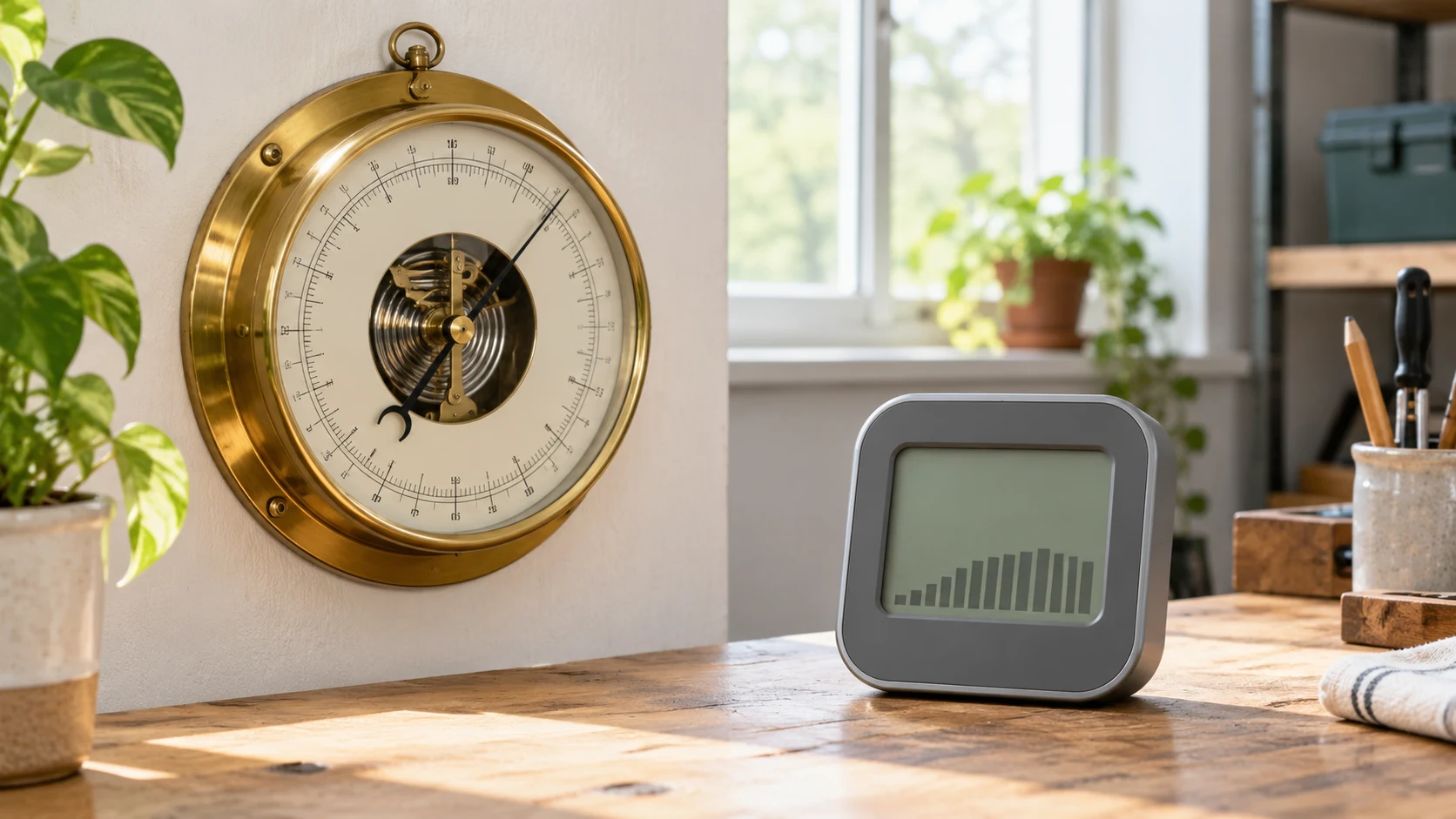
analog versus digital barometer is a useful comparison only after you decide where the instrument will live and what information you expect to read from it. A brass dial on a boat or wall and a portable digital unit for a laboratory may both be sold as barometers. Their product pages can answer different buying questions. Start with the stated application, supplied parts and display description. Leave accuracy, calibration and weather predictions open unless the specific listing supplies evidence for them.
Consider two current examples. The Weems and Plath Endurance II 135 Open Dial Barometer Brass listing calls out a weather-resistant finish, mounting methods for boat or shore, and a lifetime warranty on the finish and movement. The Traceable Barometer, Digital, Gray 6530 listing names two included batteries and a certificate, and identifies laboratory and manufacturing-plant applications. Those statements establish two different purchase contexts. They do not, by themselves, prove that one instrument produces better readings than the other.
Understand analog barometer mounting
An open dial presents a reading on a fixed face. You can see the pointer without waking a screen or finding a menu. This is useful when the intended location lets you view the face clearly. Before choosing one, think about the wall, bulkhead or other surface where you would put it, the direction from which you will read it, and whether the face will be easy to inspect in ordinary light. A product photo cannot confirm that the dial will be legible from your particular chair or position on a boat.
The Weems and Plath page specifically mentions mounting methods for boat or shore. That is a reason to inspect its current mounting instructions and the delivered hardware before drilling holes. The phrase does not identify every suitable surface, fastener or installation condition. If your surface is unusually thin, curved or exposed, check the actual mounting requirement rather than treating “boat or shore” as universal installation approval.
The same listing says its protective coating is weather resistant and describes a warranty on the finish and movement. Read those as claims about the listed item, then check the current warranty terms and care instructions. Weather resistance does not establish that a unit can be submerged, left unprotected in every climate, or cleaned with any chemical. The listing's finish claim also does not quantify reading accuracy. Keep environmental suitability, care and measurement performance as separate questions.
A dial can be attractive in a room, but appearance should not substitute for the information you need. Decide whether you want to glance at a reading occasionally, record it over time, or use it in a particular workflow. If you need a written record, plan how you would capture a dial reading. A decorative location that is difficult to reach may be less convenient for regular notes, even when the face looks good in a photograph.
Read digital barometer documentation by application
The Traceable 6530 page names a digital barometer and identifies laboratory and manufacturing-plant applications. It lists two batteries and a certificate. This gives a buyer practical questions to ask: Where will the unit sit? Will the display be visible at the intended viewing distance? What exactly does the certificate cover? What batteries are supplied, and how are they replaced? Use the manufacturer's current instructions or ask the seller when the product page omits an answer.
“Digital” tells you the reading appears electronically; it does not tell you every display mode, logging feature, alarm, communication port or power-life figure. Do not infer any of those features from a photograph or from another model in the same brand family. The page's certificate statement should be read literally as an included item. Without the certificate's actual contents, it does not establish a particular calibration procedure, interval or tolerance for your use.
A digital unit may be easier to integrate into a bench routine if the screen is positioned where you work. It may be less convenient if you expect a reading from across a room and the display is too small from that distance. These are placement questions to test against the actual dimensions and display information. If your purchase depends on logging or a specific unit of pressure, find those specifications for this exact model before buying. Do not fill gaps with features from unrelated digital barometers.
Battery inclusion reduces one immediate setup question but does not settle long-term upkeep. Confirm the required replacement type and access method when the item arrives. Keep the product's instructions with any certificate so the next person who uses it can identify the model and its documented limitations. If a workplace has its own instrument-control process, compare the supplied documentation with that process before treating the item as ready for controlled measurements.
Separate pressure display from a forecast
A barometer is chosen to show atmospheric pressure. The pressure number or dial position is a reading at the instrument. It is not a promise that a particular weather event will occur at a particular time. People may watch pressure changes as one input to weather awareness, but a product listing should not be stretched into a forecast service or a safety guarantee. If a trip or activity depends on weather, use appropriate current forecasts and warnings as well as any local observation.
Our weather station readings guide separates ranges, totals and forecasts. That broader guide helps you keep a pressure observation in context; this article deals with choosing the barometer display and documentation for one location.
For home use, decide how often you would look at a reading and whether you want to compare observations over time. Write down the time and value if that comparison matters to you. If the instrument has selectable units or an adjustable reference, consult its own manual before changing settings. This article cannot tell you which control sequence either of these exact products uses, because their storefront descriptions do not provide that sequence.
Our relative humidity and temperature guide explains why two environmental readings belong together in a room. It does not certify pressure specifications or the installation of either barometer here.
Two instruments may display different numbers if they use different settings, are placed in different conditions, or are read at different times. That possibility is a reason to check each instrument's instructions and setup; it is not evidence that either listed product is defective. Do not promise agreement between these two listings without a controlled comparison and the relevant specifications. For a task requiring documented accuracy, obtain the actual model documentation before purchase.
Compare the installation and upkeep you can verify
Make a short plan for the exact location. For a dial, note the mounting surface, available space and viewing angle. For a digital unit, note the surface or support, power access and whether the display can be read from your usual position. The brass dial's boat-or-shore language and the digital unit's laboratory-or-plant language point to different starting environments. They do not prevent another use automatically; they tell you which assumptions require confirmation.
Look at the product title and exact model identifier before reading third-party instructions. A page for a related instrument may have different controls, dimensions or accessories. If the listing is sparse, contact the seller for the manufacturer's manual or a model-specific answer. This is especially important when you need a certain mounting pattern, measurement unit, certificate detail or maintenance procedure. A vague answer is a reason to leave that requirement unresolved.
On delivery, compare the box and label with the listing. Check the dial or display for damage before installation. Confirm the included parts against the seller's current description. For the Traceable unit, the listed two batteries and certificate are concrete items to check. For the Weems and Plath instrument, inspect the finish and any mounting material actually supplied; the listing's mounting-method statement does not give permission to assume a particular screw kit.
Keep the purchase documentation and model details. If you later ask for warranty service on the dial's finish or movement, the exact terms and proof of purchase will matter more than a paraphrase of the storefront claim. For a certificate supplied with the digital unit, keep the document with the instrument identity rather than separating it into an unlabeled file. These habits make the equipment easier to maintain without pretending that a listing has answered every technical question.
If the instrument will be moved between rooms or work areas, think through who will set it down, who will read it and where its documentation will be kept. The dial example is described in terms of mounting; the digital example names a certificate and batteries. Those details suggest different setup chores. They do not tell you whether either instrument can tolerate frequent moves. Ask for the exact handling instructions before building a routine around portability.
Do one dry run with the intended location before buying. Measure the available wall or workbench space. Stand where you expect to read the display. Check whether glare, a shelf edge or another object would obscure the face. For a workplace, also check whether a person can identify the instrument and its documentation without guessing. These are observations about your setting, so the product listing cannot make them for you.
Decide what evidence is still missing
Before choosing an analog or digital barometer, write your non-negotiable requirements. They might include a specific place to mount the instrument, a readable display at a measured distance, documented measurement specifications, a certain pressure unit, or a certificate with particular contents. Mark each requirement as supported by the exact listing, supported by current model documentation, or still unknown. This prevents attractive product language from becoming an invented specification.
The analog example supports an open-dial, brass-finish presentation, boat-or-shore mounting context and the stated finish-and-movement warranty. The digital example supports an electronic display category, two included batteries, a certificate and the named work environments. Neither page in this comparison supplies enough evidence to rank their accuracy or to prescribe a calibration schedule. If those questions control your purchase, pause that decision until you have model-specific documentation.
A household buyer may put visual placement first. A workplace buyer may put documentation and procedure first. Either buyer can still ask the same disciplined questions: Can I read it where it will sit? Can I install or place it as intended? Do I understand what comes in the box? Are the measurement claims I need actually documented? The right answer depends on the job, not on whether the face has a pointer or digits.
Record the first reading in context
After setting up the instrument, record a first observation with the date, time and location. Keep the notation simple enough that you will use it again. If the display shows several quantities, label the pressure reading clearly so it is not confused with temperature, humidity or a forecast graphic. If you use the dial, note what the pointer shows in the unit printed on its face. If you use a digital display, write down the unit that appears on that unit's screen. Do not convert between units by eye or assume that two differently labeled scales should show the same digits.
Make another observation at a time that matters to your own routine. Comparing two notes can tell you whether the displayed value changed; it cannot, on its own, establish why it changed or whether either unit meets a particular accuracy specification. A laboratory process may require a formal log and a documented instrument status. A casual home log can be much simpler. In either case, keep the record tied to the exact instrument and its setup rather than copying a reading into a generic weather note with no context.
If a number seems unexpected, check the model instructions, the chosen display unit and the position of the instrument before drawing a conclusion. Do not turn the product photo into a reference reading. The image may illustrate the face, but it was not taken at your location at the time you are observing. A careful first note gives you a starting point for ordinary use without claiming a measurement quality that the listing has not documented.
Choose an analog versus digital barometer by matching the listed instrument to that job. The dial listing gives useful placement and finish information; the digital listing gives different clues about power and documentation. Verify the missing specifications for the exact model before relying on it. That small step is more valuable than treating either display style as a shortcut to a performance claim.