Office Supplies & Stationery
Alternating series sum mismatch: name the limit
A fully specified alternating sequence separates ordinary partial sums, means of those partial sums and means of the terms, preserving each exact limit claim.
State the terms and the meaning of sum
An alternating series sum mismatch can come from attaching one number to two different limit questions. This paper exercise specifies every term: the first is one, the second minus one, and the signs continue alternating for every positive integer position. Let a_k be one for odd k and minus one for even k. Let S_n be the sum of the first n terms, and set S_0 = 0 for the empty prefix. The ordinary infinite sum means the limit of S_n, if that limit exists. These are exact mathematical inputs, not observations about a physical device.
We will show that the ordinary sum does not exist, while the arithmetic means of the partial sums tend to one half. Both conclusions concern the same fully specified terms. The operation applied to them changes. A third operation, averaging the terms themselves, tends to zero. Keeping these three quantities labelled prevents a valid answer to one question from becoming an unsupported answer to another. No missing pattern, unknown future term or rounding tolerance is involved in the example. The complete alternating rule remains fixed throughout the calculation.
Calculate every finite partial sum by parity
For an even prefix of length 2m, group the finite list into m adjacent pairs, each containing one followed by minus one. Every pair sums to zero, so S_(2m) = 0. This uses ordinary finite addition. For an odd prefix of length 2m+1, the first 2m terms sum to zero and the last term is one. Therefore S_(2m+1) = 1. The odd formula includes m = 0, giving S_1 = 1. These two cases cover every positive prefix length without assuming an infinite value that has not been established.
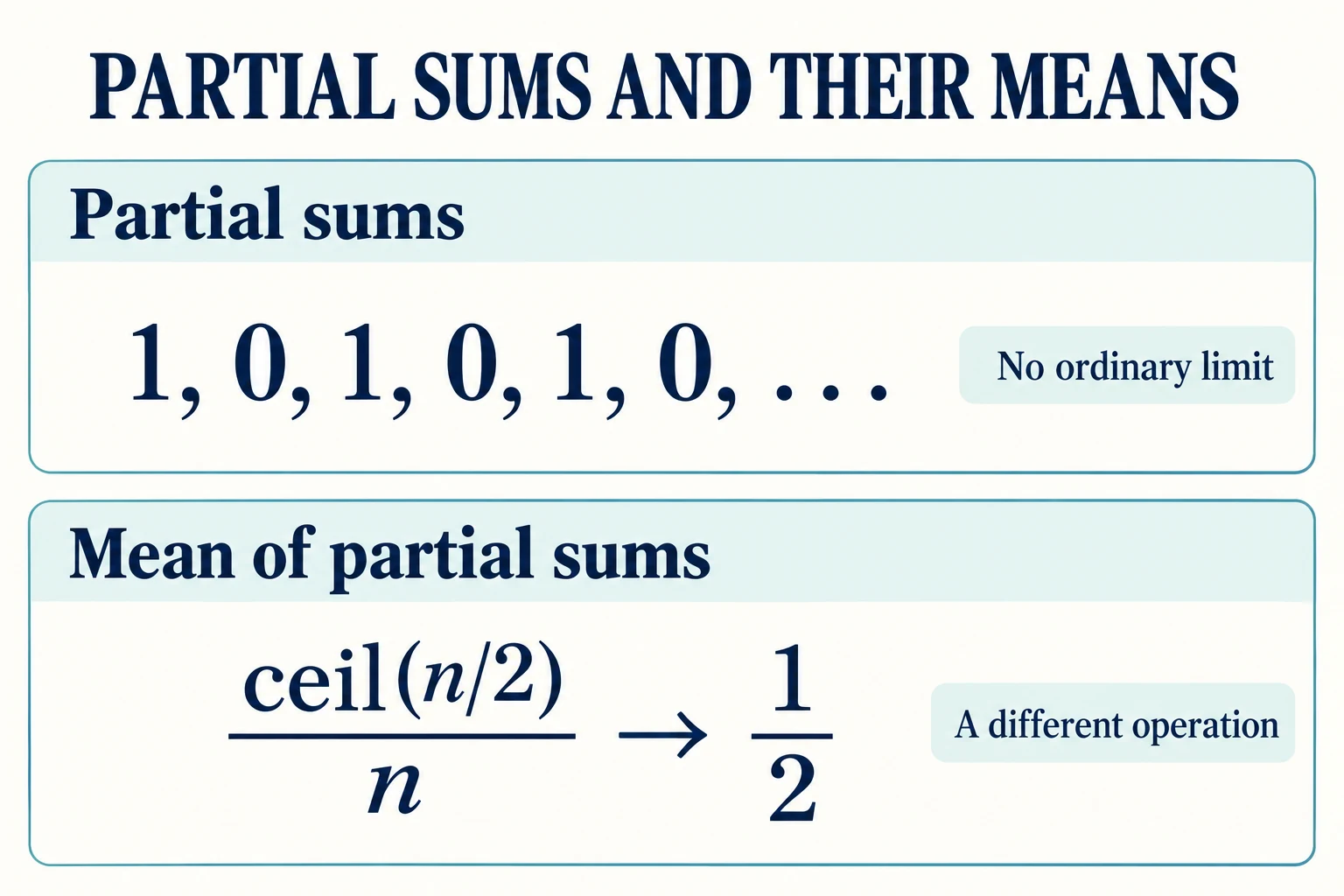
The first eight partial sums are consequently 1, 0, 1, 0, 1, 0, 1, 0. A later even prefix still has value zero, however large its length becomes. A later odd prefix still has value one. Increasing the number of terms does not make the two kinds of prefix totals move closer together. Their difference stays one. Preserve the prefix length beside each value when auditing a calculation; choosing only even lengths would conceal the odd subsequence, while choosing only odd lengths would conceal the even one.
Show why the ordinary limit fails
A real limit L would require all sufficiently late partial sums to be arbitrarily close to L. In particular, they would eventually all have to lie within one quarter of L. Choose an even index and an odd index beyond that proposed point. Their partial sums are zero and one. If both were within one quarter of L, their distance from one another would be less than one half, by adding their two distances to L. Their actual distance is one. This contradiction rules out every possible real L.
Thus there is no ordinary sum under the definition given at the start. Reporting zero from the even partial sums alone would omit infinitely many later values equal to one. Reporting one from the odd partial sums alone would omit infinitely many later zeros. Reporting one half does not help: every partial sum remains exactly one half away from it. None of these checks changes the terms. They examine whether the sequence of complete finite prefixes settles in the particular sense required for an ordinary infinite sum.
Audit the tempting algebra as a conditional statement
The finite partial sums satisfy S_n = 1 − S_(n−1) for n at least one. At n = 1 this uses S_0 = 0. At later indices, the parity formulas check it directly: a one follows a zero, and a zero follows a one. If an ordinary limit L existed, both S_n and its one-index-shifted sequence would have that same limit. The finite identity would then force L = 1 − L, whose solution is one half. That calculation identifies a necessary value under an unproved existence assumption.
It does not establish that the limit exists. The earlier even-and-odd argument has already disproved existence. Replacing every S_n and S_(n−1) with one unexplained symbol S skips precisely that issue. There is no need to call the finite identity false or to change a sign in it. The repair is to retain its finite indices and keep the proposed limiting step conditional. Solving an equation that a limit would satisfy cannot manufacture a limit that the actual partial sums fail to approach.
Define a different operation using the partial sums
Now ask for M_n = (S_1 + S_2 + ... + S_n)/n, the arithmetic mean of the first n partial sums. This list contains partial totals, rather than the original alternating terms. Among S_1 through S_n, the entries at odd positions are one and the entries at even positions are zero. There are ceil(n/2) ones, where ceil means the smallest integer at least n/2. Therefore M_n = ceil(n/2)/n. The denominator is the number of partial sums being averaged. S_0 is not an extra observation in this definition.
For n = 2m, exactly m entries are one, so M_(2m) = m/(2m) = 1/2. For n = 2m+1, there are m+1 ones, giving M_(2m+1) = (m+1)/(2m+1). Rewrite the odd expression as 1/2 + 1/[2(2m+1)]. In terms of n, its excess above one half is 1/(2n). The first six mean values are 1, 1/2, 2/3, 1/2, 3/5 and 1/2. Those fractions come from a new averaging operation on the complete partial-sum list.
Prove that the means tend to one half
For every positive n, the distance between M_n and one half is at most 1/(2n). Even n gives distance zero; odd n gives exactly that bound. Given any positive error allowance ε, choose an integer N larger than 1/(2ε). For n at least N, the distance is less than ε. This proves that M_n tends to one half. It is a bound covering every sufficiently late index, rather than a guess from several displayed fractions. The raw partial sums still alternate between zero and one throughout this proof.
One half is therefore a valid limit of the means under the stated definition. It is not an ordinary sum of the original series. Record the expression whose limit was taken: M_n rather than S_n. This permits the correct result to be retained without silently changing the original meaning of sum. The example does not claim that every alternative summation convention is invalid or that every sequence can be assigned a value by averaging. It proves one explicit averaging result for this one fully specified sequence.
Check the average of terms as a third quantity
Averaging the first n terms themselves gives T_n = (a_1 + ... + a_n)/n = S_n/n. Since S_n is either zero or one, zero is at most T_n and T_n is at most 1/n. For any positive error allowance, choosing n sufficiently large makes that upper bound smaller than the allowance. Hence T_n tends to zero. This conclusion uses the original terms as the observations being averaged. It does not use the partial totals that formed M_n's observations, and it does not give an ordinary series sum.
Check the three quantities at n = 3 before taking any limit. The partial sum is S_3 = 1. The average of the three terms is T_3 = 1/3. The average of the three partial sums 1, 0, 1 is M_3 = 2/3. Each calculation is correct for its own requested output. Writing only average or sum beside an unlabelled number would lose the difference. Keep the input list and denominator beside the output, especially when comparing worksheets that may have applied different definitions.
Repair the claim while preserving the original terms
A complete correction can retain all three results in separate lines of prose: the ordinary partial-sum limit does not exist; the mean of partial sums tends to one half; the mean of terms tends to zero. No outcome was repaired by moving a term, changing the generating rule or discarding odd prefixes. If the intended question asks for the mean-of-partials limit, name it explicitly. If it asks for the ordinary sum, retain the nonexistence result. This keeps a useful averaging calculation from becoming evidence for a different claim it did not prove.
Keep the supporting references separate
The account for the QuietSharp Glow sharpener shows a complete compact selector, receptacle and outer body with a BOSTITCH label. Catalog NOBRAND is retained without a maker relationship or model authentication. No cutter-life, noise, safety, antimicrobial, size or sharpening result is verified. No independent supplied stock is pictured.
The account for the SuperPro Glow sharpener shows a complete larger six-opening unit and BOSTITCH label. Catalog NOBRAND remains separate from the pictured word. No maker equivalence, thermal, stall-free, noise, safety, cutter-life or sharpening performance is adopted. Integral receptacle and feet belong to the whole unit, without extra supplied tools.
The guide on a missing next-term rule uses different explicit continuations to show that a finite prefix alone does not select a generating rule. Here every term is already specified. The question is which operation and limit are requested, not which continuation the reader should infer from a few entries.
The guide on the smallest positive fraction question checks membership when constructing a smaller rational candidate. This worksheet instead tests convergence of a specified sequence and of its averages. A least-member question, a bound on averaging error and an ordinary series sum are different outputs with different definitions.
Keep any actual order separate
A reader considering a sharpener order through republeq.com needs current transaction information separate from the series worksheet. The alternating terms, partial totals and fractions above are exact mathematical inputs, not prices, package quantities, fees or cryptocurrency amounts. Before considering USDT, verify whether the particular checkout offers that method for the intended item and order. A reference here establishes no availability. Read the actual instructions for the requested asset, network, payable amount, receiving destination and order reference from the responsible checkout or service. Clarify missing or conflicting details before authorizing a transfer. Keep the selected offer and quantity attached to those instructions rather than carrying an answer about another order across without checking. Review delivery information, total charges and any disclosed payment or conversion conditions using the current transaction. A familiar token name alone cannot supply those details. Check applicable cancellation, return and refund terms before relying on them, including how any refund would be handled for the chosen method. This article supplies no wallet address, exchange rate, transfer timing or assurance that a payment can be recovered. Retain the actual acknowledgment and payment record for an action completed, keeping pending steps distinct from confirmed results. If order or payment status remains uncertain, resolve that status before considering another payment. An unchanged page is not proof that a previous transfer failed. The mathematical distinction between two limits cannot authenticate a recipient or establish that a checkout accepted an order. You can finish the worksheet without buying a sharpener, and a completed purchase cannot supply a missing convergence proof. Keep transaction communications and receipts separate from the stipulated terms and their calculated averages.
Save the quantity whose limit was checked
Retain the full alternating rule, the parity formulas for S_n, and the bound for M_n together. Keep the conditional equation L = 1 − L labelled conditional, with the ordinary-limit failure beside it. For the third quantity, retain T_n = S_n/n and its bound by 1/n. These records explain why no ordinary sum, one half and zero can all be correct statements about different operations on the same terms, without turning one answer into an unproved substitute for another.