Crypto Commerce
Aicok FOHERE 5.5-quart stand mixer vs AREALER stand mixers for batch baking
Compare Aicok FOHERE 5.5-quart stand mixer by bowl claims, dough tools, speed controls, stability, cleaning, and brand and exact model.
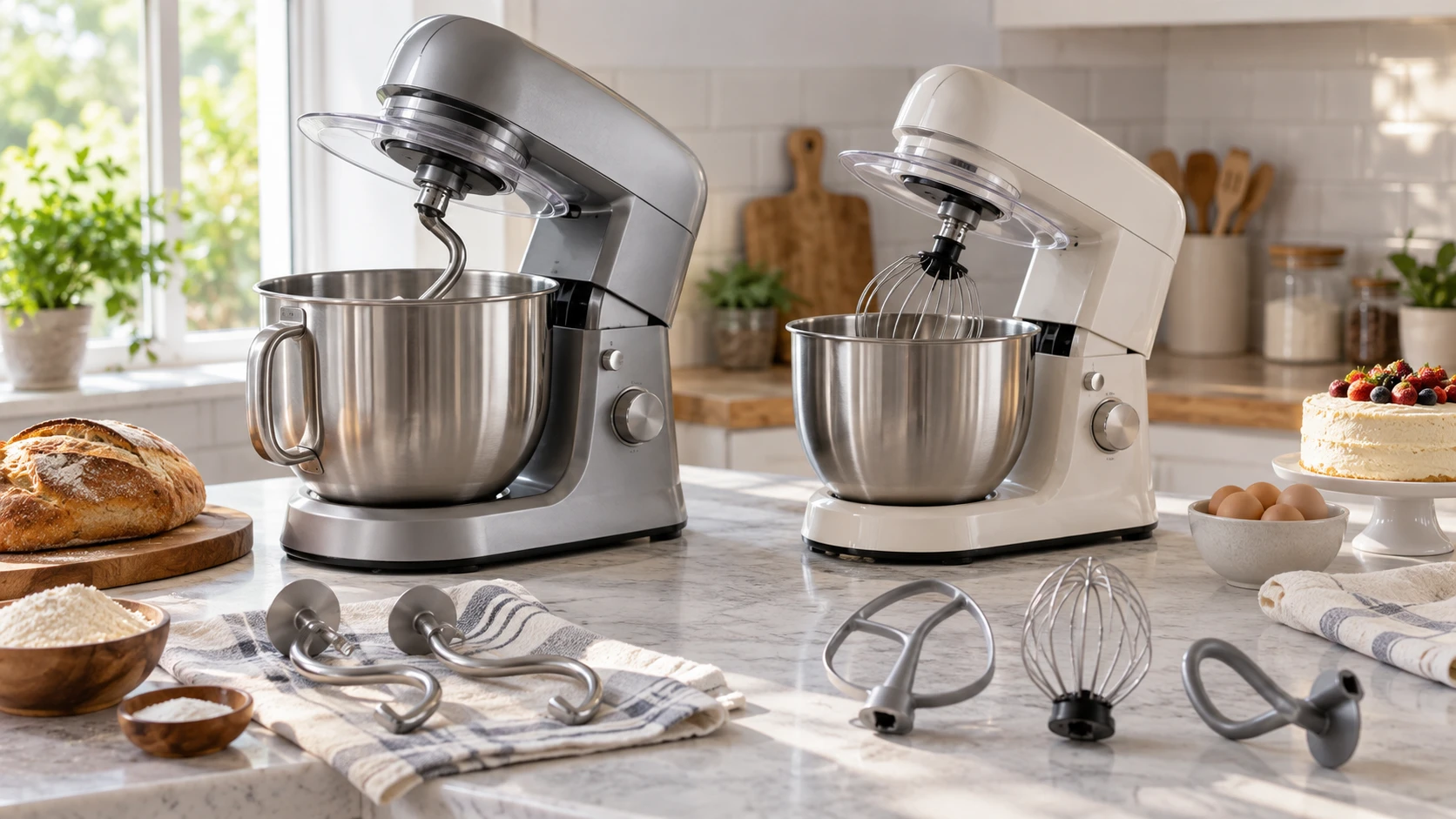
The Aicok FOHERE 5.5-quart stand mixer is listed with a handled stainless-steel bowl, six speeds, a 500 W motor, and a double dough hook. AREALER lists a smaller bowl, eight speeds, a 380 W motor, and three familiar tools for dough, batter, and whipping. Both use tilt-head access and a splash guard. If you bake bread and the occasional small cake, the bowl's usable range and the tools' reach deserve more attention than a speed count. Cleaning the bowl and attachments after a dense dough also belongs in the decision.
The published guide on stand mixer bowl capacity explains why a bowl's nominal volume should be tied to the actual amount you mix. It does not test these models. A large bowl can help with a double recipe but may leave a small quantity below the beater's reach. Write down the smallest and largest batches you make in a month, then compare the tools and bowl geometry for each. Ask whether a single egg white reaches the whisk and whether a double bread recipe leaves room for the dough to move.
Reconcile the bowl measurements — stand mixer bowl capacity
The Aicok or FOHERE source states a 5.5QT stainless-steel bowl with a handle. Its product title and source use different brand names: the catalog item identifies Aicok, while the linked product and description name FOHERE. Confirm the model and branded package before purchase. The stated capacity is larger than the AREALER's title figure, but usable capacity depends on clearance for rising dough, a splash guard, and the shape of the beater. Ask for a recommended minimum and maximum batch weight for the exact motor and bowl.
AREALER's description calls its bowl both 4.5 liters and 4 quarts. Those are not exact equivalents, so verify the capacity stamped on the supplied bowl or given in a model-specific manual. The source says the bowl is food-grade 304 stainless steel and suitable for a four- or five-person household, but household size is not a measured recipe capacity. Compare the volume of a recipe you actually make, including room for ingredients to move without climbing over the rim.
A bowl handle can make carrying a heavy batter easier, especially when scraping it into pans. The Aicok listing explicitly mentions a handled bowl. The AREALER source describes a slotted bowl design but does not identify a carrying handle. Check how each bowl releases, how it balances when lifted, and whether it can sit steady on a counter. The difference matters for a baker who transfers multiple batches, but the saved excerpts do not provide a handling test.
Small batches deserve equal attention. A single egg white or a small frosting batch may not reach the whisk in a deep bowl, while a dense loaf can strain a mixer that is full to the top. Neither listing gives minimum whisk volume or maximum dough weight. Ask for the maker's recipe limits and observe a test with the amount you usually prepare. You may find that the stated capacity advantage matters for holiday baking but not for an ordinary weeknight cake.
Compare the tools and mixing motion — AREALER 4-quart stand mixer
Aicok describes a three-in-one design with a double dough hook, beater, and whip. Its source says the dough hook kneads with planetary mixing motion. AREALER lists a dough hook, flat beater, and whisk for dough, thick batters, meringues, and cake cream. The tools sound similar at a high level but may differ in shape, reach, and how they attach. Confirm what comes in the exact box and whether the tools are safe for the recipe texture you intend to use.
The double-hook claim may be relevant to a baker who makes bread often, but it does not establish a maximum flour weight or kneading time. A strong-looking hook cannot compensate for an unverified motor limit. Make a small dough in a supervised trial and check whether the mixer walks across the counter, whether flour stays unmixed at the edge, and whether the head remains locked. Neither saved source supplies a controlled kneading test or a guarantee that either machine handles stiff dough continuously.
For cakes, the flat beater's job is different from the whip's. The beater should pull ingredients from enough of the bowl to combine them without constant scraping; the whip needs to reach a small amount of liquid and incorporate air. These are use checks rather than specific performance claims for either product. Try the actual tool with a familiar recipe and note how often you must stop and scrape. A tool count of three cannot tell you how well each tool meets the bowl.
Attachment compatibility is another question. The saved Aicok and AREALER excerpts do not state whether additional tools, spare bowls, or replacement beaters are sold separately. Do not assume attachments from a similarly sized mixer will fit. Identify the model on the delivered unit, check the shaft and bowl locking design, and price replacements before deciding that a starter package will serve for years. The Aicok naming difference makes the exact model especially important for finding parts.
Ingredient staging can reveal whether the guard and bowl openings suit your recipes. Measure flour, liquid, and mix-ins before starting, then add them in the order your recipe calls for while the mixer is stopped or on the maker's recommended low setting. Check whether the guard allows additions without spilling and whether the head can be raised without hitting a cabinet. Neither saved listing provides an opening dimension for its cover. A pause function on AREALER may be convenient here, but the exact control behavior should be verified in the manual or a demonstration.
Test speed, stability, and noise — AREALER 4-quart stand mixer
Aicok lists a 500 W motor with six-speed control. AREALER lists a 380 W copper motor with eight speeds and a pause function. Wattage describes an electrical rating, not a direct measure of torque at the beater, dough capacity, or energy cost for a recipe. More speed positions may give finer choices, but only if the steps suit the work. Try a low speed for adding flour, a middle speed for batter, and a higher speed for whipping. Check whether the transition is smooth and ingredients stay in the bowl.
AREALER's source describes four anti-slip suction feet, a tilt head, and a splash guard. Aicok names non-slip silicone feet, a tilting head, and a splash-proof cover. Both have parts intended to steady the mixer and contain splatter, but the short descriptions do not quantify movement under a heavy dough load. Place each machine on the same kind of counter you own and see whether it stays put. Check the head latch before running and leave room above the mixer to raise it fully.
AREALER gives a noise figure at or below 76 dB. Aicok's short excerpt gives no comparable measurement. That does not prove one sounds quieter. Listen during a typical mixing job, noting pitch as well as loudness. A mixer may sound different when whipping a small bowl of cream than when kneading dough. If the kitchen is shared with conversation or a nearby workspace, a short supervised test at the intended load is more useful than comparing one published number with an empty field.
The saved sources do not give comparable exterior dimensions or weights. Measure the counter space and the height beneath cabinets with the head raised. Decide whether the mixer will stay out or be lifted from a cupboard each time. A larger handled bowl may need more storage space, and a splash guard and extra tools need a drawer or shelf. A mixer that is difficult to retrieve can be used less often regardless of its motor rating.
Clean the parts you actually use — AREALER 4-quart stand mixer
AREALER says its attachments are dishwasher safe, while the main body should be wiped with a soft cloth rather than washed in water. Aicok's excerpt does not provide a cleaning method for its tools or bowl. Check current manuals for coating and dishwasher instructions, especially for a dough hook or beater with a finish that may be damaged by harsh detergent. Scrape and wash promptly after sticky dough. A splash guard can reduce mess during mixing while adding another part to clean.
Safety and maintenance should be part of the first trial. Unplug the mixer before removing a beater or reaching into the bowl, and follow the maker's limits for running time and cooling between dense batches. Inspect where flour dust gathers around the controls and how easily the splash guard can be removed. The saved descriptions do not state duty cycle, overload response, or service procedure for either motor. Those omissions matter for someone who plans repeated bread batches more than a published wattage difference does.
The AREALER 4-quart stand mixer gives a more detailed tool-care claim and a pause function, with a bowl-volume inconsistency to clarify. The Aicok or FOHERE offer gives a larger stated bowl, handled design, and double dough hook, with its brand identity to confirm. Try the smallest and heaviest recipes you actually make. Check the branded box and manual for the supplied tools, bowl capacity, and cleaning limits before trusting either listing's shorthand.