Office Supplies & Stationery
Accessory assignment bottleneck: check shared port choices
A fully specified paper compatibility model separates individual choices from simultaneous assignment, using a shared-choice obstruction and a verified repair witness.
Individual choices can hide a shared shortage
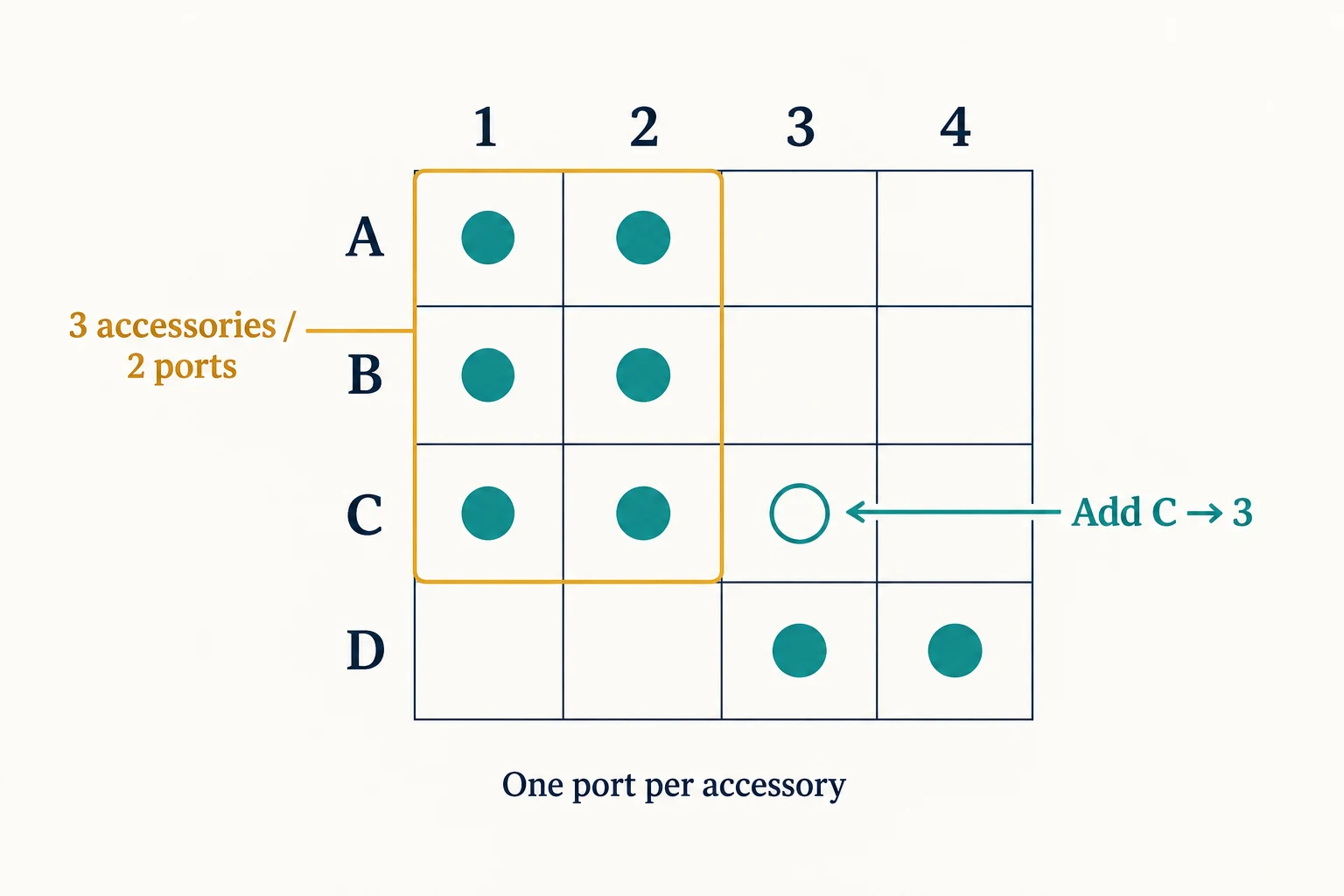
An accessory assignment bottleneck can remain hidden even when every accessory has two allowed ports and every port has at least one possible user. Consider a fictional paper compatibility sheet with four accessories, labelled A, B, C and D, and four ports, labelled 1, 2, 3 and 4. Each accessory needs exactly one port, and each port can hold at most one accessory at the same time. The question is whether all four can be assigned together. These are stipulated worksheet rules, not findings about real connectors, equipment, or a desk pad.
Write the permitted connections before making any choices. A may use port 1 or port 2. B may also use 1 or 2, and C has those same two options. D may use port 3 or port 4. No other connection is allowed in the original version. All four accessories must be accommodated in one simultaneous assignment. Moving an accessory later, sharing a port, or leaving one accessory disconnected would change that requirement. Keeping those conditions explicit makes it possible to prove a failure without speculating about a device or its intended use.
Check what the simple counts actually establish
Every accessory has two choices on this sheet. Every port appears somewhere: ports 1 and 2 appear for A, B and C, while ports 3 and 4 appear for D. There are four accessories and four ports, so the overall counts also match. These observations eliminate some obvious problems, such as an accessory with no allowed connection or too few ports in total. They do not establish a complete assignment. A choice listed for one accessory remains available to that accessory only if the simultaneous choices of the others leave its port free.
The two options for A, B and C overlap completely. Listing two choices three times does not create six distinct ports. Their combined set of allowed destinations is still just 1 and 2. D's separate access to 3 and 4 does not enlarge that set. This is why checking every row of a compatibility sheet on its own can miss the relevant obstruction. The problem belongs to a group of accessories competing for the same limited set, even though no single row looks empty and the entire sheet has an equal number of objects on both sides.
Use three accessories as a failure certificate
Focus on A, B and C and temporarily set D aside. A simultaneous assignment would have to give these three accessories three different ports, because the capacity rule permits only one accessory in each port. Yet all three must choose from the two-element set containing 1 and 2. At most two of them can occupy distinct permitted ports. Therefore no assignment of the full four-accessory set can satisfy the original rules. This short group argument rules out every possible ordering of choices, rather than diagnosing only one failed attempt.
Put A in port 1 and B in port 2 to inspect one failed attempt. C then has neither of its allowed ports available. Swapping A and B leaves the same problem. Starting with C instead merely changes which of A or B is left out. Meanwhile D can use 3 or 4, leaving the other port empty. That empty port does not rescue the omitted accessory: the sheet allows none of A, B and C to use it. A physically unoccupied position and an allowed available position are different things within this model.
Save the certificate as three pieces of information: the accessory group A, B, C; its complete allowed-port set 1, 2; and the comparison three required distinct positions versus two available positions. Another reader can check the certificate directly against the sheet. It does not require a record of which accessory was tried first. If someone challenges the conclusion, the relevant question is whether an allowed connection or a capacity condition was recorded incorrectly. Changing the order of the same choices cannot overturn a certificate that depends only on the stated sets.
Look between a single row and the entire set
In this example every one-accessory group has two possible ports, which is enough for that group considered alone. Every two-accessory group also has at least two ports in its combined allowed set. The group A and B, for example, has exactly 1 and 2. A group containing D and one of the others has all four ports in its union. The complete four-accessory group likewise has all four ports. Thus single rows, pairs, and the total group all pass this necessary count check. The intermediate three-member group A, B, C is where it fails.
The general necessary check follows from the same capacity rule. Take any group of accessories in a proposed complete assignment. Their assigned ports must be different, and every assigned port must belong to at least one of that group's allowed lists. The union of those lists must therefore contain at least as many ports as there are accessories in the group. Finding a group that violates this condition proves impossibility. This article uses that necessary condition and an explicit repair witness; it does not claim a general theorem that passing every group check is sufficient.
Add one allowed connection and verify a complete result
Change exactly one item on the sheet: let C use port 3 as an additional option. C's new list is 1, 2, 3. The other three lists stay as they were. Now assign A to 1, B to 2, C to 3 and D to 4. Each chosen connection appears on its accessory's current list. The four chosen ports are distinct, so none exceeds its capacity of one. Every accessory has exactly one destination. These direct checks establish a valid complete assignment under the revised sheet, rather than merely showing that the earlier obstruction has disappeared.
Adding C's third option does not require using every permitted connection. The repaired sheet still permits C to choose 1 or 2, but the witness uses 3 because that leaves 1 and 2 available for A and B. A compatibility list describes possibilities; a completed assignment selects one possibility per accessory while respecting shared capacity. Keep both records. The revised allowed lists say what choices were permitted, and the assignment A1, B2, C3, D4 says which choices were used to demonstrate feasibility. A list of possibilities alone would leave the demonstration unfinished.
One added allowed connection is enough for this particular repair, and zero added connections cannot be enough because the original sheet is impossible. That establishes a minimum of one added connection when the other rules are held fixed and additions are the permitted kind of change. It does not establish that C-to-3 is the only possible repair. Nor does it identify a real adapter that could create such a connection. The edge is a newly stipulated permission in a paper model. Any real hardware change would need its own verified physical and operational evidence.
Check whether a proposed change reaches the failing group
Suppose someone instead gives D permission to use all four ports while leaving A, B and C unchanged. D would gain two choices, and the sheet would contain more permitted connections overall. The original failure certificate would still apply: A, B and C would still have only ports 1 and 2 between them. Therefore this change cannot produce a complete assignment. Counting added options across the whole sheet can conceal whether any option reaches the accessories that need relief. Inspect the affected group before treating a longer compatibility list as a resolved problem.
Other alterations would define other questions. Allowing two accessories to share a port changes the capacity rule. Accepting an assignment of only three accessories changes the required coverage. Connecting accessories at different times changes simultaneity and requires a scheduling model. None of those changes is part of the original or the one-edge repair above. Record an agreed change before applying it, then check its resulting assignment under the resulting rules. This prevents an apparently successful demonstration from quietly answering a more permissive question than the one that failed.
Keep the supporting references separate
The account for the LOFTMAT Full Desk Slim desk pad has a sole photograph showing a complete dark padded surface with a keyboard and mouse. Those peripherals are unconfirmed supplied scene objects. Exact dimensions, material, comfort, ergonomics and surface performance are not authenticated here. The pad is optional worksheet context.
The account for the Eco-Clear desk pad shows a complete frosted rectangular pad with rounded corners. The pictured pen, note and photograph do not establish supplied contents. No antimicrobial, recyclable, non-glare, protection or cleaning claim is adopted. The pad does not establish any allowed connection in the fictional model.
The guide on assigning holiday tasks to named helpers counts ownership arrangements under unrestricted eligibility and a requirement that every helper receive a task. This worksheet instead asks whether restricted choices can satisfy unit capacity. Its answer needs an obstruction or a complete witness, rather than a count of covered ownership arrangements.
The guide on a missing next-term rule diagnoses a prefix that leaves its generating rule unstated. Here every permission and capacity condition is already given. The difficulty comes from satisfying those conditions together, so the repair changes a specified connection instead of supplying an absent sequence instruction.
Keep a purchase separate from the paper connection
A reader considering an actual desk pad order on republeq.com should check the particular offer and checkout independently of this worksheet. The letters and ports above are invented labels; an allowed connection in that model says nothing about a seller, a payment destination, or a transaction being accepted. If USDT is being considered, verify whether the current checkout actually offers that cryptocurrency method for the intended order. Do not infer availability from the mention here. Ask for clarification of the requested asset, network, amount, receiving destination and order reference before authorizing a transfer. A familiar token name alone does not settle those details. Review the item identity, quantity, delivery information and total charge using the actual order, and retain the terms that apply to that transaction. Any disclosed fees or conversion terms need their own current evidence. This article supplies no exchange rate, wallet address, transfer guarantee or recovery procedure. Determine the applicable cancellation, return and refund process before relying on one, including how any refund would be handled for the chosen method. If the payment or order status is uncertain, resolve that status with the responsible service before considering another payment. An extra option appearing on a screen does not by itself establish that a previous action failed or that a second transfer is needed. The paper repair adds a defined edge and checks a complete assignment; a purchase involves an actual counterparty and conditions that the graph cannot verify. Completing the mathematical exercise requires no order and no payment. Choose whether to proceed only when the relevant terms and instructions for that particular transaction are clear, and keep the resulting records separate from the fictional compatibility sheet.
Retain the certificate and the repaired witness
For the original sheet, save the A, B, C group and its two-port union as the reason a full assignment is impossible. For the revised sheet, save the single added C-to-3 permission and the complete A1, B2, C3, D4 witness. Check allowed edges, distinct ports and full coverage in that order. The two records show both why the first version fails and why the stated repair succeeds, without attributing the result to a choice order, an empty port, a product property or an unstated relaxation of capacity.