Crypto Commerce
Yeego YEG-BS24 beverage cooler vs EUHOMY RU-05: measure before loading 180 cans
Compare Yeego YEG-BS24 beverage cooler by cabinet height, door depth, temperature range, shelf access, front ventilation, and support.
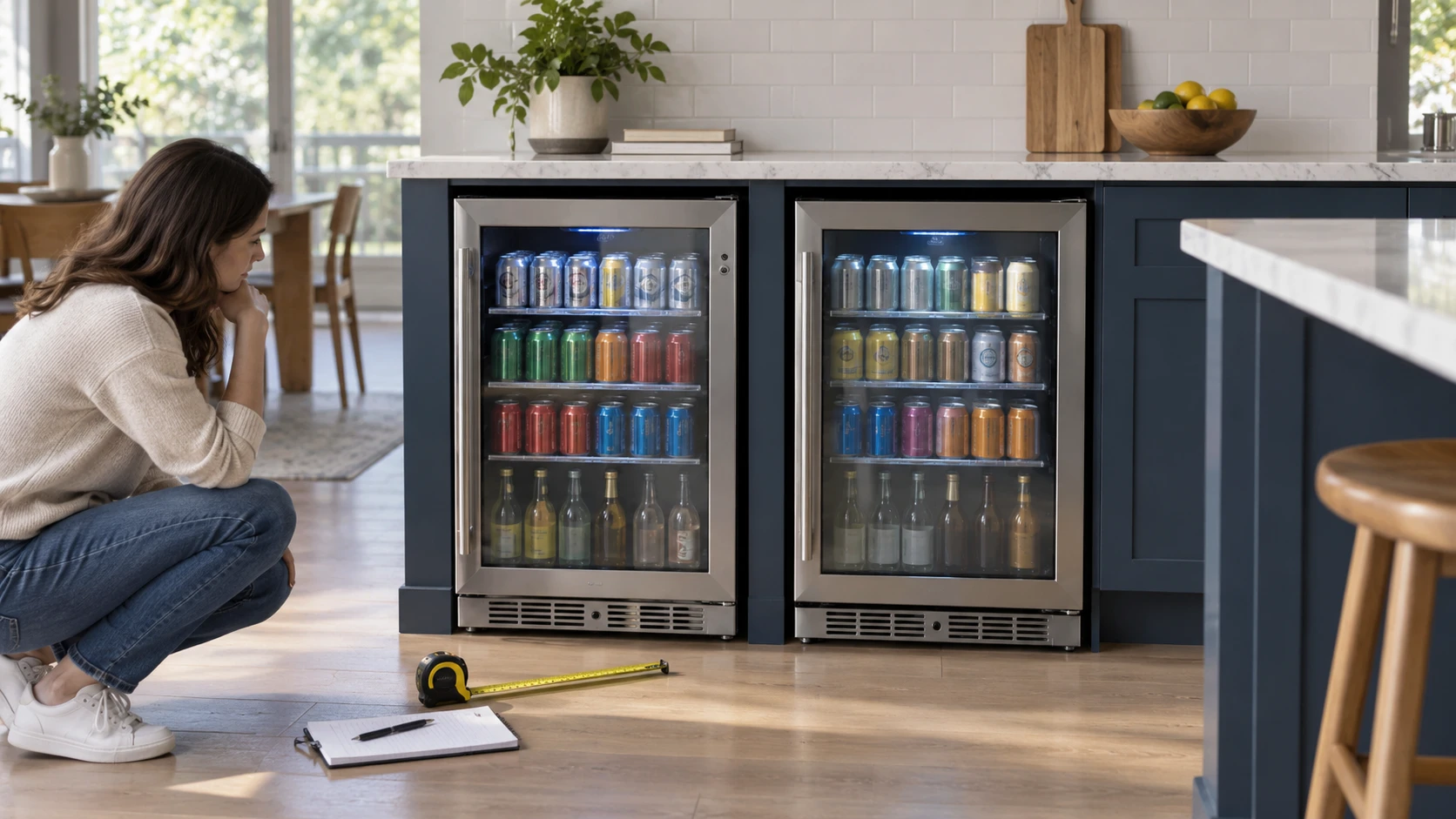
The Yeego YEG-BS24 beverage cooler and EUHOMY RU-05 both claim room for up to 180 standard cans in a nominal 24-inch cabinet. That shared capacity does not make them identical under a counter. Yeego's saved dimensions include a 32.3-inch height; EUHOMY lists 34.3 inches. Door depth, shelf arrangement, and the actual drinks stored may matter more than the matching can count.
The saved rows are Republeq's product descriptions, not a matched capacity or cooling test. Both describe front ventilation and possible built-in placement, but each exact model still needs its own installation drawing. Before ordering, measure the opening at the floor, countertop, and trim, then check the door's path with a person standing in front of it. A refrigerator that slides into a cabinet but cannot open far enough to remove a shelf is not a good fit.
Look at the actual opening — EUHOMY RU-05 beverage refrigerator
Yeego lists 32.3 inches high, 24 inches wide, and 22.4 inches deep without the handle, or 24.1 inches deep with the handle. The added handle depth is material in a narrow walkway or a kitchen island where people pass close to the door. Its row also says the adjustable feet can change the height by up to two inches. Ask for the exact minimum and maximum installed height in the current manual, including the floor under the appliance and any grille at the front.
EUHOMY lists 22.6 inches deep, 23.4 inches wide, and 34.3 inches high. Its row says front ventilation permits built-in installation without extra clearance at the sides or rear, and it also allows freestanding use. Verify that no-clearance statement against the current manufacturer's drawing; electrical access, door swing, and service removal still need planning. A lower countertop may allow Yeego's body but not EUHOMY's taller one, while a slightly narrower opening may favor EUHOMY's listed width. Measure rather than extrapolating from a shared 24-inch class.
The published guide on built-in and freestanding beverage-cooler placement covers different models. Its installation questions transfer to this comparison, but its dimensions do not. Ask which surfaces need breathing room, whether the front grille can be blocked by a toe kick, and how the unit will be pulled out for service. A photo of a cooler under a counter cannot establish that the particular cabinet opening is approved.
Check the door-open depth with tape on the floor. The appliance can protrude past neighboring cabinets once its handle is included, and the open door reaches farther still. The saved rows do not give a full door-swing diagram or hinge-side clearance. Try to identify where a drawer, dishwasher door, or bar stool would be while someone reaches for a drink. Shelves must slide past the open door; a hinge that stops against a wall can reduce usable storage even when the cooler body fits.
If the unit will stand alone, measure the area the same way. Freestanding does not mean it can be pushed against any wall or placed next to a heat source. Use the manufacturer's permitted location and clearance instructions. Adjustable feet can make the cabinet level on an uneven floor, but they do not create extra room under a countertop that is already too low.
Check with Republeq whether delivery includes placement and removal of packaging, and keep the official installation sheet available when the unit arrives. Check the model tag and exterior measurements before the old cooler is moved or cabinetry is changed. A product in the right 24-inch category may still have a different handle or foot adjustment from the one shown online. If a bar area has a raised threshold, include that in the delivery path. Once the cabinet is full of drinks, moving it for a missed measurement becomes a much larger task.
Test the 180-can claim against real drinks — EUHOMY RU-05 beverage refrigerator
Yeego describes a 5.65-cubic-foot interior, three removable metal shelves, and room for 180 standard 12-ounce cans. EUHOMY also claims up to 180 standard cans and lists three pull-out shelves that can be set in five fixed slots. Both counts depend on a specific can shape and loading pattern. Tall slim cans, glass bottles, and milk cartons occupy different heights and widths. Make an inventory of the drinks actually bought and decide whether the shelves can be arranged to keep the most-used items easy to reach.
Removable shelves can solve one tall-bottle problem while reducing the number of layers available for cans. A crowded cabinet may also hide older drinks at the back. Ask for shelf depth, maximum load, and the position of the cooling parts in the official manual. Neither saved row provides a real-world load diagram for a mixed collection. A household with several drink sizes should prioritize flexible spacing over a maximum can count tested with one standard format.
The two front-vented designs may make under-counter placement possible, but full shelves still need airflow inside the cabinet. Yeego lists an internal circulation fan. EUHOMY describes circulating-air duct cooling. The rows do not provide a matched test of temperature with every shelf packed tightly. Follow any loading limits in the manuals rather than assuming the number 180 is a target that must be reached.
Compare temperature controls — EUHOMY RU-05 beverage refrigerator
Yeego's single-zone digital touch control is described as adjustable from 34 to 54 degrees Fahrenheit. EUHOMY lists a 37-to-64-degree range. These are stated settings, not a common test of actual drink temperature after repeated door openings. A household that wants colder soda may focus on the low end; one that stores a mix of drinks may value the broader upper range. Check the recommended storage temperature for the beverages involved and verify each model's actual setting behavior in its manual.
The EUHOMY RU-05 beverage refrigerator row claims temperature variation of no more than 3.6 degrees Fahrenheit. Yeego's row says it can reach its minimum in under 40 minutes. Neither statement gives matched conditions, such as how much warm beverage was loaded or how often the door opened. They should prompt questions, not decide the purchase on their own. A thermometer in the installed, loaded cooler can show how it performs in the chosen room.
Both rows mention restoring a saved temperature setting after a power cut. That means the control can return to a selection, but it does not prove drinks stayed cold while power was absent. If the cooler holds temperature-sensitive items, arrange a way to assess the actual temperature after an outage. Beverage convenience and food-safety storage should not be conflated merely because the appliance looks like a small refrigerator.
Yeego describes frost-free operation. EUHOMY says its circulating-air system produces no air frost. These are Republeq's catalog phrases without a common maintenance test. Read the instructions for cleaning shelves, checking seals, and handling condensation in the installed environment. A front grille and a busy beverage door can collect dust and fingerprints even when frost is not visible inside.
Consider sound, light, and support — built-in and freestanding beverage-cooler placement
Yeego lists 38 decibels of operating noise. EUHOMY lists a compressor rating at or below 42 decibels. The rows do not state identical measurement conditions, so the four-decibel gap should not be treated as a guaranteed difference in a living room. Cabinet enclosure, floor, and compressor cycling can change what is heard. If the cooler will be near a sofa or bedroom, ask for current sound data and consider where the appliance can be evaluated after installation.
Yeego lists a blue LED interior light and a two-layer tempered-glass door with a stainless frame. EUHOMY describes a blue LED sensor light that turns on with the door or can stay on, and a stainless door insulated with high-density foam. These are different viewing arrangements: one row emphasizes a glass front, the other an insulated door. Check the exact EUHOMY product images and manual before assuming whether its door displays drinks. Think about whether an always-visible collection or a more concealed cabinet suits the room.
Yeego's row states a limited warranty with one year for parts and three years for the compressor. EUHOMY's row says twelve months of product support. Those are not equivalent coverage descriptions. Request the current warranty terms, including labor, shipping, and who services the appliance locally. A beverage cooler installed tightly under a counter may be inconvenient to move for repair, so service access belongs in the decision along with the purchase price.
EUHOMY lists 0.84 kilowatt-hours per day; Yeego's saved row does not provide a matching energy-use number. Compare current energy information for both exact models if the cooler will run all year. A one-sided claim cannot show which will cost less in the home. Include the room temperature, frequency of door opening, and chosen temperature setting when estimating use.
Yeego merits a closer look when its shorter listed height, glass-door presentation, and 34-degree lower setting fit the space and drink routine. EUHOMY merits one when its narrower listed body, adjustable shelf slots, and insulated-door arrangement are preferable. Verify the cutout, door opening, permitted ventilation, mixed-drink capacity, and current warranty documents before choosing between two matching 180-can headlines.