Writing & Documents
Winter market meeting story: the missing statue
An original seasonal story follows two adults who recognize the same meeting place after its familiar statue has been removed.
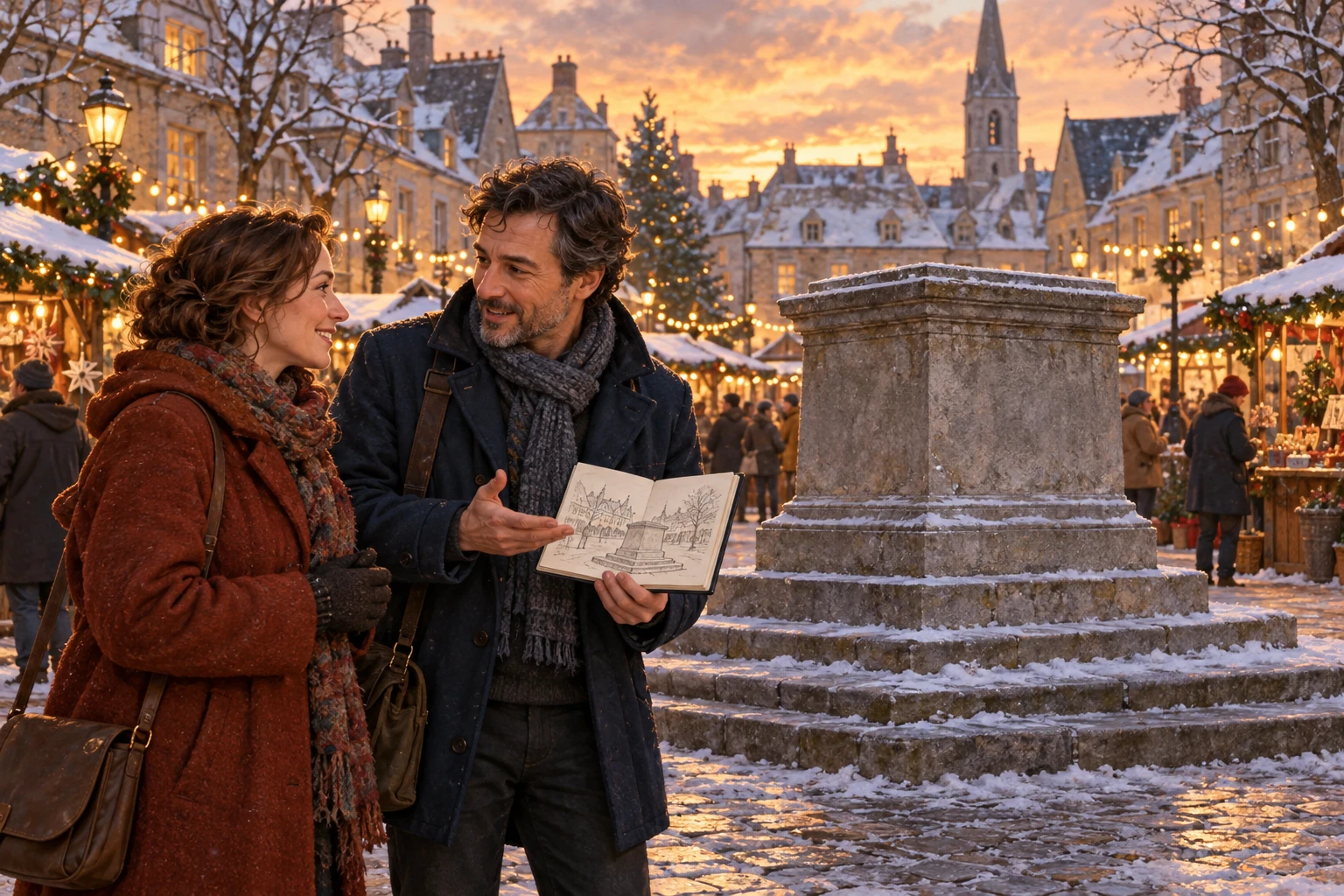
This Winter market meeting story is original fiction. Sera, Oren, the square and its absent statue are invented. Two adults have arranged to meet beside a familiar landmark at a seasonal market. The statue has gone, but the place remains. Their encounter supplies no real travel, navigation, weather or meeting-safety advice. Actual puzzle accounts appear separately after the story.
The place where the statue stood
Sera came into the square beside a stall selling little paper stars. She had expected to see the statue above the roofs, one arm extended toward the clock. From this entrance its hand usually appeared before its head. This afternoon there was only the clock, with a line of snow resting along the ledge beneath its face. She stopped at the corner of the stall and looked again.
The plinth stood exactly where she remembered it. A wooden stall had been put up beyond it, and somebody had wound lights around a tree on the other side. The space above the stone was empty. Sera could see a window that the statue's shoulder had always hidden from this part of the square. In that window, a person was drawing a curtain across the glass.
She went closer. The stone steps had their usual shallow hollows, with snow collected at the corners. Across the top lay a broad white patch interrupted by two darker marks. She could not tell what the marks had held. She had passed the statue many times without looking at its feet, and she now found that she could remember very little about them. She remembered the pointing hand quite clearly.
Oren had said they should meet by the statue. She had answered that she would know where to find him. They had arranged it during a conversation about something else, while he was trying to remember the name of a book. The meeting place had needed no explanation then. Sera put her hands into her pockets and stood beside the bottom step, where she had expected to stand.
A view through the empty space
A man carrying a crate came round the plinth and nearly stopped beside her. He looked up at the empty top, then shifted the crate against his coat and carried on. Sera watched him disappear behind the star stall. She had almost asked when the statue had been taken away. By the time she had formed the question, he was speaking to someone she could not see.
She tried to remember its face. There had been a broad nose, she thought, and a collar turned up beneath the chin. Perhaps the collar belonged to a different statue in another square. What she remembered with certainty was the gesture. When she was younger, she and Oren had disagreed about what it indicated. He had said the clock. She had thought it was pointing past the clock at the bakery.
The bakery had closed years ago. Its old doorway now belonged to a shop with narrow shelves visible through the glass. Sera could see people passing in front of them. Without the statue, the whole side of the square appeared closer. She had never thought of the figure as blocking her view. It had simply been part of what she saw, like the steps and the tree beside them.
A small child asked an adult why there was nothing on the stone. The adult said she did not know. They continued toward the lights without making up an answer. Sera heard the child begin another question about a hanging star. She looked toward the entrance Oren usually used. A tall person in a blue coat was coming through it, but when the person turned, it was someone else.
Oren arrives with a page folded back
She saw Oren a little later on the far side of the square. His coat was open at the neck, and he was carrying something flat against his chest. He came toward the plinth without looking up at its empty top. Sera lifted a hand. He saw her, smiled and changed his course slightly to come round the steps. The flat object was his sketchbook, held closed by one finger.
"You found it," he said. Sera looked at the stone above them. "Most of it." Oren followed her glance and laughed. He had forgotten, he said, that she might not know. The statue had been gone when he passed through earlier that week. He had meant to mention it during their conversation, then had become occupied with the book whose name he could not remember.
"I was beginning to wonder whether I remembered the right square," Sera said. Oren looked around as though considering another one. He knew a square with a statue of a horse, but neither of them could imagine having arranged to meet beneath that. The horse's rider had never pointed at a bakery. Sera said she was glad this limited the possibilities. He asked whether she still thought it had been the bakery.
She did. Oren shook his head with the pleasure of returning to an old disagreement. Then he opened the sketchbook. A page had been folded back against its cover. On it was the plinth with nothing above it, a corner of the shop and the bare branches of the tree. The drawing stopped partway along the nearest step. He had left that line unfinished when somebody wanted to pass in front of him.
The drawing has no statue either
Sera took the book when he offered it. He had drawn the small window she had noticed on arriving, including the ledge beneath it. In his drawing the curtain was still open. She told him she had watched someone close it. Oren looked from the page to the window as if she had reported a change inside his picture. He had not drawn anybody in that room.
"When did you do this?" she asked. He said it had been earlier that afternoon. He had come before their meeting because he wanted to see what the market looked like before the lamps were lit. He had expected to draw the stalls. Instead he had stood opposite the plinth, trying to remember how far above it the statue's hand had reached. His first page had given the hand nowhere to belong.
He turned back one sheet. There were several short marks above the stone, none joined to a figure. Sera recognized the attempt before he explained it. She had been trying to reconstruct the face in much the same way. She told him about the broad nose and the uncertain collar. Oren thought there had been a hat. Neither could decide whether this improved their account or introduced a second figure into it.
They returned to the empty-plinth drawing. It looked more like what Sera could see than their combined description of the statue did. She held it beside the view for a moment. Oren had made the tree's nearest branch dip lower than it appeared now. He said he had noticed that too, but had liked where the line ended. The page was his drawing of the afternoon, with that branch left as he had made it.
A question neither of them can answer
Someone behind them asked whether the statue was coming back. Sera turned. An older woman stood at the bottom step with a bag folded beneath her arm. Oren said that he did not know. The woman studied the empty top and said she had used it as a meeting place for as long as she could remember. Then she looked toward a person waving from beside the tree and went over to join them.
Oren watched the greeting. "That seems to be working," he said. Sera handed back the sketchbook. She had arrived expecting him to be beside a figure with an outstretched arm. He had arrived expecting her to be beside the remaining stone. They had both come here. There was no other place they needed to visit before they could begin the afternoon they had planned.
He asked whether she wanted to look round the stalls. She said yes, then stayed where she was for another moment. A stallholder was switching on a string of lamps one short length at a time. Each new section showed them more of the tree behind it. Sera could see the empty space over the plinth darkening against the sky. Oren shut the book without folding the unfinished step out of sight.
As they turned away, Sera asked whether he had remembered the name of the other book. He had. He began to say it, stopped and opened his bag. This time he had brought the book itself. He showed her the cover, pleased with the solution, and she recognized it as one she had lent to somebody years earlier. She could not remember whether the person had returned it.
The market beyond their meeting place
They reached the stall with the paper stars. From the other side, Sera could see that several had been hung in front of a mirror. She had thought there were more of them when she arrived. Oren was looking at a plain folded one near the edge. He liked the uneven shape of its shadow against the cloth. Sera asked whether he intended to draw that too. He said he was trying to look without opening the book again.
Farther on, they stood aside while a stallholder carried an empty box through the gap between tables. Oren moved his bag in front of him to make space. Sera could still see the plinth over his shoulder, though she could no longer see its lowest step. A couple had stopped beside it. One pointed at the empty top, and the other looked toward the clock. Sera wondered which of them had expected the statue to be there.
"We should have asked what it was called," she said. Oren knew at once which thing she meant. He had never thought to ask when it was present. They had always called it the statue, as though there were no other figures in the town. He said that perhaps they had read its name once. Sera remembered lettering on the front, but not whether it had named the figure or the person who had given it.
They did not return to inspect the stone. The stallholder had put down the box and was inviting the people nearest her to move closer. Sera and Oren went with them. Their meeting place remained behind the line of coats, with its upper edge visible whenever somebody stepped aside. Oren tucked the sketchbook into his bag beside the other book, keeping one hand around its cover until it was all the way in.
When they passed the square's clock later, Sera looked back along the line the old arm might have made. From here she could imagine it pointing at almost anything. Oren caught her looking and said nothing. He was still holding the book he wanted to show her. She took it, opened to the place he had marked and asked which sentence he had been thinking about. He leaned nearer to find it with her.
Actual puzzle accounts outside the fiction
The On the Farm jigsaw puzzle account identifies SKU 125334592. Its sole image shows a rooster, tractor, rabbit and farm landscape. The catalogue states 500 pieces and 24-by-18 inches; count, dimensions, interlocking fit and framing suitability were not tested here. No separate supplied accessory is established by that illustration.
The Dowdle American Cities set identifies SKU 2881686015 and UPC 671095994040. Its package shows four named city puzzles and an included branded assembly tray. A collect-all-sets grid and a different demonstration scene are broader examples, not additional supplied sets. Materials, fit and loss-prevention performance remain unverified. Both offers appear in Puzzles.
Other winter stories
The first frost walk story follows two companions choosing a new destination for an annual outing. Sera and Oren reach their unchanged meeting place after its physical landmark has gone. Their afternoon introduces no new annual route or agreement about next year's visit.
The winter cupboard sea story brings impossible sea sounds into one adult's kitchen. This market encounter stays ordinary, with two people, a missing statue and a drawing of the place that remains. No magical explanation is offered for the removal.
Keep a possible order with its own current terms
If you plan to purchase an item on republeq.com, check the particular offer and current checkout before ordering. This story does not establish that any cryptocurrency payment option is available. If USDT is offered for the intended order, verify the requested asset, network, amount, receiving destination and order reference with the responsible service before authorizing a transfer. Review the actual product identity, selected variant, quantity, delivery details, total charge and applicable terms. Use the confirmed order details when checking the payment instructions. Confirm any fee, conversion term or exchange rate from the current transaction information. Determine the applicable cancellation, return and refund process, including how a refund would be handled for the selected payment method. Keep the relevant instructions and transaction records, with dates and confirmed references. If essential instructions change, ask the responsible service to confirm the change against the exact order. An acknowledgement should identify the order and the agreed details; it does not replace checking whether the selected product is the one you intended to buy. If payment or order status remains uncertain, reconcile that status before considering another transfer. Do not treat an unresolved transaction as evidence that nothing happened. This article supplies no wallet address, transfer guarantee, recovery procedure or assessment of a counterparty. A product enquiry does not authorize a payment or resolve an uncertain order. If support provides an answer, retain the exact question and response so a later reviewer can understand what was confirmed. Decide whether to proceed only when the conditions of the particular transaction are clear, and retain the confirmed transaction information with the exact order.