Home Decor & Table Settings
A wind chime memory at the kitchen table
An original household scene follows two relatives and a familiar chime whose remembered history differs; the scene makes no retail product or sound claim.
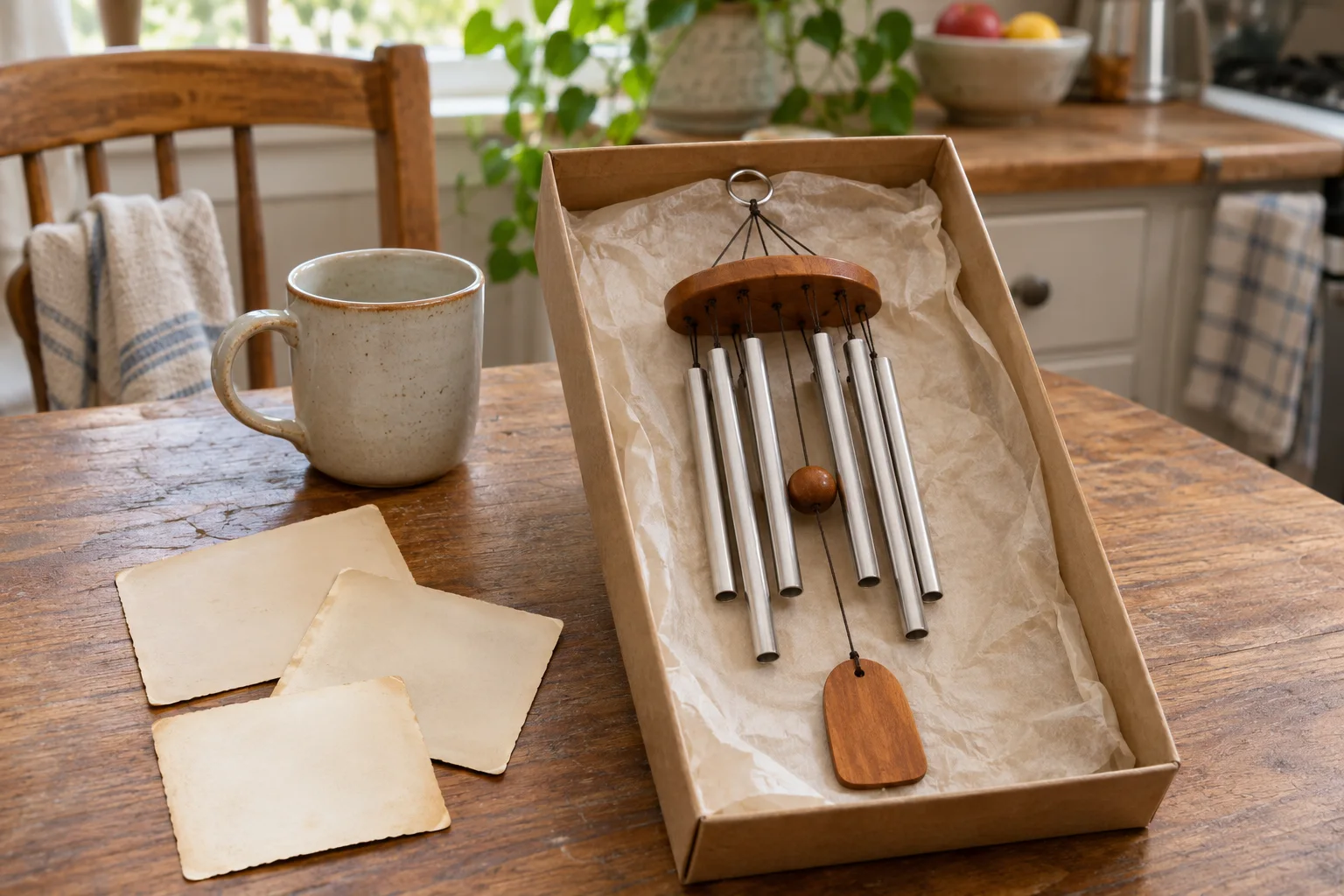
Illustrative kitchen-table keepsake scene; generic intact chime, no exact retail model, actual family history or sound test.
A wind chime memory interrupted Leda's search for a photograph of her mother's kitchen. Her brother Rune had come over to help sort the family pictures, and the box was already on the table when he arrived. This original fictional household scene follows their different recollections of one familiar object. The people, photographs and chime are invented; neither retail model discussed below was used or tested.
The box beside the album
Rune put his coat over the chair and asked whether she had found the picture with the yellow cupboard. Leda had found several yellow things, including a car neither of them recognised, but no cupboard. She had also found the chime. It had been in a box of her own belongings since her last move, wrapped with a newspaper she had not stopped to date.
He recognised it before she finished explaining. He remembered their mother bringing it back from a seaside holiday, in a paper bag that had become soft in the rain. Leda looked up from the album. In her memory, their mother had bought it from a shop near the bus station, on an afternoon when Leda had gone along to choose a birthday card. She could picture the counter and the row of postcards above it.
Rune moved his chair closer to the table. He was certain about the seaside bag. He could remember their father complaining that they had brought too many things back, then taking charge of the bag himself. Leda remembered that complaint too, though she could not attach it to a particular holiday. Their father had made similar remarks about books, plants and a very large lampshade.
She turned another album page. “Perhaps I'm remembering the card shop because we were looking for something else,” she said. Rune allowed that the bag might have held something else. Neither concession quite removed the picture each of them had. Leda still saw the postcards. Rune still saw their father carrying a bag through a hotel entrance, holding it away from his wet coat.
What each person remembered
They had planned to put names on the backs of unidentified family photographs. Leda had brought a pencil to the table for that purpose, and Rune had brought a list of relatives he thought he would recognise. The chime had given them a question that neither list answered. Leda drew a small box on a loose sheet and wrote “Mum's chime” above it, then stopped before adding where it came from.
Rune asked whether she meant to put it on a list of things to give away. She shook her head. It belonged to her, and she wanted to keep it. She had been trying to give the box a label that would make sense the next time she opened it. He said he would have recognised it without a label. She reminded him that she had recently opened a box marked “useful cables” and found a tablecloth.
He laughed and reached for the photograph of the yellow car. On the pavement behind it stood their mother, looking away from the camera. The picture had no date. Rune wondered whether it came from the seaside trip he remembered, then noticed a shop window he did not recognise. Leda knew nothing more about the street. They left the photograph in the group they were still trying to identify.
“I don't want to write your holiday down as though I've suddenly remembered it,” she said. Rune said he would not want the card shop written as though he had been there. They could each describe what they recalled. Leda turned the loose sheet over and wrote their names separately. Under hers she put the shop counter and the birthday card. Under his she left space for the bag.
Rune took the pencil. His account ran for longer than he expected. He remembered a narrow hotel corridor and a picture of a boat above the stairs. He could not remember whether the chime had been visible in the bag, so he crossed out the sentence that said it had. When he handed the sheet back, Leda read the crossing-out as carefully as the words he had kept.
A pause for the ordinary afternoon
The kitchen clock reminded Rune that he had promised to call his daughter. He went to the other room while Leda made tea. From the kitchen she heard him ask about a missing shoe and then say that he could look when he got home. The album remained open. She looked again at the yellow car, this time at the person whose arm was just visible beside the camera's shadow.
When Rune returned, she asked whether it might be their aunt taking the photograph. He could not tell from the sleeve. They would ask her when they next spoke. He resisted the urge to turn that into a call immediately; she might remember the street, or she might want to talk about something else that day. Leda put a small note beside the picture so that they would remember the question.
Over tea, Rune told her about the shoe. His daughter had found it inside a bag she had already checked, and was annoyed that he had suggested checking again. Leda said she had similar feelings about the useful-cables box. He asked what she had expected to do with the tablecloth. She had put it in the cupboard with the other tablecloths, which seemed an unambitious but adequate ending.
The chime stayed in its box while they talked. Nobody needed to make it sound to continue the afternoon. Leda wanted the family recollection on paper because the disagreement had revealed details she had never heard from Rune. He had not known about the birthday card trip. They could enjoy hearing those accounts while leaving the object's exact origin unanswered.
Two actual chime references
The Woodstock Chimes of Earth DCB37 listing is one real reference outside this fiction. Its selected gallery form has bronze-coloured tubes and a diamond-shaped lower piece bearing the Earth and Encore names. The own catalog colour field is Brown. Those observed fields identify the offer without establishing a measured shade, material, installed dimension or sound result. It is not Leda's fictional keepsake.
The Woodstock Heroic Windbell HWMC listing supplies a different form: a cylindrical bell with a leaf-shaped lower piece. Its diagram names Medium and Antique Copper; its own catalog colour is Brown. The gallery's general promotional and packaging scenes are not additional supplied chimes or mounting equipment. No physical property or musical result from this offer is transferred to the object on Leda's kitchen table.
The note that went back in the box
After tea, they returned to the album. They identified a cousin in one photograph and put another aside for their aunt. Rune found a picture of their mother holding a bowl of apples, with the yellow cupboard finally visible behind her. Leda had forgotten that the cupboard doors had different handles. Rune remembered being sent to find a replacement, then returning with one that their mother disliked.
He began explaining why he had chosen it. Leda interrupted to say that she had disliked it too. He put a hand over the photograph in mock protest, and she moved it away so she could look at the cupboard again. The remembered errand belonged to him. The memory of the handle belonged to both of them, with a small difference in emphasis that remained after they stopped laughing.
Leda read the chime note once more. She had written no date beside either account and decided to leave it that way. Rune added that the hotel corridor was a memory of his own, without claiming that it settled the object's history. She folded the sheet and put it with the box. This keepsake story had acquired two accounts that someone could ask them about later.
The separate wind chime porch corner guide considers preferences about a sounding decoration in a shared place. Leda has made no porch plan during this scene. The borrowed wind chime story concerns returning a particular loan while somebody proposes a replacement. Here, Leda is keeping her own object; neither relative is proposing an exchange or speaking for an absent owner.
If a separate purchase comes later
The household scene ends without a purchase. If you separately consider a wind chime order on republeq.com, use the actual offer and checkout for that transaction. This fictional keepsake has no order reference and establishes no payment availability. If checkout presents a cryptocurrency option such as USDT, read the information shown for the selected item and destination before deciding whether to use it. A previous visit, a remembered preference or a product description cannot establish the conditions of a later payment flow. Keep any essential product questions with the order you are considering. A photograph of a chime supplies no tested sound, mounting suitability or confirmed delivered inventory, and a payment option would not answer those questions. This article provides no receiving address, transfer network, wallet procedure or payment sequence. It makes no promise about fees, conversion rates, delivery timing, cancellation, refunds or a transaction's outcome. Read the actual terms that apply and seek a clear answer through the responsible service when something you need remains uncertain. If someone else helps with an order, give them the exact selected offer and the decisions you have actually made. Do not send them the invented family scene as though it were a report about a delivered item. Retain real order and payment records if you proceed, keeping an uncertain existing transaction unresolved until its status has been reconciled before considering another payment. You can leave an order undecided while a product or transaction question remains open. The story can also remain an afternoon at a kitchen table, with no retail purchase needed to give the relatives something to remember.
Before Rune went home
Rune put on his coat and asked for a copy of the cupboard photograph. Leda would make one after they had finished sorting the rest. She left his name beside it so the request would survive the next stack of pictures. He picked up the yellow-car photograph once more, then returned it to the unanswered group. “Ask her about the street,” he said. Leda added the question to the note already waiting there.
After he left, she closed the album and carried the empty cups to the sink. The box was still on the table. Before putting it away, she opened the folded sheet and found the sentence Rune had crossed out about seeing the chime in the bag. Under it, he had written what he could remember: their father turning sideways in the hotel doorway, trying to keep his wet coat off the wall.