Crypto Commerce
Whynter WC-201TD thermoelectric wine cooler vs IVATION IVFWCC181LSS: two small wine coolers with different cooling systems
Compare Whynter WC-201TD thermoelectric wine cooler by cabinet fit, controls, doors, bottle mix, and saved price.
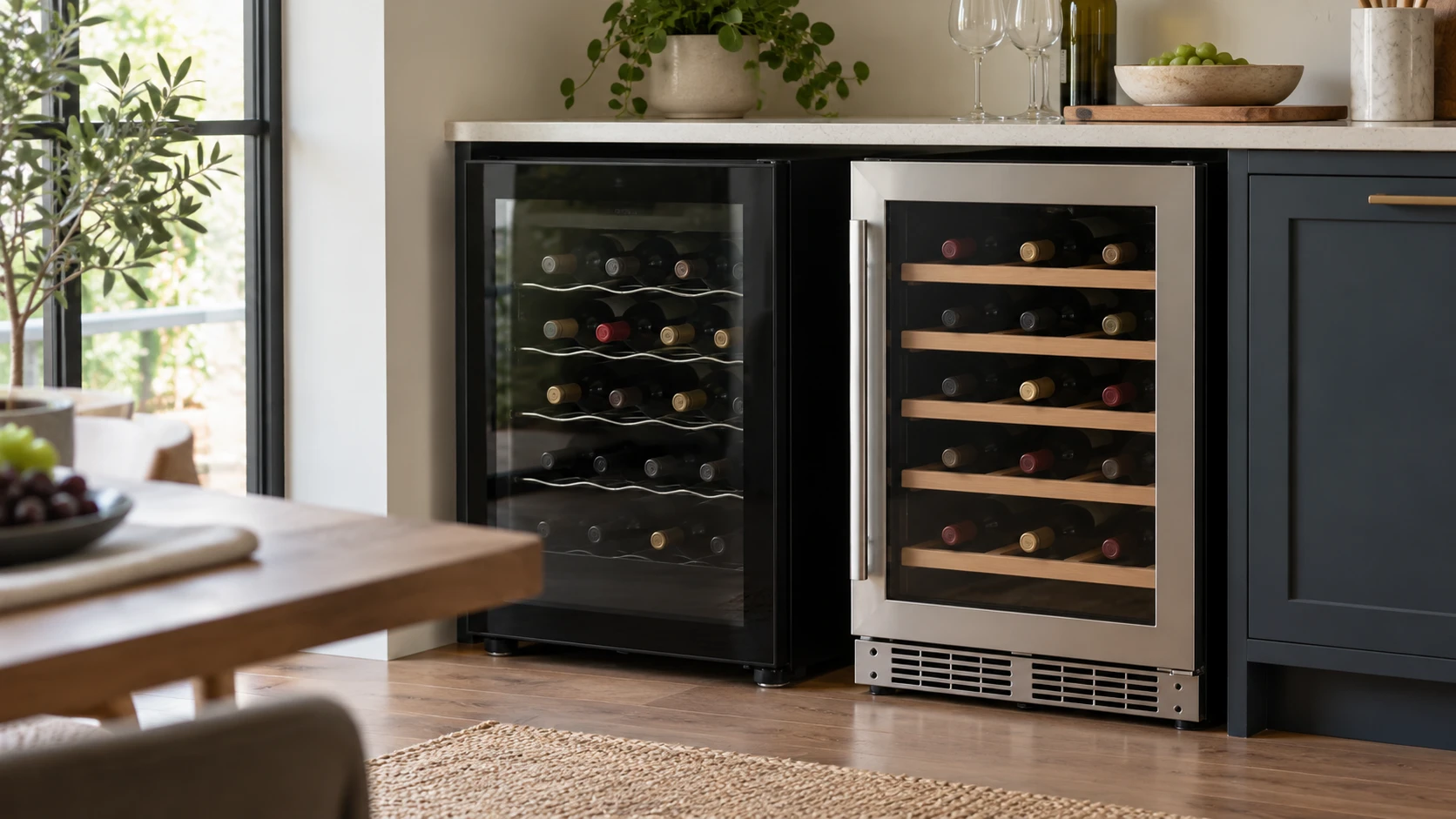
A small wine cooler can solve a simple storage problem without taking over a kitchen. The harder choice is where it will sit and what the owner expects from its cooling system. The saved catalog lists the Whynter WC-201TD as a 20-bottle freestanding thermoelectric unit and the IVATION IVFWCC181LSS as an 18-bottle freestanding compressor unit. Their nominal capacities are close enough that a buyer might compare them on shelf fit, controls, door design, and room conditions instead of treating two bottles as the whole decision.
The Whynter WC-201TD thermoelectric wine cooler has the more detailed dimensional listing: 22 inches high, 16 inches wide, and 20.5 inches deep. It has a black cabinet, a tinted mirror-glass door, and five removable scalloped chrome shelves. The catalog gives it a 46°F to 66°F adjustable thermostat and soft-touch digital controls. Its saved price is $287.49. The nominal bottle count assumes standard 750 ml bottles; wider bottles can change a real loading plan.
The related guide to 33-bottle wine refrigerators compares other units and makes a useful reference for thinking about bottle mix and cabinet fit. It does not test either cooler in this comparison or prove their temperature performance. Use it to frame questions, then check each candidate's current listing and installation instructions. The IVATION IVFWCC181LSS compressor wine cooler is the alternative here. Its saved description specifies an 18-bottle capacity, a locking door, UV-resistant double-paned glass, removable chrome shelves, touch controls, and an LCD. Its saved price is $387.49.
Start with the spot where the cooler will live — IVATION IVFWCC181LSS compressor wine cooler
Measure the actual space before choosing either cabinet. For Whynter, the catalog's 16-inch width may look easy to fit in a niche, but the 20.5-inch depth still has to allow for the plug, cord routing, and opening the door. A countertop, floor, or furniture shelf also needs to support a filled unit. The saved row calls this model freestanding. It does not authorize enclosing it tightly within cabinetry. Consult the current manual for ventilation clearances, then mark those clearances on the intended location rather than subtracting only the bare cabinet dimensions from the opening.
The IVATION row also calls its 18-bottle unit freestanding, but the saved excerpt does not provide its exterior height, width, depth, or required air gaps. Get those from the current product specifications or manual before deciding that it fits the same place as Whynter. A similarly sized bottle rating is not a cabinet measurement. Door swing matters as well: look at hinges, handle reach, and whether nearby furniture would prevent shelves or bottles from coming out. Neither saved excerpt confirms that its door is reversible, so do not assume a hinge change can rescue a poor placement.
Think about where a person will stand to load the cooler. A narrow gap beside a dining cabinet might leave room for the appliance but not for pulling a long bottle forward. Measure the usable path with the door open. If it will sit on a stand, consider the height of the controls and the weight of full bottles when shelves are extended. Keeping a little spare room for the planned collection is more useful than treating the advertised maximum as a guarantee for every bottle shape.
What the cooling descriptions establish — IVATION IVFWCC181LSS compressor wine cooler
Whynter describes a vibration-free thermoelectric cooling system. IVATION describes compressor cooling that maintains a stable temperature. Those are different mechanisms, yet the two catalog excerpts do not contain a matched test in the same room with the same load. They give no measured cool-down time, power draw under identical conditions, operating noise level, or temperature trace. A claim that one is quieter or holds temperature better in this particular comparison would need evidence beyond the saved product rows.
The location may make the distinction practical. If a room gets warm at certain hours, check with Republeq or manual for the permitted ambient range and how the cooler behaves near its upper limit. Check the intended setpoint against the climate of the room. Whynter supplies a stated thermostat range of 46°F to 66°F. The IVATION excerpt mentions touch controls and an LCD, but it does not state a temperature range. Confirm its available setpoints before buying for a wine that needs a particular serving temperature. A display shows a selected or measured value only according to the manufacturer's design; the short catalog description does not tell us which one it shows.
A simple acceptance check after installation is to put a separate thermometer inside, allow the cabinet to settle according to its instructions, and observe it over normal room changes. Do not load valuable bottles on the first hour and assume the number on the control proves every shelf is at that temperature. Note where the thermometer is placed and whether a frequently opened door changes the reading. This is a way to verify the chosen setup at home, not a performance claim about either product.
Plan bottles around the shelves — IVATION IVFWCC181LSS compressor wine cooler
Whynter's description says up to 20 standard 750 ml bottles and lists five removable scalloped chrome shelves. Scalloped supports can help show where standard bottles belong, while removal may create room for a less uniform collection. The row does not specify the number of large-format bottles that fit after a shelf is removed. Count the bottles actually owned, including Champagne-style or wider-shouldered bottles, and sketch the loading arrangement before treating 20 as available slots.
IVATION's catalog capacity is 18 bottles and its chrome shelves are removable. The saved row does not say how many shelves are included or provide spacing between them. It also does not state whether its count assumes Bordeaux-shaped 750 ml bottles or another mix. Check current photos and dimensions with the retailer if the collection has unusual shapes. If a buyer stores only a dozen everyday bottles, either advertised count may be ample. If the collection sits close to full already, neither nominal capacity leaves much margin for new purchases or a shelf taken out to fit a tall bottle.
The two-bottle difference is small compared with arrangement. Removing one shelf could erase that difference in usable bottle count, depending on shelf geometry. The catalog does not quantify such a loss, so test the actual bottle mix or ask for an interior layout. Decide whether the goal is a fixed serving rotation, longer storage of a small collection, or extra overflow from another refrigerator. A cooler bought for overflow can be organized by near-term use; a collection meant to stay longer may need more breathing room and a place to track what is inside.
Doors, light, and access — IVATION IVFWCC181LSS compressor wine cooler
Whynter has a tinted mirror-glass door and black cabinet. IVATION has a double-paned thermopane glass door that the saved description calls UV-resistant, a stainless steel finish, soft interior lighting, and a lock. Whynter's excerpt does not make a UV-resistance claim or list a lock. That absence in the excerpt is a reason to verify current specifications, not proof that a feature cannot exist in another variant or updated listing. Inspect the exact model and SKU before paying for a feature named in a retailer's general description.
A lock may matter in a shared space where access to bottles should be controlled. Ask how keys are handled and whether the household has a safe place for a spare. If access is unrestricted, the lock may add little value. Interior lighting is convenient for reading labels, although a glowing cabinet in a bedroom or small apartment may be distracting. The IVATION row mentions soft light, but it does not describe an automatic timer or a way to switch the light off. Check those controls if the unit will be in sight at night.
Glass treatments matter most when the location is exposed to sunlight, but neither excerpt specifies a quantitative UV-blocking rating. Avoid placing either freestanding unit in direct sun or close to a heat source without checking its manual's conditions. Shading the cabinet and allowing proper airflow are placement decisions a buyer can make without assuming that a door treatment solves the heat load of a sunny window. For either unit, wipe the glass and check seals during regular cleaning so a visible cabinet remains easy to use.
Compare controls at the point of use — IVATION IVFWCC181LSS compressor wine cooler
Whynter names a soft-touch digital control panel and adjustable thermostat; IVATION names touch controls and an LCD display. Neither excerpt details the exact number of button presses to change a setting, whether the controls can be locked, or what happens after a power interruption. If those questions matter in a shared home, read the current manuals. A readable display and obvious setting control are especially useful if a person other than the buyer will restock bottles or reset the unit after cleaning.
Ask whether the displayed number represents the target temperature or a sensor reading, and whether the manufacturer advises waiting between a setting change and evaluation. These questions prevent overreacting to a temporary door-open reading. The Whynter range of 46°F to 66°F offers a concrete first check against intended serving temperatures. The IVATION range needs confirmation before comparison. The descriptions also do not identify separate temperature zones for either unit, so plan around one cabinet setting unless the exact current model documentation says otherwise.
A small cooler often gets opened more frequently than a cellar because it sits near serving areas. Keep the bottles most likely to be used where they can be reached without moving the rest. If shelving can be removed, retain the shelves and hardware so a later owner can restore the standard arrangement. Make a note of the chosen temperature and thermometer reading after the cabinet has stabilized. That record helps distinguish a changed setting from a temporary warm reading after a busy evening.
Price and the checks before ordering — guide to 33-bottle wine refrigerators
The saved snapshot puts Whynter at $287.49 and IVATION at $387.49, a $100 difference. Those are catalog amounts from the September 30 snapshot, not a promise of today's price, stock, tax, or delivery fee. Compare current checkout totals and return terms for the exact SKUs. A damaged door or wrong cabinet size can make a cheap headline price expensive to resolve. Inspect the package promptly under the return terms in Republeq's offer, especially the glass, seal, shelves, and control display.
The higher IVATION saved price accompanies a listed lock, UV-resistant double-paned door, compressor system, and smaller nominal capacity. The lower Whynter saved price accompanies stated dimensions, a stated 46°F to 66°F range, and a nominal two-bottle capacity advantage. These lists do not establish which cooler uses less electricity or lasts longer. Ask for energy information, warranty coverage, and service options if running cost or repairability is a deciding factor. Check the final manufacturer's model number against the catalog row; wine-cooler listings sometimes combine similar names or finishes.
For a buyer with a measured freestanding spot around the Whynter dimensions, mostly standard bottles, and a budget nearer $300, WC-201TD is the clearer first candidate. Confirm its ventilation space and the room conditions before ordering a thermoelectric cooler. If locking access and the listed door construction carry more weight, IVFWCC181LSS deserves a closer look, provided its full cabinet dimensions and temperature range fit the intended place. Neither choice can be settled by bottle count alone. Measure the space, count the actual bottles, verify current specifications, and check temperature after installation with the cabinet in its real room.