Crypto Commerce
Whynter six-place-setting countertop dishwasher — Two compact dishwashers, two kinds of capacity claim
Compare Whynter six-place-setting countertop dishwasher by loading capacity, water connection evidence, cycles, controls, and space requirements.
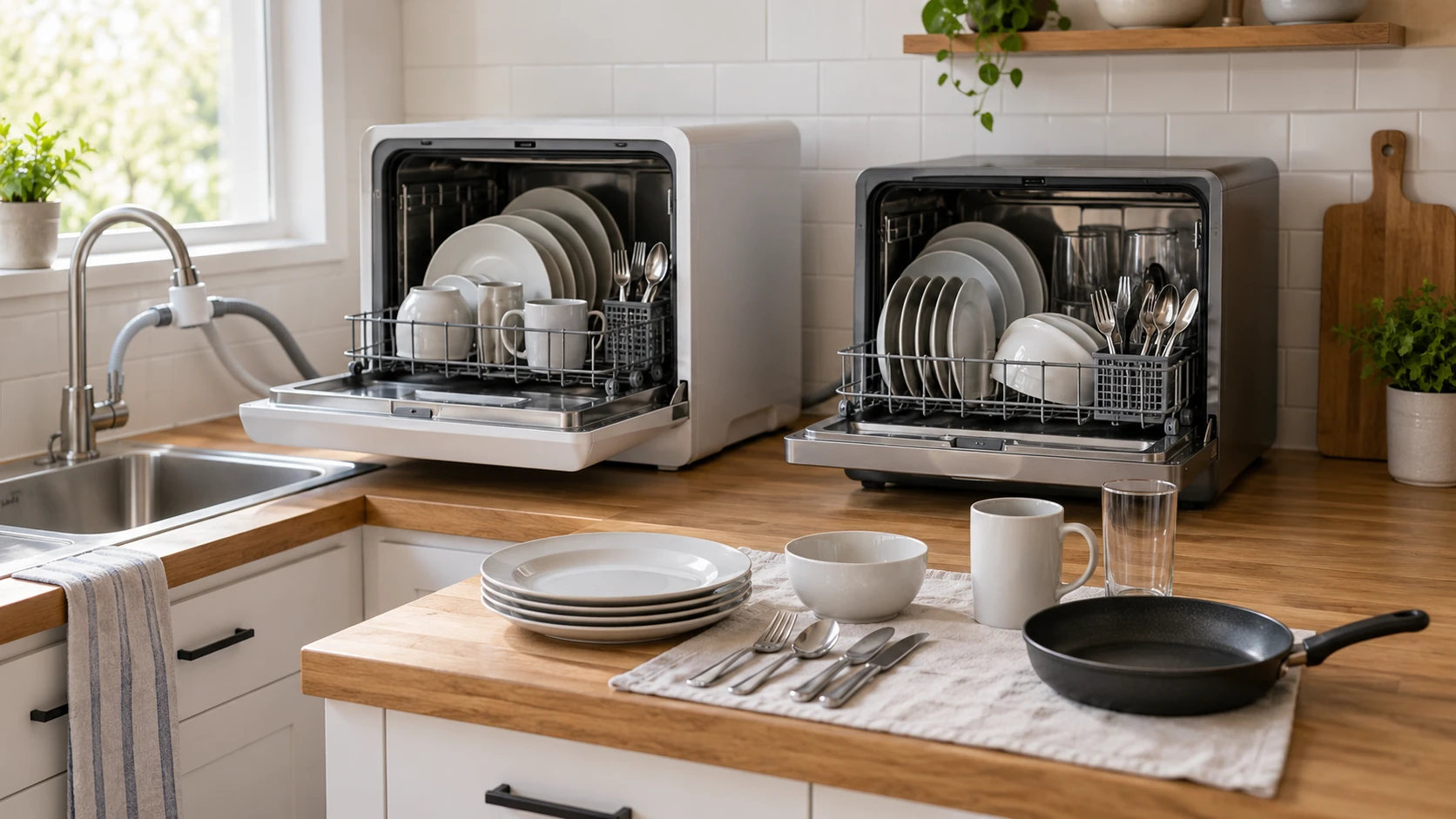
A countertop dishwasher has to fit the dishes, the counter, and the way water gets to the machine. The Whynter six-place-setting countertop dishwasher advertises room for six standard place settings and includes a quick-connect faucet adapter, inlet hose, and drain hose. The Autrinix 8410900256926 listing instead says it holds 12 to 20 pieces and uses two gallons of water per cycle. A place setting and a piece count measure different things. Neither figure proves that your largest plates, tall glasses, or daily cookware will fit.
Make a short inventory of what you actually wash after dinner. Include the widest plate, a cereal bowl, a tall mug, utensils, and any small pan you hope to load. Count both the number of items and their awkward shapes. Then compare those measurements with current rack diagrams, door clearance, and the manufacturer's loading examples. The saved Whynter excerpt names a dish rack and silverware basket; it does not give their usable dimensions. The Autrinix excerpt gives no rack diagram or place-setting standard. A quoted capacity is a starting point for checking fit, not a promise that every household's dishes will fit in one cycle.
The counter itself deserves the same attention. Whynter lists a unit 17.25 inches high, 19.75 inches deep, and 21.75 inches wide, reaching 32 inches when the door is open. Measure the space from counter to upper cabinet and the clear floor area in front of the open door. Leave room for the hoses, faucet reach, and any clearance the current manual requires. The saved Autrinix description calls it compact but gives no dimensions. Ask for its exact width, depth, height, door-open footprint, and weight before assuming it will fit where Whynter does.
Measure the path from the counter to a suitable electrical outlet too. Neither saved excerpt gives cord length, plug type, power rating, or rules for extension cords. A machine may fit next to the sink yet have no permitted way to reach power there. Check the rating label and current manual, and have an appropriate professional assess the outlet if its condition or circuit is uncertain. Also plan for the weight of the machine when full of dishes and water. The source descriptions do not provide a loaded weight, so use the manufacturer's installation guidance rather than treating any open shelf or rolling cart as automatically suitable.
Start with the available water connection — countertop dishwasher water hookup
Whynter's listing provides the clearer connection plan: a quick-connect adapter for most kitchen faucets plus inlet and drain hoses. "Most" still needs a check against your faucet. A pull-out sprayer, unusual aerator, or inaccessible spout may need a different approved adapter or may not be suitable. Identify the faucet model and thread arrangement, then ask Whynter or the Republeq's catalog to confirm the exact adapter and any restrictions. Check where the drain hose must discharge and how it must be secured. A hose that reaches the sink loosely is not necessarily installed as the manual requires.
The Autrinix excerpt says the unit uses two gallons per cycle but does not describe how water enters or drains. It does not say whether this model has a refillable tank, requires a faucet, or uses another approved connection. The published guide on countertop dishwasher water hookup illustrates why faucet and bucket-fill arrangements must be checked for the exact machine. That guide concerns a different model; it does not establish Autrinix's connection method. Obtain the current Autrinix manual and included-parts list before making a purchase based on an assumed tank or hookup.
Think through the daily path of the hoses as well as the first installation. If the machine will be stored after use, decide whether you can disconnect it, drain it, and move it safely according to its instructions. If it will stay on the counter, decide whether the faucet remains usable for hand washing and food preparation while the dishwasher runs. Ask about the permitted hose routing and the need to keep the area dry. Do not rely on the word "portable" to settle these practical questions.
The sink is part of this plan. A drain hose may need to empty into a basin at a specified height, with the end secured so it cannot slip out during a cycle. The short listings do not supply those requirements for either model. Check the installation drawings for both the inlet and the outlet, including any restrictions on hose length or bends. If the only suitable counter sits far from the sink, the distance could rule out a dishwasher before capacity or program choice matters.
Autrinix names anti-leakage and anti-dry-burn protection. These are useful listed features, but the excerpt does not specify the faults they detect, the alarm behavior, or their limits. They do not remove the need for an approved connection and regular checks for a damaged hose or spill. Whynter's excerpt does not describe comparable protection. An omitted feature in a short listing is not proof that the device lacks it; consult the exact manual if it matters to your setup.
Compare cycles with real loads — Autrinix 8410900256926 portable dishwasher
Whynter lists six wash cycles: Heavy, Normal, BabyCare, ECO, Glass, and Speed. Autrinix lists three modes: fast, standard, and strong. More named cycles can give you choices, but labels alone do not tell you the wash temperature, run time, drying method, water use, or permitted detergent for a particular load. Download the program tables for the exact models and compare the cycles you would actually use. If most loads are ordinary plates and cups, a well-matched standard cycle may matter more than extra names on the panel.
For a household that washes delicate glasses alongside heavily soiled cookware, Whynter's Glass and Heavy labels suggest separate programs worth investigating. Ask whether glassware of your size is permitted and how each cycle treats dried food. Autrinix's strong mode may be useful for some stubborn loads, but its listing does not specify a soil test or a temperature. Do not assume that a strong label means a pan with baked-on residue will emerge clean. Check the manual's loading exclusions and consider which items may still need hand washing.
Whynter lists automatic detergent and rinse-agent dispensers. Confirm which detergent form and quantity its current instructions permit and how the rinse-agent setting is adjusted. The saved Autrinix excerpt gives no dispenser detail. Find out whether detergent is added to a compartment and whether a separate rinse aid is supported. An appliance that is simple to load but fussy to maintain can lose its appeal after a few weeks, so compare the ordinary routine rather than only the cycle count.
Autrinix describes a touch panel and remote control. A remote may help if the machine sits at the back of a deep counter, but its listing does not say which functions are available remotely, what power source it uses, or how it behaves when misplaced. Whynter's title mentions LED, while the saved description does not explain its interface. If controls need to be accessible to someone with limited reach or vision, inspect the exact panel, labels, and feedback before relying on either description.
Treat hygiene and water claims carefully — Autrinix 8410900256926 portable dishwasher
The Autrinix listing states a 99.9 percent sterilization rate using high-temperature steam. The excerpt does not identify the test organism, method, program, or independent certification behind that number. Avoid treating it as a medical sanitation guarantee. Ask for the complete manufacturer evidence and the exact cycle conditions. For baby items or anything needing a verified sanitizing standard, follow the item's own care instructions and use a machine whose relevant certification and cycle can be confirmed. Whynter's BabyCare cycle name also does not, by itself, establish a sanitizing result.
Autrinix's two-gallon figure is a listed per-cycle claim without a named program or load in the saved source. Whynter's excerpt supplies no comparable per-cycle quantity. It would be misleading to call either machine more water-efficient from these descriptions. Seek manufacturer water-use tables for comparable cycles and loads. Include any water used for a pre-rinse or hand washing items that do not fit. The household total may differ from an appliance's test-cycle figure.
Whynter's stainless-steel interior and spray arm are described as durability features. A material choice does not guarantee that every cycle reaches every surface of a crowded rack. Loading instructions, clean filters, correct detergent, and water supply all affect results. Autrinix lists a built-in filter; the Whynter excerpt does not name one. Check each manual for filter access and cleaning frequency. If you dislike frequent maintenance, compare the steps involved in removing food debris and clearing the spray path, not just the presence of a filter.
The Autrinix 8410900256926 portable dishwasher may appeal when a smaller item count, three named modes, and remote control match the household's routine. Its missing dimensions and connection method are material gaps to resolve first. Whynter provides a clearer six-place-setting and faucet-connection description, along with its dimensions and six programs. It still needs a faucet compatibility check and a test against your plates and available space.
Choose from a measured load and a confirmed water plan. Put your largest dishes next to the published rack specifications, measure the counter with the door open, and verify the exact faucet or other approved supply method. Then compare the cycle tables and maintenance instructions for the load you wash most often. That work will tell you more about daily fit than a capacity number or a sanitation percentage taken alone.