Crypto Commerce
Whynter FWC-1201BB wine refrigerator — A collection cabinet or a smaller serving cooler
Compare Whynter FWC-1201BB wine refrigerator by bottle fit, cabinet space, temperature controls, door access, and daily use.
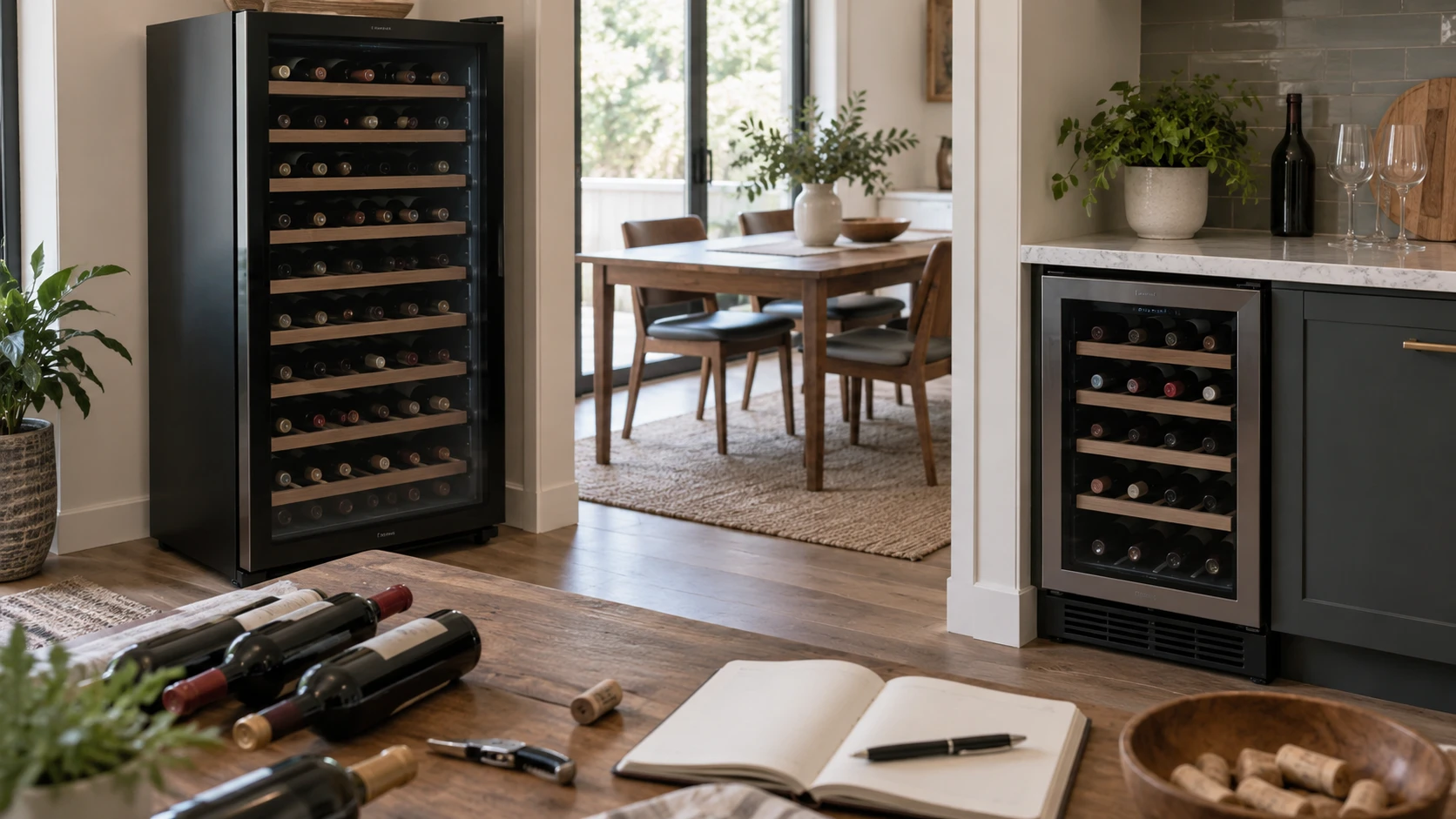
The Whynter FWC-1201BB wine refrigerator is listed as a freestanding cabinet for up to 124 standard 750-milliliter bottles. It has digital temperature controls spanning 40 to 65 degrees Fahrenheit, compressor cooling, an internal circulation fan, and a reversible door. This is a different scale of storage from a cooler kept near the dining area. Count the bottles already owned and the number likely to arrive over the next year before giving a tall cabinet a permanent space.
The published guide to wine refrigerator bottle-fit checks compares other cabinets, but its practical question applies here: does the stated count fit the shapes of the bottles actually collected? A capacity figure based on standard bottles may fall when larger shapes, gift boxes, or shelf changes enter the plan. Sketch how many bottles are opened frequently and how many are being held longer. The two groups may call for different access and placement even if their preferred temperature ranges overlap.
The Sunpentown WC-2194A wine cooler is listed for 21 standard bottles and may be installed under a counter or used freestanding. Its digital control range is 41 to 68 degrees Fahrenheit. A double-pane insulated glass door, reversible opening, security lock, and interior light are named in the saved row. The smaller count can suit a frequently used selection where every bottle is easy to see. It does not serve the same role as a 124-bottle collection cabinet unless the rest of the collection is stored elsewhere.
Start with a bottle inventory — wine refrigerator bottle-fit checks
Write down the bottle shapes and the number that must fit now, then leave room for realistic additions. The Whynter claim is expressly tied to standard 750-milliliter bottles. The Sunpentown row says standard bottles without describing their exact shape or shelf layout. Try a few representative bottles on the intended shelves, including a wider bottle if one is common in the collection. Check whether a shelf can be moved or removed according to the current manual, and measure how much capacity that adjustment costs. A numerical capacity should be tested as an arrangement, not treated as a guaranteed fit for every label.
The 124-bottle Whynter offers much more stated capacity than the 21-bottle Sunpentown, but a larger interior also takes longer to organize and search. Group bottles in a way the owner will remember: for example, by drinking window or by the part of the collection used at dinners. Leave frequently opened bottles where they can be reached without shifting several others. A quick inventory list on paper or a phone can help if the cabinet is nearly full. If only a few bottles are kept at one time, unused shelf capacity may be less valuable than a convenient position near where drinks are served.
For the smaller cooler, test the access pattern with bottles in place. A 21-bottle arrangement can become awkward if removing one bottle requires lifting another from a tight shelf. The saved Sunpentown excerpt does not list shelf dimensions or a complete accessory inventory. Confirm these before deciding where particular bottle shapes will sit. Its security lock may be useful in a shared space, but check where the key is stored and whether the door can still be opened conveniently during ordinary use. A lock is a control feature, not a substitute for a sensible location.
Measure the cabinet space and door swing — Sunpentown WC-2194A wine cooler
Whynter's saved row gives two close sets of outer measurements: 55.5 by 23.5 by 22.5 inches in the product dimensions and a rounded 56 by 24 by 23 inches in its listed size. Confirm the height, width, depth, and required clearances from a current model-specific source before ordering cabinetry or clearing a floor spot. This model is described as freestanding; the saved row does not authorize enclosing it under a counter. Include room to open its reversible door and reach the lowest storage position without moving furniture.
The Sunpentown row explicitly permits under-counter or freestanding use, yet the saved excerpt does not give exact dimensions or ventilation clearances. Measure the available opening and check the manufacturer's installation instructions for this exact unit. An under-counter space needs room for the door to swing, a hand to reach bottles, and the ventilation path the unit requires. Test a full-size cardboard outline if the margin is narrow. Do not infer that every small wine cooler can be built in merely because this listing describes that option.
Both rows name reversible doors. Decide which side should hold the hinge by standing where a person will remove a bottle and opening a mock door into the room. Check for a cabinet handle, adjacent wall, or chair that would interrupt the swing. On Whynter, the size of the door and tall cabinet can make reach important at the top and bottom. On Sunpentown, the under-counter position may force a person to bend while pulling a bottle from a low shelf. These everyday movements matter more than the door direction shown in a product photograph.
Compare controls and temperature checks — wine refrigerator bottle-fit checks
Whynter's digital control range is 40 to 65 degrees Fahrenheit. Sunpentown's is 41 to 68 degrees Fahrenheit, with a display that can show Celsius or Fahrenheit. The ranges overlap, and neither saved row establishes a separate upper and lower temperature zone. If different groups of wine need separate settings at the same time, verify that requirement against the actual cabinet design before purchase. One control range on a listing cannot be read as proof that two independent climates exist inside the unit.
Put an independent thermometer in a representative location during the first days of use, then check it at different times and with the intended load. A setpoint is a command to the cooling system, not a measured temperature at every bottle. Whynter's compressor and internal fan are described as helping circulate air. Sunpentown's row also names a circulation fan and automatic defrost, but it does not state a cooling mechanism comparable to Whynter's compressor description. Check current technical specifications if that difference matters to the buyer.
The Sunpentown listing says it restores the last temperature setting after a power failure. That is useful to test during setup with the manufacturer's safe procedure, especially where brief outages occur. Whynter's saved excerpt does not describe a comparable memory function. If an outage would be costly for the collection, decide how someone will notice it and verify the cabinet temperature afterward. A remembered setpoint does not establish how long the interior remained within a desired range while power was absent.
Consider light, access, and maintenance — Sunpentown WC-2194A wine cooler
Whynter's black cabinet has an interior LED light with its own on/off switch. Sunpentown also lists an independently switched interior light and a double-pane insulated glass door. Check how the selected unit looks at the intended position, including whether glare makes bottle labels harder to read. Keep the light use consistent with the current product instructions. The saved Whynter row does not describe a glass specification, and the Sunpentown row does not establish the same cabinet color. Judge appearance from the exact offer rather than assuming the two doors are built alike.
Sunpentown names automatic defrost, a leveling leg, and an insulated glass door. Level the unit according to its instructions and check that the door seals evenly. The Whynter excerpt does not state its defrost method, so read its care guide for any draining or cleaning steps. For either cabinet, leave enough space to remove bottles and wipe a shelf without risking a dropped bottle. A cooler that is inconvenient to clean may be left crowded with spills or torn labels even when its temperature control works well.
The Sunpentown row also notes ETL and ETL Sanitation listings. Those listings do not by themselves show that a particular bottle arrangement fits or that the unit maintains every shelf at an identical temperature. Whynter's saved row does not present matching certification information. Verify any certification needed for the planned setting from current documentation, especially if the cooler will be used in a business. For a home, the practical checks remain the installation location, temperature reading, door seal, and access to the collection.
Decide by storage role — Sunpentown WC-2194A wine cooler
Whynter may suit a growing collection when a freestanding floor position is available and the owner is willing to organize a tall, high-capacity cabinet. Its stated range, reversible door, fan, and compressor should be tested with a realistic bottle load. Sunpentown may suit a smaller selection close to where it will be served, provided its under-counter dimensions and clearances fit. Its lock, setting memory, and reversible door may be useful in a shared room, but the stated 21-bottle limit is a real planning constraint.
Confirm both cabinets' exact dimensions and current installation instructions before buying. Put representative bottle shapes into a proposed shelf plan and decide which bottles must be easy to reach. After setup, check the actual interior temperature and door seal rather than relying only on the display. The better match is the cabinet whose capacity, location, and daily access fit the way the collection is used.