Educational & Explainer Articles
Why kaleidoscope patterns repeat: mirrors and the changing view
Understand repeated reflections, changing motifs and the limits of retail details for the Hygloss set and Roorkee three-mirror kaleidoscope.
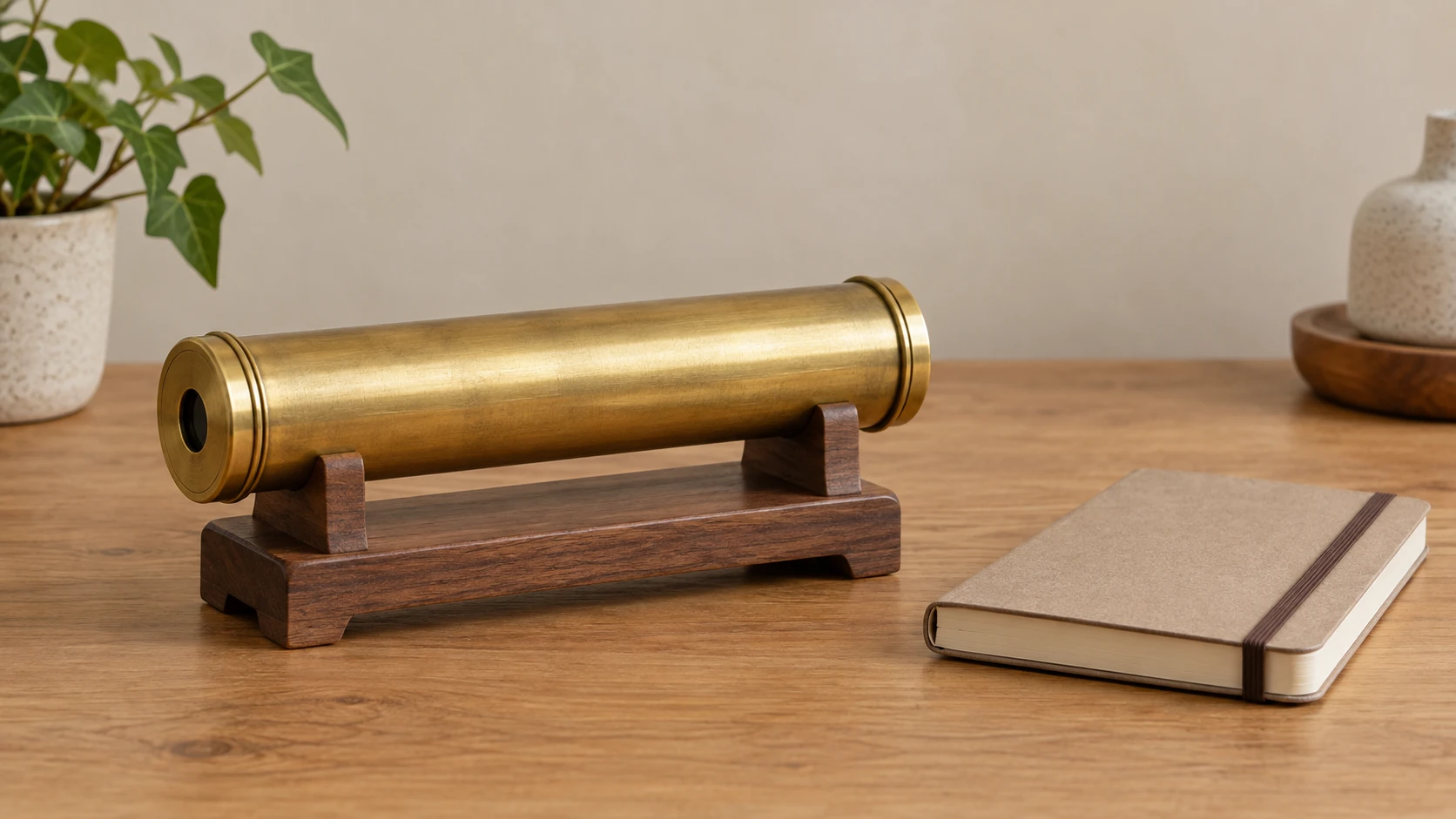
Why kaleidoscope patterns repeat comes down to reflected images. The objects supplying a motif need not be arranged as a complete star or flower inside the instrument. Mirrors show those objects along several reflected paths, joining the resulting views into a repeated pattern. Changing the objects' arrangement can change the motif while the mirror arrangement continues to organise its repetitions.
Keep the reflected view separate from the physical collection of beads. It also helps when reading a retail description. A statement about three mirrors concerns the reflecting arrangement. A statement about glass pieces concerns the objects being viewed. Neither supplies every angle, dimension or performance detail of the finished instrument.
One object can supply several visible images
Begin with the familiar distinction between an object and its reflection. A reflected view of an object is not another physical copy placed behind the mirror. The light reaching the observer has followed a reflected path. In a kaleidoscope, several such paths can show the same object in different apparent positions.
Sir David Brewster's 1870 third edition of The Kaleidoscope: Its History, Theory, and Construction explains the instrument through combinations of reflecting planes. His first chapter follows the images made by two mirrors and the further images produced through successive reflections. His second considers how direct and inverted forms combine into a symmetrical picture.
The distinction between a direct view and a reflected view matters. A visible pattern can contain an object seen directly alongside images formed after reflection. Counting every visible appearance as a physical piece would confuse the pattern with its contents. Several appearances of a coloured fragment do not establish that several matching fragments were supplied.
Successive reflections extend the idea beyond one mirror showing one object. A view formed by one mirror can contribute to a further reflected view involving another. Brewster works through those relationships in detail. The explanation concerns the paths making the pattern, rather than a hidden mechanism that manufactures or prints more objects inside the tube.
Kaleidoscope mirrors and symmetry concern the whole arrangement
Kaleidoscope mirrors and symmetry belong together because the reflecting planes organise where images appear and how neighbouring views relate. The original object can be irregular. A reflected version can meet its counterpart in a regular relationship, making the combined appearance seem more ordered than the object that supplied it.
Reflection and simple repetition are different ideas. Repeating the same mark in the same orientation preserves that orientation. A reflected mark changes its relationship to the reflecting boundary. Brewster's account distinguishes direct and inverted forms rather than describing the pattern as a collection of identical stamps all facing the same way.
Imagine a fictional asymmetrical coloured mark, with a small projection on one side. Repeating that mark around a centre without reflection would retain its facing direction. Pairing it with its reflected form changes how the neighbouring projections relate. The example explains an image relationship; it describes no particular piece supplied in either selected product.
Keep the reflecting arrangement in the explanation. Mirror number alone does not tell you all the angles or the resulting field. Brewster discusses more than one configuration, and his analysis depends on geometry and object position. A retail description naming three mirrors therefore needs more information before it can support an exact diagram of that product's internal layout.
An ideal angle example has clear limits
In Brewster's two-mirror discussion, a 60-degree opening is one sixth of a full circle. His explanation follows how the directly viewed sector and reflected sectors fill the circular arrangement. That is an ideal geometry example with its own stated conditions. It is not evidence that either selected retail offer uses two mirrors at that angle.
Keep sectors, images and objects distinct when following such an explanation. A sector describes a portion of the apparent field. An image describes a visible representation formed along a viewing path. An object is the physical source of the viewed form. The same count should not be transferred among those categories without explaining what was counted.
Brewster also examines arrangements that do not make the same neat junction. His account considers how object position and mirror inclination affect whether the last parts join symmetrically. Symmetry follows from specific relationships. It is not a universal promise that any two reflective surfaces will create the same complete picture.
For three reflectors meeting at 60 degrees in his separate discussion, Brewster describes an equilateral-triangle arrangement and an extended pattern of reflected triangles. That is another defined example. The three-mirror wording in a modern product description does not, by itself, bind that product to his particular angles or prove an exact visible repetition count. A diagram illustrates its stated arrangement; it cannot establish the unseen construction of a retail instrument without evidence.
Why turning a kaleidoscope changes the picture
Why turning a kaleidoscope changes the picture depends on what moves in the actual instrument. When the viewed pieces change their arrangement relative to the mirrors, the image supplying the repeated motif changes. The reflecting arrangement can continue to organise that new image even though the colours and shapes now meet differently.
A changed motif and a changed repetition rule are separate possibilities. Imagine the same mirror arrangement viewing two different positions of a coloured fragment. The fragment can appear elsewhere in the repeated field without the mirror angles having changed. You do not need a different reflecting structure for every new arrangement of the contents.
That explanation does not identify the mechanism of every product. An object cell, the tube and a viewing arrangement can be constructed in different ways. Obtain the matching operating information before assuming which part turns or whether any part is intended to open. This article gives no instruction for dismantling either selected instrument.
Nor does a changing view guarantee that a particular pattern can never recur. The retail phrase endless color expresses an appealing experience rather than a documented count of unique outcomes. A pattern can be enjoyable without a mathematical promise that every future view will differ from every earlier one.
The Roorkee listing names three mirrors and a dry chamber
The Roorkee Instruments brass kaleidoscope with wooden display stand describes a three-mirror system and a side-lit object chamber. Its dry chamber contains lampworking glass pieces and glass beads. Those are distinct parts of the account: the mirrors concern reflected views, while the chamber contents supply forms and colours to be viewed.
The native brand is Roorkee Instruments (INDIA) A Nautical Reprodcution House. Retain that product identity when requesting further information. The description also names a lacquered, etched brass surface and a wooden display stand. These statements describe the offered object and supplied stand; no material inspection or optical handling test was performed for this article.
The text does not state the three mirror angles, a visible field measurement, an exact repetition count or the dimensions of every component. Side-lit identifies the description's illumination wording. It does not supply a procedure for choosing a light source or establish a result under every lighting condition. Use the actual operating instructions for handling and viewing.
The dry-chamber wording should not be converted into a liquid-filled-cell claim. Likewise, named glass pieces do not establish their complete count, dimensions or every possible colour. The title's reference to adults and kids supplies no age approval here. Obtain the actual suitability information when choosing an instrument for a particular user.
The Hygloss set leaves the internal details unstated
The Hygloss 1430159 kaleidoscope set of twelve is listed in Science & Education. Its short native description identifies a Make Your Own Kaleidoscope set, the quantity and model. It does not provide the complete component inventory, assembly sequence, mirror count, mirror angles or finished dimensions.
A quantity of twelve answers the listing's package question. It is not a stated count of sectors in one view or glass pieces in each object cell. Keep the quantity attached to the offered set while asking what each supplied unit contains. A make-your-own title does not supply instructions that the retrieved description lacks.
For a planned group activity, obtain the actual contents and matching instructions before deciding what preparation is required. This article does not turn Brewster's historical construction discussions into assembly directions for the Hygloss package. The modern materials and supplied parts need their own instructions and suitability information.
Neither selected offer is treated as an optical benchmark for the other. Roorkee's description provides some internal details; Hygloss's provides fewer. That difference establishes the available documentation, without proving which instrument produces a preferred view, has better mirrors or is more appropriate for a particular user.
The observer sees a field through a particular opening
The position from which a reflected arrangement is viewed belongs to the explanation as well. Brewster specifies the eye position while following his two-mirror example. An observer has to receive the relevant reflected light to see that image. A drawing of several mirror planes on paper therefore needs its viewing assumptions; it does not show every possible appearance from every position around a real instrument.
Keep that distinction when recording a view through an actual opening. Describe the visible arrangement without assuming that an outside photograph of the barrel shows the optical field inside. The outside photograph can identify the object or its decoration. A photograph taken through the viewing opening concerns another view and needs its own description. Neither independently measures the internal mirror angles.
The word mandala in the Roorkee description characterises the image's appearance. It does not supply a technical drawing of the reflectors or a count of physical pieces. A pattern name can help describe an impression while leaving those construction questions open. Use the supplied structural statements for the structure question and the observed view for the appearance question.
Separate a physical pattern from an optical one
The bead-pattern planning tutorial concerns physically placing beads in a recorded sequence. A kaleidoscope's repeated image has a different relationship to its contents. Counting apparent repeats through the viewing opening cannot replace an inventory of the actual pieces in its chamber.
A record of the view can still be useful. Describe what you observed and the instrument reference, keeping an observation separate from an explanation of unseen parts. A visible repeated colour is an observation. A claim about exact mirror angles requires additional evidence. Enjoying the pattern does not depend on filling that gap with a guess.
The window-art afternoon guide considers the composition of a room's view using actual decorative listings. Its arrangement choices concern a physical window scene. Here the visual arrangement arises through reflected images. Neither guide supplies the other's application method or an approval for modifying glass.
Keep the optical questions with the purchase
If you consider purchasing a kaleidoscope through republeq with crypto such as USDT, identify the exact offer and the information still needed about it before proceeding. The Hygloss description names a set of twelve without a complete inventory or assembly instructions. The Roorkee description names three mirrors, a dry chamber with glass pieces and beads, and a wooden stand. A preferred payment method cannot make those descriptions interchangeable or supply missing suitability information. Ask the supplier the questions that matter for the intended user and retain the answer with the product reference. At checkout, inspect the payment choices available for the selected basket. Cryptocurrency appears among the categories in the retrieved product records; that broad category does not specify a token, transfer network or complete payment arrangement for a later order. If you want to use USDT, follow the actual presented instructions only after clarifying any missing detail. No wallet address, network selection or transfer procedure is furnished here. Review the current delivery and return information attached to the purchase. A planned viewing session does not establish an arrival date, and a package quantity does not promise a particular optical result. Keep the order confirmation together with the confirmation supplied by the selected payment route. Those records should identify the same offer and transaction if a later enquiry is needed. Choosing an available payment route supplies no evidence about mirror alignment, age suitability or the contents of an unopened package. Leave the purchase unresolved while necessary product or checkout questions remain unanswered for this purchase.
Read a kaleidoscope as a relationship between objects, mirrors and the observer's view. The objects provide the motif; reflected paths organise its appearances. Keep that explanation separate from the specifications a particular retail description has yet to supply.