Dishwashers
Observe wet dishwasher dishes before blaming the dry phase
Build a clear account of which items are wet and where the water remains before asking about an unexplained dishwasher result.
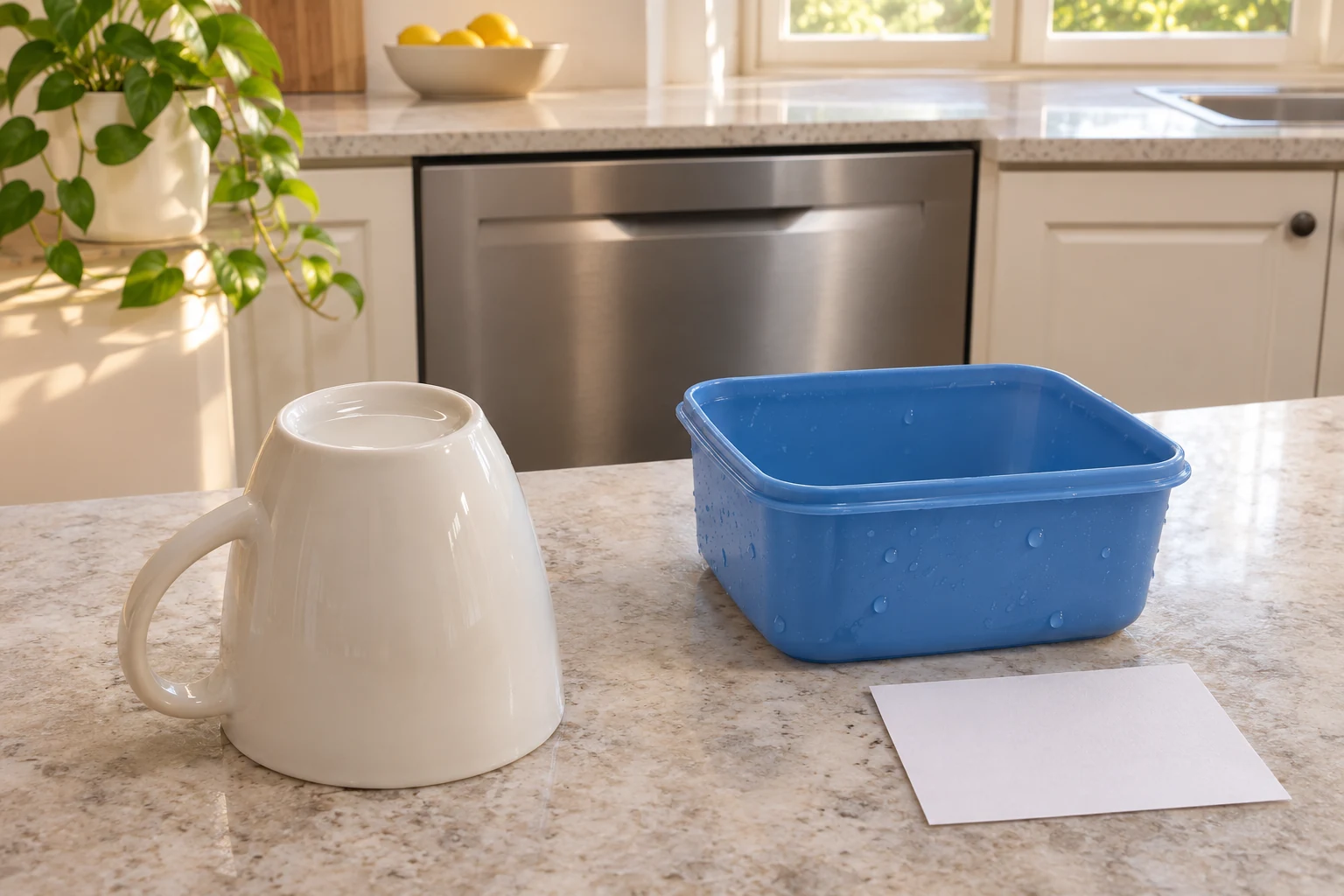
Conceptual after-cycle observation; generic cooled dishwasher and cup recess water, no exact appliance or tested drying result.
Describe wet dishwasher dishes before deciding what the dry phase failed to do. Name the actual item and the place where water remains. A broad statement such as “nothing dried” can hide a much narrower observation. GE's Dry Cycle Operation guidance gives two useful limitations to keep beside that question: plastic items do not dry well, and the dishwasher does not dry puddles collected in the bottom of a glass or cup.
Keep a limitation separate from a diagnosis
Those GE statements do not prove that every wet load is normal. They also do not identify a faulty component in your appliance. They establish why a report about an actual plastic item or collected cup water should remain specific. Describe what you found, then consult the applicable instructions or support about the behavior that remains unexplained.
This guide adopts no inlet-temperature adjustment, rinse-aid filling step, heated-dry selection or service procedure from the source. It does not ask you to repeat a disputed cycle, touch hot dishes or open an appliance panel. No load has been washed or measured for this article. Its narrower purpose is to make an account of an already observed result useful.
Begin with the item you actually mean
Choose the item that prompted the concern. “The blue container” or “the white cup” may be enough to distinguish it in your own kitchen. If the conversation is with somebody who has not seen the load, add a plain description. Do not begin by assigning a material, model or treatment that you cannot identify from the actual item.
Record where the water was seen. For your particular account, it may have been collected in a recess or visible across another surface. Use the description that fits your observation rather than borrowing a phrase from an example. If you noticed only one side, say which side you saw and leave the unexamined area unreported.
A photograph can preserve an observation without deciding its cause. Keep the particular item recognizable and explain what you intended the picture to show. If the photograph does not make the water clear, retain a plain written account rather than treating the image as proof of a detail it does not reveal. This is a reporting suggestion, not a test method.
Separate your own observation from another person's summary. If someone says the dishes were wet but you saw only a cup afterwards, those are two accounts with different scopes. You can preserve both without enlarging your own. Ask which items they meant before writing that the entire load had the same result.
Distinguish collected water from a general description
The phrase collected water identifies a location in your account. It should not silently become an explanation for everything in the machine. If you saw water gathered in one part of a cup, keep that finding attached to the cup. Other items may still need their own descriptions before you can give a broader account.
Likewise, “wet” can be an accurate but incomplete description. A person receiving it may not know whether you mean a visible pool, separate droplets or a surface you have not examined closely. Say what you can support. You need not invent a quantity or a comparison with an earlier load to make the report sound more technical.
If more than one item concerns you, give each a short entry. You might distinguish a particular cup from a particular container without treating them as matched samples. The article supplies no controlled comparison between those materials or shapes. The benefit of separate entries is that a reply can address the item you actually asked about.
A limited observation can remain useful when the rest of the load is unknown. “I noticed this cup; I did not check the other dishes” states an honest boundary. It supplies a clearer starting point than either “everything failed” or “everything else was fine” when you have evidence for neither statement.
Identify the appliance without inferring a performance result
The GE GDF550PSRSS dishwasher offer names the GDF550P collection. Its five whole gallery frames show the closed appliance, loaded interior, installed setting and controls, including Dry Boost wording. Dishes, cookware and kitchen props are staging. The native material establishes no measured dry result, factory model authentication from the pictures or remedy for your load.
The GE GDT670SFVDS dishwasher offer identifies SKU 5145260923 and UPC 084691914471. Its five whole gallery frames show the appliance, empty interior, controls and installed scenes. Racks and baskets are integral components; kitchen props are staging. The description's unexpanded “Feature 8” adds no specification. No drying result is inferred from its controls or photographs.
These are separate appliance references rather than a drying contest. A button label does not report how an actual household load finished. Keep the exact model of the appliance involved in your concern beside the observation. Neither linked offer establishes what happened in another unit or which option somebody selected there.
If the model is uncertain, leave that point open while obtaining applicable information. A reply about another dishwasher should stay attached to that model. It may help you understand the question while leaving your own result unresolved. Do not substitute a similar-looking appliance in the report to make an available answer seem applicable.
Write an account of a single occasion
Imagine an original fictional example. Ellis is describing dishes after a household cycle, once they are cool enough to handle under their applicable instructions. A white cup and a blue container caught Ellis's attention. This scenario reports no real dishwasher test and assigns no actual result to either linked offer.
Ellis initially writes, “The dishwasher did not dry anything.” On rereading, Ellis realizes that only the cup and container were noticed. The revised account names those two items and leaves the other dishes unreported. It is a narrower statement because the observation was narrower, rather than because Ellis has decided the appliance is working correctly.
For the cup, Ellis notes where water appeared to have collected. For the container, Ellis uses the description actually observed without assuming the same pattern. The note does not call one a failed test and the other a successful test. It preserves two observations from an ordinary occasion, with no claim of controlled conditions.
Now suppose a second person says they saw another wet item. Ellis adds that person's account as a separate entry and asks which item they meant. There is no need to make the new information agree with the first note. The broader picture can change while the original account remains an accurate statement of what Ellis personally noticed.
The example stops before a technical conclusion. It does not end with Ellis changing a setting, adding a product, replacing a part or proving a cause. A real account should leave an equally clear stopping point when those things have not happened. A precise description is a completed reporting task, even while the equipment question remains open.
Keep remembered settings at their actual level of certainty
If you know which program or drying option was selected for that occasion, retain its exact name in the account. If you do not know, write unknown. A familiar button visible in a product photograph does not establish what was selected in your kitchen. Nor does a setting remembered from last week establish the choice for this particular occasion.
When another person selected the cycle, ask for their actual recollection without supplying the answer in your question. They may remember the program but not an additional option. Preserve that partial answer. Filling the gap with a likely setting would create a more complete-looking record while making it less reliable.
Keep a later discovery separate from the original observation. For example, finding a manual afterwards gives you a document to consult; it does not retrospectively establish every control choice. Add the applicable reference and the question it helps you ask. Do not rewrite the occasion as though you had already confirmed a detail that remains unknown.
Use adjacent guides for the questions they own
The dishwasher rinse-aid spill guide addresses a named Farberware filling incident and its applicable cleanup instruction. That is a different task from describing an unexplained wet item. This article does not infer a spill, recommend an additive or transfer the Farberware procedure to a GE appliance.
The M optimized and Miumaeov comparison examines water supply, counter placement and buying questions for different countertop appliances. It briefly notes that some loads retain water, but it supplies no diagnosis for either GE offer. Keep those purchase questions separate from the occasion you are describing.
Prepare the unresolved question for support
A useful enquiry names the appliance, the actual items and the observed water location. It can also state which setting details are known and which are not. Ask about the particular result that remains unexplained. You do not need to announce a failed component before somebody qualified has considered the relevant account.
If your concern involves several items, keep the questions distinguishable in the enquiry. You may have a clear description for one item and an incomplete account of another. Ask about each at its actual level of certainty. Do not make the second entry appear settled merely because you have found guidance relevant to the first.
Read any answer for the item and occasion it actually addresses. An answer about collected cup water may leave another item's condition unexplained. Retain a useful partial answer without labelling the entire concern resolved. Where the next action requires an applicable operating instruction or service, obtain that guidance for the actual appliance.
Leave a replacement purchase as a separate decision
If you separately consider buying an appliance through republeq.com, keep the purchase proposal apart from the unresolved observation about equipment you already have. This article establishes no need to replace a dishwasher and promises no drying result from a new one. Identify the exact offered item and variant, then read the current description, delivery arrangements and return terms before deciding to order. Cryptocurrency is a possible route only if the actual checkout for that particular basket offers it at the time. If USDT appears, review the requested asset, network, amount, receiving destination, expiry and confirmation instructions before authorizing anything. A token name alone does not identify the network requested by a payment service. This article provides no wallet address and guarantees no coin, provider, fee, exchange rate or successful transaction. Check the displayed total and any shipping charges or taxes, using the actual order information rather than a figure remembered from a different purchase. Ask how cancellation, returns and refunds apply to the proposed payment method when those terms remain unclear. Keep order references and any actual transaction identifiers in private purchase records, without sharing wallet keys or recovery information. If another person helps with the order, send the exact selected offer and the unanswered product questions together. A proposed substitution should come back for consideration rather than inherit an earlier decision about a different model. If an order or payment attempt has an uncertain outcome, reconcile that exact attempt before considering another transfer. An unconfirmed result is not proof that nothing happened. A completed purchase record would identify an order; it would not diagnose the earlier wet item or establish a tested result for delivered equipment.
Return to the item that prompted the concern. Write what was wet, where water remained and which details are still unknown. Take the remaining specific question to the applicable instructions or support.