Crypto Commerce
WANAI 4.5 cu ft two-door mini fridge vs Upstreman 3.2 cu ft two-door mini fridges
Compare WANAI 4.5 cu ft two-door mini fridge by compartment capacity, freezer room, cabinet fit, temperature claims, energy evidence, and saved price.
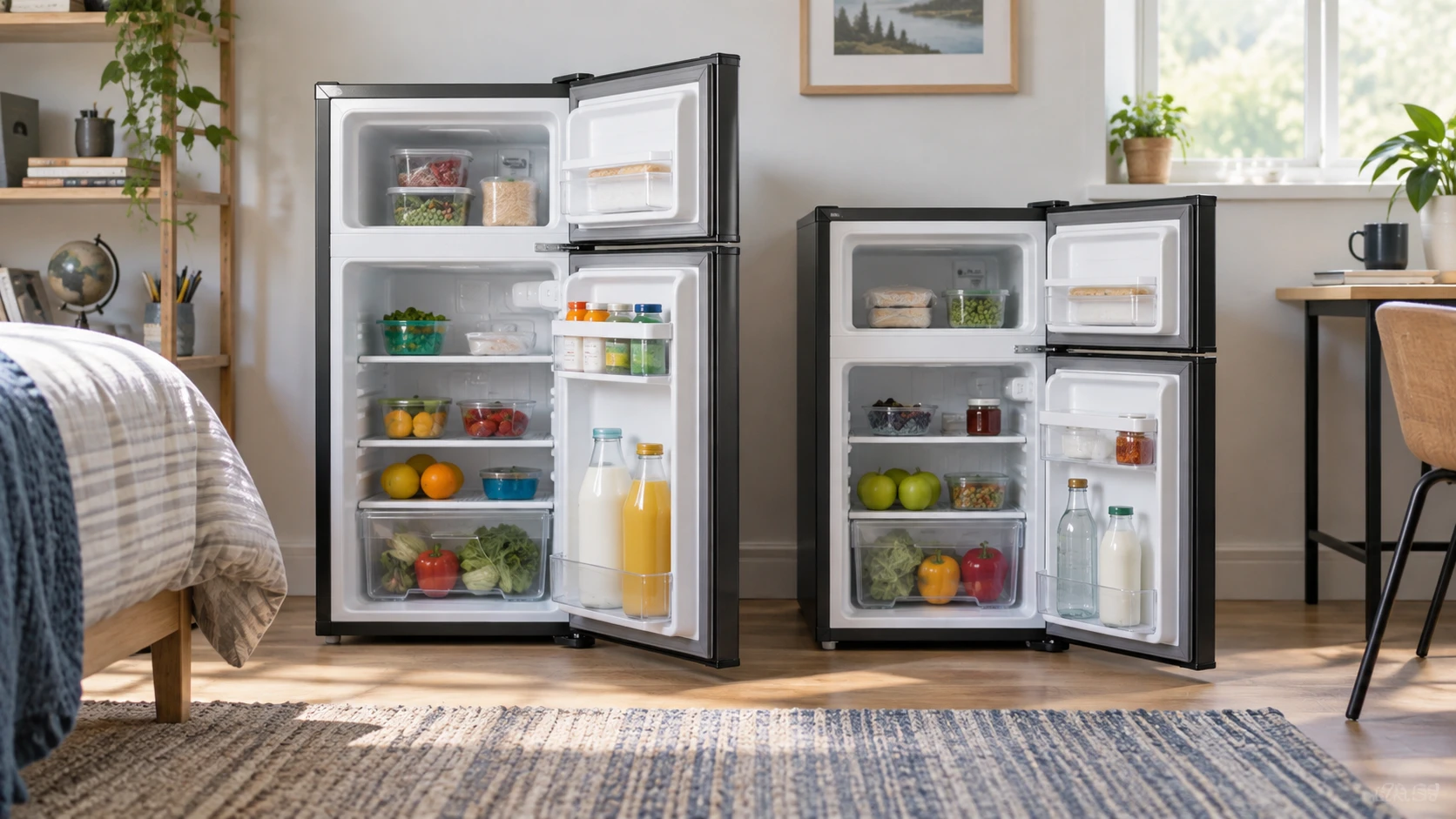
Two-door mini fridges can give a small room separate access to chilled food and frozen items, but a capacity label does not show how much space each compartment provides. WANAI's listing calls its unit 4.5 cubic feet. Upstreman lists a 3.2-cubic-foot BD321. Both descriptions mention adjustable shelves, a crisper, and reversible doors. Before choosing the larger number, check the actual compartment measurements and where either cabinet can stand with its doors open.
The September 30 catalog snapshot marked both products available, with saved minimum prices of $323 for WANAI and $224.99 for Upstreman. Both exact product pages and a related guide returned HTTP 200 on October 3. Those facts do not establish current stock, checkout price, or a measured temperature test. The listings also contain different levels of dimensional detail. Use them to narrow the questions for the current manuals and Republeq's catalog entries, especially if a dorm, apartment, or office has a tight appliance space.
Resolve the capacity numbers first — refrigerator compartment capacity beyond the total number
The WANAI 4.5 cu ft two-door mini fridge title gives 4.5 cubic feet. Its description separately assigns 1.2 cubic feet to the freezer and 2.3 cubic feet to the fresh-food compartment. Those compartment figures add to 3.5 cubic feet, one cubic foot below the title's total. The saved listing does not explain the difference. It could reflect an error or a different way of reporting cabinet volume, but neither explanation is verified here. Ask for the exact model's specification sheet and compartment dimensions before counting on 4.5 cubic feet of usable food space.
Upstreman lists 3.2 cubic feet across a fridge and freezer area. Its saved description does not break that total into separate volumes. It may serve a household with mostly fresh food differently from one that needs several frozen meals, even if the total seems adequate. Request a diagram or internal measurements. A freezer that takes much of a compact cabinet can leave less fresh-food room than expected. Shelves, door bins, and the crisper further shape what can fit.
The published refrigerator compartment capacity beyond the total number guide addresses this general problem for another refrigerator. Use its compartment checklist with your grocery list. Count the bottles, cartons, meal containers, produce, and frozen packages that arrive together after shopping. Ask how many can stand upright without blocking airflow or hiding food behind other items. A nominal cubic-foot number cannot answer those questions alone.
If this will be a second refrigerator for drinks and snacks, the smaller Upstreman may offer enough useful space. If it will hold all food for a household, the larger WANAI could help, provided its real internal layout and capacity match the offer. Either way, choose the role first. A mini fridge bought for occasional overflow has different demands from the only cold-storage appliance in a studio apartment.
Measure the whole installation space — Upstreman BD321 3.2 cu ft mini fridge
Upstreman gives exterior dimensions of 17.9 by 19.7 by 34.1 inches. These make it possible to sketch a first layout, but they do not include the clearance required for ventilation, door swing, or pulling out a shelf. WANAI's saved description calls its unit compact without giving comparable outside dimensions. Request the current width, depth, height, packaged dimensions, and weight before planning a spot. Do not assume that the higher-capacity cabinet has a particular footprint or will pass through a narrow doorway.
Both Republeq's product descriptions describe reversible doors and adjustable feet. The WANAI listing mentions seven-level temperature control, adjustable shelves, a crisper, and an interior light. Upstreman describes removable glass shelves, a crisper, and a light that comes on when a door opens. These conveniences matter only if the cabinet can be reached. Check the hinge side, how far each door must open to remove a drawer, and whether the floor allows the feet to be leveled. A refrigerator wedged against a wall may lose access to its full interior even though its cabinet physically fits.
Place the outlet on the same sketch. Follow the exact manual's electrical and ventilation instructions; the listings do not provide a full installation specification. Avoid routing a cord across a walkway or relying on a temporary extension arrangement. If the unit is going into a dorm or rented apartment, check the building's appliance rules and the permitted location before buying. A product description's suggestion that a fridge suits dorms or bedrooms is not authorization from a particular property.
Think about sound in that location. WANAI claims a compressor level of 38 dB or less, while Upstreman lists 38 dB. The saved descriptions do not state matching microphone distance, room, or compressor phase. The equal-looking figures are not a same-method comparison. A cycling compressor can be noticeable beside a bed and unobtrusive across a kitchen. If quiet operation matters, seek a measured test of the exact models or assess the selected unit within a useful return period.
Check temperature by compartment — refrigerator compartment capacity beyond the total number
WANAI's listing describes seven settings and a temperature span from -11°F to 50°F. That broad span appears to cover freezer and refrigerator use, not a promise that every shelf in both compartments can be set anywhere within it. The saved text does not map each control position to a measured temperature in each zone. Ask for the manual's thermostat instructions and use a suitable thermometer after the loaded cabinet stabilizes. A dial number is not the same as the temperature of food.
Upstreman describes five settings, with a refrigerator range of 33.8°F to 46.4°F and a freezer figure of -0.4°F. These are figures in Republeq's catalog under unspecified conditions. Check the maker's instructions for adjustment and placement of food. Repeated door openings, warm groceries, and a crowded shelf can affect actual temperatures. If frozen food storage is a major use, verify the exact freezer guidance and the space available for the packages you buy.
WANAI's stated 1.2-cubic-foot freezer may be easier to plan around once its dimensions are confirmed. Upstreman does not provide a separate freezer volume in the saved description. Avoid deciding freezer capacity from the number of doors alone. A freezer may include shelves or a shape that prevents a large box from fitting. Measure a typical frozen pizza, meal carton, or ice tray and compare it with the internal dimensions rather than the exterior width.
For produce, both pages describe a crisper. WANAI says it helps organize fruits and vegetables; Upstreman calls its drawer a place to keep produce fresh. Neither listing provides a controlled freshness test or humidity-control specification for the exact drawer. The useful question is whether the drawer fits your usual produce while leaving room for milk and leftovers. Cleanable shelves and easy access can matter more than a vague freshness claim.
Read energy claims with their test limits — Upstreman BD321 3.2 cu ft mini fridge
WANAI's listing claims 0.58 kWh per day. Upstreman claims 0.8 kWh per day. If measured under the same conditions, those figures would point toward different energy use, but the saved descriptions do not give a shared test standard, ambient temperature, thermostat setting, or load. They cannot establish what either unit will consume in your room. A warm office, frequent openings, and a colder thermostat can change the result. Ask for standardized energy information for the exact models before translating the claims into an annual bill.
The difference between a 4.5-cubic-foot title and 3.5 cubic feet of listed WANAI compartments also matters for energy comparisons. If the model identity or specification is unclear, the power figure may describe a particular variant rather than the selected offer. Confirm the model plate, package, and energy label. Upstreman identifies the BD321 in its title; verify that the current cart matches that model as well.
Neither product page gives a complete maintenance schedule. Find the current instructions for defrosting, cleaning the door gasket, and leaving the unit unplugged for an absence. The presence of a freezer does not tell you whether its defrost method is automatic. A removable shelf and crisper are useful only if they can be taken out and washed without forcing them past a wall. Plan for routine care when deciding where to place the cabinet.
Compare today's offer rather than only the saved price — Upstreman BD321 3.2 cu ft mini fridge
The saved minimum-price gap is $98.01, with Upstreman lower. WANAI may offer more space if its actual compartments support the 4.5-cubic-foot title, but that is exactly the number to resolve. Upstreman gives dimensions that are easier to use for an initial room plan and a lower historical price. Neither description supplies a matched durability test. Check today's shipping, returns, warranty, and delivery requirements for both. WANAI's saved page mentions a one-year warranty; request the exact current terms and service contact. Ask for comparable Upstreman terms rather than treating their absence from this excerpt as proof there is no coverage.
A mini fridge can cost more in time than its price suggests if a door cannot open fully, the freezer is too small for normal packages, or the unit must be moved whenever a shelf is cleaned. Make a scale sketch of the room, write down a weekly grocery load, and confirm the cabinet and compartment dimensions in the current manuals. Then compare the current WANAI offer with the Upstreman BD321 3.2 cu ft mini fridge offer. The right cabinet is the one that stores your actual food at the right temperature in the space you have.