Cost & Savings Articles
Wallpaper pattern-repeat budget: when four panels need another roll
Follow a fictional phase-aligned roll layout to see why four slightly taller panels need another roll despite enough total length.
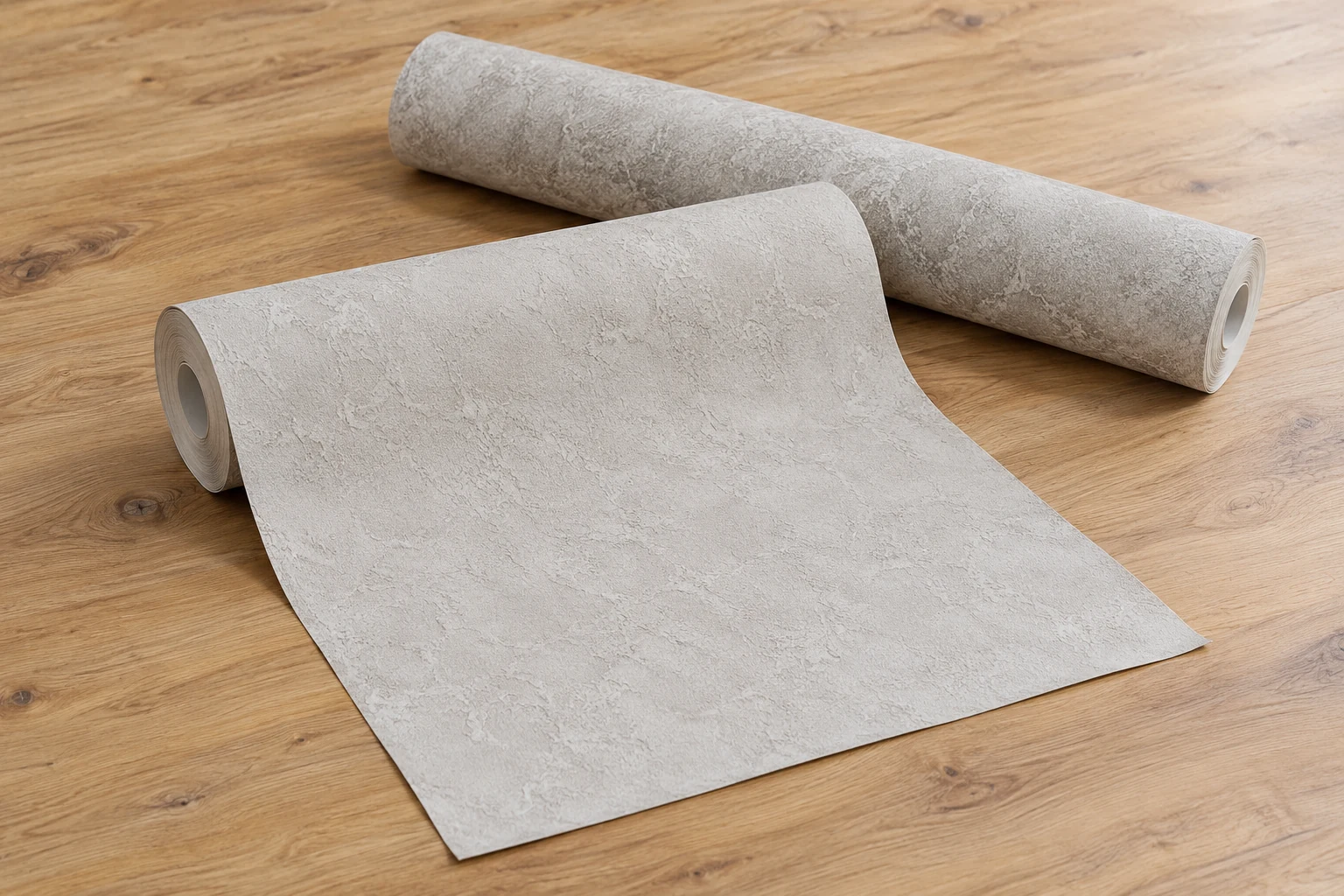
A wallpaper pattern-repeat budget can change when the required panel height increases by a small amount. The total length of paper can look sufficient while the permitted starting positions leave too little room for the last complete panel. A fictional example makes that difference visible: one roll supplies four panels at one height, while a slightly taller version needs another roll.
The Rasch Newcomb Grey Trailing Branches Wallpaper description identifies an 11.8-inch repeat and drop match. It names unpasted vinyl material and a roll 20.9 inches wide by 33 feet long, with about 57.5 square feet of coverage. Keep those statements together as information about this particular offer.
The A-Street Prints Essex Light Grey Geometric Wallpaper description identifies a 20.9-inch repeat and straight match. Its unpasted nonwoven roll is described as 20.5 inches wide by 33 feet long, covering about 56.4 square feet. The two offers therefore supply different repeat and matching descriptions despite sharing a stated roll length.
Brewster's glossary defines repeat through the vertical recurrence of a design. It describes straight matching as strips meeting at the same design position at the ceiling line. It also explains that matching can consume material because strips must start at particular points. That provides context for the example below. The example's dimensions and exact starting rule are invented.
Wallpaper strip alignment fixes the allowed starts
Imagine a paper roll 205 centimetres long. Give its length a coordinate starting at zero and ending at 205. For this exercise, every finished panel must begin at one of the positions zero, 12, 24, 36 and so on. Those positions represent the chosen starting phase of an imaginary repeating design. The rule applies to every panel in this one model.
All panels have the same required width, already supplied by the imagined roll. Width therefore plays no further part in the arithmetic. Each panel must also be one uninterrupted piece. We are comparing two versions of a job requiring four such panels. These premises define the exercise; they supply no installation or cutting method for either listed wallpaper.
In the first version, each panel needs 48 centimetres of length. Begin the first at coordinate zero. It ends at 48, which is also an allowed starting position because four groups of 12 reach 48. A second panel can therefore begin there and end at 96. Continuing in the same way gives starts at 96 and 144 for the remaining panels.
The four end positions are 48, 96, 144 and 192. The last panel ends before the roll's endpoint of 205, leaving 13 centimetres after it. Four complete panels fit under all the stated rules. A fifth panel would extend the sequence to 240, beyond the imagined roll, so this version supplies exactly four complete panels.
For wallpaper strip alignment, keep the panel's start and end positions visible. A note containing only the four-panel total would conceal how the layout meets the required phase. Here, each 48-centimetre panel ends precisely where another permitted start occurs. The taller version below changes that exact fit.
Pattern match cutting loss after a one-centimetre change
Now change the required panel length from 48 to 49 centimetres, leaving every other premise alone. The first panel still starts at zero, but now it ends at 49. The next allowed start beyond that endpoint is 60. Beginning the second panel at 49 would break the rule requiring a start at a multiple of 12.
The second panel begins at 60 and ends at 109. Its earliest permitted successor starts at 120. That third panel ends at 169, so the fourth panel's earliest start would be 180. A 49-centimetre panel beginning at 180 would end at 229. The roll ends at 205. The fourth complete panel therefore does not fit.
Compare this result with the simple material sum. Four panels of 49 centimetres require 196 centimetres in total. That is less than the roll's 205 centimetres. The sum correctly counts the length inside the finished panels, but it leaves out the positions at which those panels are permitted to begin.
The new requirement has added only four centimetres across the four finished panels. Even so, it changes the example's minimum purchase from one imagined roll to two. The difference comes from the gaps between permitted placements. Calling every centimetre in the roll equally available to every part of the job would lose the constraint that produced the extra-roll requirement.
Starting the first taller panel later cannot recover the missing fourth panel. If the first begins at coordinate 12, the earliest following starts move to 72, 132 and 192. The fourth would then end at 241. Starting at zero already gives the earliest possible finish for this model. Moving the entire sequence forward consumes more of the available roll before the final panel ends.
This is the pattern match cutting loss illustrated by the model. The first two spaces between panels each measure 11 centimetres: from 49 to 60, then from 109 to 120. These spaces are part of the roll's length even though they belong to none of the three full panels obtained from it.
Read the remaining paper by its position
After the third 49-centimetre panel ends at 169, the model has 36 centimetres of roll remaining. Add that tail to the two 11-centimetre spaces and the unassigned material totals 58 centimetres. That total exceeds the 49 centimetres required for another full panel. It still does not supply that panel under the uninterrupted-piece rule.
The material occupies separate intervals. One piece lies between the first and second panels, another between the second and third, and the tail comes after the third. Adding their lengths removes information about where each piece begins and ends. The exercise requires a complete panel from one interval, so its calculation must preserve those boundaries.
Even the tail's full 36-centimetre length is not available to a new panel with the specified starting phase. Its first allowed start is coordinate 180, leaving 25 centimetres before the roll ends. The 11 centimetres between 169 and 180 come before that permitted start. A length measurement alone does not express this second limitation.
Try a separate, shorter-panel question within the same imagined roll. A 24-centimetre panel could begin at 180 and end at 204. It meets the starting rule and stays within the roll. A 26-centimetre panel beginning there would end at 206 and fail to fit, although the tail's overall length is 36 centimetres.
This shorter-panel exercise gives a precise meaning to a potentially useful offcut. Its usefulness depends on a specified panel and an allowed start. It does not repair the original four-panel requirement, which still calls for four uninterrupted 49-centimetre panels. Adding a different small panel to the exercise changes what the remaining paper can supply.
If a proposed revision allows joining pieces, that revision changes a premise. It needs its own account of the permitted joins and intended result. No joining arrangement is supplied here. Keeping the original rule visible lets another reader understand why the 58-centimetre sum was insufficient without treating it as permission for any physical wallpapering technique.
Locate the threshold before calling it a saving
The two versions have a useful boundary. At 48 centimetres, a panel uses four complete 12-centimetre periods. Increasing its length to 49 passes the next panel's former starting point. Every later panel must move forward to the next allowed phase. That is why a small change in the finished height can produce a larger change in the required supply.
Keep the 49-centimetre finished panel length separate from the 60-centimetre distance between successive starts. The distance includes a panel and the following 11-centimetre gap. It does not mean that the example has changed the required height to 60. A record that gives only that spacing could make another reader believe a different panel was required.
There is also no need to reserve an extra gap after the last panel. Four times the 60-centimetre spacing gives 240, but the fourth panel actually ends at 229. There are three spaces between four panels. The span is therefore one 49-centimetre panel plus three 60-centimetre start intervals. That distinction matters when testing a different roll length.
The roll length also matters. If the second version instead had an invented roll 230 centimetres long, its fourth panel could end at 229 and fit. That additional example changes the roll, not the matching rule. It demonstrates why the required height, allowed starts and available length must stay attached to the same calculation.
A separate variation shows why the repeat number alone cannot rank supply requirements. Keep a 48-centimetre panel but change the invented period to 10 centimetres. Permitted starts then occur at zero, 50, 100 and 150, and the fourth panel ends at 198. The smaller period has produced a longer span than the original 192, although both versions still fit within 205.
The reason is the relationship between the required height and the allowed positions. Forty-eight already fits exactly into the original 12-centimetre spacing. With 10-centimetre spacing, the next panel must wait until coordinate 50. In these examples, comparing the repeat numbers without the panel height would omit the remainder that produces each gap.
The number of required panels matters too. Three of the 49-centimetre panels already fit within the original 205-centimetre roll. Asking for a fourth crosses the supply threshold in this example. A budget based on three panels cannot silently stand in for the four-panel job simply because their individual lengths are the same.
These are quantity findings for invented material, with no selling prices attached. They identify when a planning model changes from one roll to two. They do not establish a monetary saving from choosing either actual offer. An unused interval also has no assigned financial value merely because a different hypothetical panel could fit inside it.
A wallpaper pattern-repeat budget can retain both the finished-material sum and the placement result. For the taller example, those entries are 196 centimetres of finished panels and two imagined rolls to supply the required placements. Recording both makes the apparent disagreement understandable instead of discarding whichever number seems less convenient.
Keep the real matching descriptions separate
The listed A-Street Prints wallpaper identifies straight match, while the Rasch wallpaper identifies drop match. The fictional same-phase rule is not an offset specification for the Rasch offer. Its drop-match wording does not provide a numerical offset here. Likewise, neither real offer uses the invented 205-centimetre roll or 12-centimetre repeat.
The native pattern photographs are close views of the designs. They show no measured strip layout for a particular wall. A visible motif therefore supplies no replacement for a repeat specification, a roll's stated dimensions or the actual matching information. The exercise has kept its imagined coordinates separate from those product photographs throughout.
For a real quantity estimate, the relevant wall and product inputs need their own applicable information. The four-panel case has assumed uniform width and height and has specified no openings, sloping edges, trimming allowance or damaged material. Changing those premises produces a different problem. No universal extra-roll allowance follows from this particular model.
The room measurement sketch guide keeps supplied lengths attached to named reference points. That distinction remains useful when assembling the dimensions for a wallpaper question. Its scale-drawing exercise supplies no wallpaper matching offset or order quantity, and this article supplies no laser-measurement procedure.
The caulk coverage budget guide explains a volume requirement before counting containers. The material models differ: this example must preserve the separate intervals and starting phases of unbroken panels. Combining lengths in a sum cannot remove those premises or turn disconnected pieces into the panel required here.
Keep the original two plans together: four 48-centimetre panels finish at 192 within one imagined roll; four 49-centimetre panels would finish at 229 and need two. The finished-material sum remains useful beside those endpoints. A later change to the required height can then be checked against the same visible placement rules.