Cost & Savings Articles
Waffle maker replacement payback needs a supported saving
Assess waffle maker replacement payback using extra outlay and a supported recurring saving, keeping Disney and ChicHomey power labels out of false forecasts.
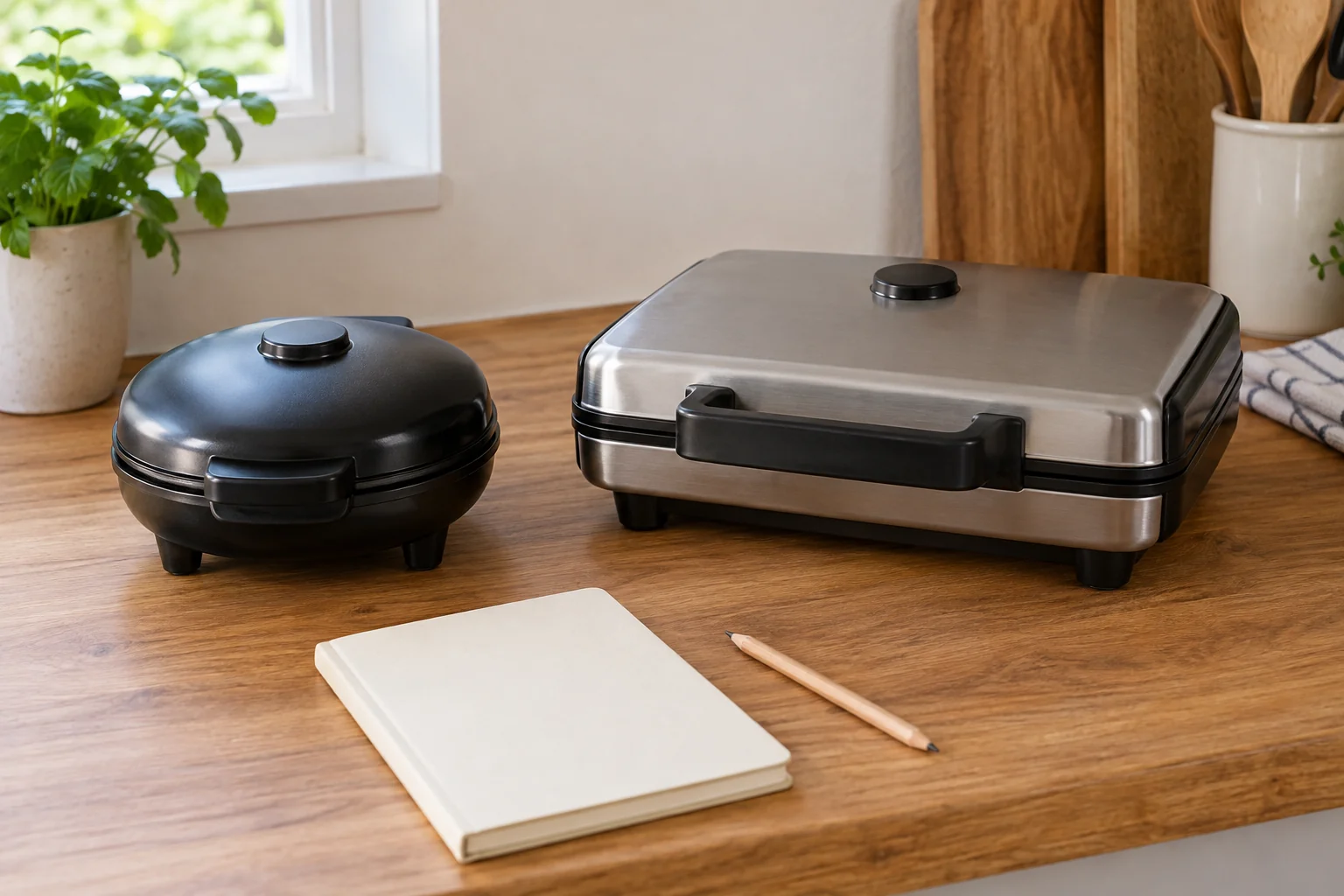
Waffle maker replacement payback asks whether a supported recurring saving would recover the extra amount spent on replacing an appliance. A wattage label cannot answer that question alone. You need an actual purchase comparison and an energy-saving estimate that applies to comparable work. If either input is missing, the payback remains unresolved.
The Disney MIC-62 and ChicHomey offers provide concrete examples of why a replacement decision needs more than two power figures. Disney describes a double-flip machine with six Mickey-shaped waffles across two sides. ChicHomey names a timer and temperature range, with a different application account. The descriptions do not establish that they perform an identical household task or that either uses a particular amount of electricity for that task.
Begin with the decision to replace an appliance
Identify the appliance you are considering keeping and the specific replacement you are investigating. Write down why replacement is under consideration. An item that no longer serves the required task raises a different decision from a working appliance whose owner hopes to reduce energy expense. Keep that reason visible before making a savings calculation.
For an energy-only comparison, the proposed alternative needs to serve the actual intended work. Check the waffle shape and batch arrangement you need, along with any control feature that matters to you. Establish the requirements you need. A different feature set can be a reason for a purchase, but its value should stay separate from a claim that energy savings recover the outlay.
Also identify the comparison you are making. Replacing an existing appliance and choosing between two new purchases are different starting points. Identify what you would otherwise spend in the comparison you actually have. A headline purchase figure cannot stand in for every replacement scenario.
Keep energy savings in a replacement budget evidence-based
For energy savings in a replacement budget, begin with energy used for comparable work under stated conditions. Power in watts and accumulated energy in kilowatt-hours are different quantities. The amount of work, the operating pattern and the period included in an observation all matter to what the resulting energy number means.
Virginia Cooperative Extension's Energy Series: Estimating Appliance and Home Electronic Energy Use, authored by Robert Grisso, Martha Walker and John Ignosh, gives the relationship wattage multiplied by hours, divided by one thousand, for kilowatt-hours. It also explains that actual power can depend on the setting used. This guide uses that general relationship without transferring the publication's old illustrative tariffs or typical appliance values into either selected offer.
The actual appliance electricity estimation guide develops that prerequisite using a heater's changing operating states and a Veeboto washer's whole-program question. It distinguishes a listed rating, an assumed operating pattern and an accumulated energy observation. Use that distinction before claiming a recurring saving here. Its heater and washer examples provide no waffle-making consumption figure.
An energy estimate should cover the same intended work on both sides of a replacement comparison. A figure for one completed session cannot be compared directly with another appliance's isolated power rating. If the available information does not establish comparable energy, retain that missing input. Do not create a saving by assigning both appliances the same unverified time at their listed wattages.
The Disney MIC-62 has its own task and rating
The Disney MIC-62 Black and red double-flip waffle maker identifies SKU 375943303 and UPC 655772017307. Its description names double-sided rotating plates with three waffles per side, six total. That is the offer's stated batch arrangement. It gives no measured time or electrical consumption for a completed batch in your household.
The listing states 120 volts and 1400 watts. It also names adjustable browning control, nonstick plates, an illuminated power switch and ready lights described as indicating when the waffles are cooked. These are product statements, without a complete control sequence or a measured result for a particular recipe. This article gives no batter, cooking, rotating or cleaning instructions.
The six-waffle account does not establish six identical portions for every person or an hourly production rate. Keep the product's stated arrangement with its identity. If the intended work requires a particular shape or batch outcome, obtain the applicable information before treating a different appliance as its equivalent replacement.
The ChicHomey title provides a different set of labels
The ChicHomey 1600W waffle maker offer names a zero-to-five-minute timer and a 50-to-300-degree-Celsius control range in its title. Its description names nonstick Teflon pans, a stainless-steel body, foot pads and a handle. It describes applications including bakeries, restaurants and kiosks. Those are its stated features and intended-use examples.
The title's 1600-watt label is different from an accumulated energy measurement. The timer range does not establish that a particular waffle batch takes five minutes or that the unit draws its stated wattage continuously throughout that period. Its short description also does not supply a counterpart to Disney's six-waffle arrangement or establish the same electrical supply specification.
Neither set of labels supplies a matched energy trial. A comparison between 1400 and 1600 watts therefore cannot establish recurring energy savings or a recovery date for an appliance purchase. Obtain the actual task, supply and control information important to the proposed replacement without transferring one offer's specifications to the other.
Define the extra outlay before dividing anything
For a simple replacement model, identify the additional amount you would spend because you replace the existing appliance instead of keeping it. Use actual current purchase information for your own decision. Include a separately required item only when its need and cost are established. This article quotes no current appliance price or accessory total.
Keep a possible resale or credit separate until its actual terms and amount are established. An imagined future sale should not silently reduce the outlay used in the model. Equally, a necessary expense associated with keeping the existing appliance needs its own evidence before it is treated as avoided by replacement.
Use the same comparison throughout. If you begin with replacing an appliance you already own, do not later switch to the difference between two new offers merely because that produces a shorter result. Write the comparison beside the amount so another reader can understand what spending decision the calculation represents.
Simple payback assumptions need a positive recurring saving
Under simple payback assumptions, divide the extra initial outlay by a positive recurring saving expressed for the chosen period. If the saving is annual, the result is a number of years. The model assumes the saving repeats unchanged. It does not account for the changing value of money or establish the complete financial outcome of owning the appliance.
Consider a wholly invented example: an extra initial outlay of sixty monetary units and an assumed saving of six monetary units per year. Sixty divided by six gives ten years. Under that model, ten years of unchanged saving would accumulate sixty units. These amounts are not prices, quotes, tariffs or savings figures for Disney, ChicHomey or any household.
Change the invented annual saving to three units while leaving the extra outlay at sixty. The simple model now gives twenty years. The calculation shows how strongly the answer depends on the supported saving assumption. It does not establish that either appliance will remain usable for ten or twenty years, that its owner will keep it that long or that the same tariff will persist.
A zero saving cannot recover a positive initial outlay through energy savings. A negative saving means the proposed energy expense increases under that particular comparison, so it does not produce an energy-only recovery period. Leave those results explicit. Do not insert a tiny positive denominator simply to make every purchase produce a finite payback date.
Check the annual saving before treating it as repeated
An annual energy saving needs a justified amount of comparable activity and the applicable electricity rate. Keep the energy observation or estimate with its conditions, then state how often you expect equivalent work. A busy season and occasional weekend use can imply different annual totals. Neither selected product description establishes your household's frequency.
Use the charge associated with the applicable energy in the comparison. An energy-use calculation does not automatically change every item on an electricity bill. If the relevant tariff varies over time, preserve that condition in the estimate. This article provides no current utility rate, fixed-charge saving or account-specific bill calculation.
The actual folding cooktop and True Induction TI-2C power guide keeps shared unit power distinct from independently controlled cooking areas. Its 1800- and 1750-watt statements do not establish equal power on each zone or a matched cooking result. That concrete label problem is relevant when deciding what a power figure can support in a replacement budget. Its cookware and electrical requirements remain with those cooktops.
Keep the saving period beside the amount
A saving per month and a saving per year need different labels. In another purely mathematical illustration, sixty units divided by six units per month gives ten months. The earlier example used six units per year and gave ten years. The numerical division is the same, while the time basis changes the meaning of the answer.
Do not take a monthly saving from one estimate and label the result as years because another worksheet used annual figures. Retain the period beside the denominator and carry it into the result. If you convert a monthly scenario into an annual scenario, keep the assumption that the same monthly saving repeats visible. A seasonal pattern may not support that repetition.
The starting decision can also change the model. If keeping the existing appliance is no longer a viable option, comparing a new purchase with an indefinitely usable old appliance would describe the wrong choice. Identify the alternatives you actually have and the spending difference between them. An unusable appliance cannot become a cost-free, fully functional baseline simply to make a replacement calculation look complete.
Write a short decision note beside the arithmetic. It can say that the feature requirements are established but recurring energy is still unknown, or that the energy scenario is conditional while the actual outlay remains to be quoted. Use the note to choose which missing input to investigate next. You can continue investigating the purchase without treating an incomplete model as a reason to promise a recovery date.
Keep the result tied to the reason for replacement
A proposed purchase may have a reason beyond energy expense. Someone may need a documented batch arrangement or a particular control feature. State that reason directly if it is what matters. A purchase can be considered on those requirements while an energy-only payback remains unresolved. Keep a desired feature separate from an unmeasured energy saving.
Before relying on a calculated recovery period, read its inputs back: the extra spending compared with keeping the current appliance, the supported recurring saving and the assumption that it repeats. Mark any input that remains unknown. This worksheet gives no electrical connection, metering, appliance-use or cooking procedure.
Use waffle maker replacement payback only for the conditional spending question the model answers. The selected Disney and ChicHomey descriptions identify different equipment features and power labels. They do not supply a measured energy saving or a promised purchase-recovery date. Keep the calculation provisional until its actual inputs support it.
Waffle maker replacement payback requires a supported spending comparison and recurring saving; the conceptual cover depicts generic inactive appliances without a measured energy result.