Crypto Commerce
folding 1800-watt double induction cooktop 1800W vs True Induction TI-2C: two pans share the supply
Compare folding 1800-watt double induction cooktop by shared power, storage shape, cookware fit, control claims, electrical requirements, and cleaning.
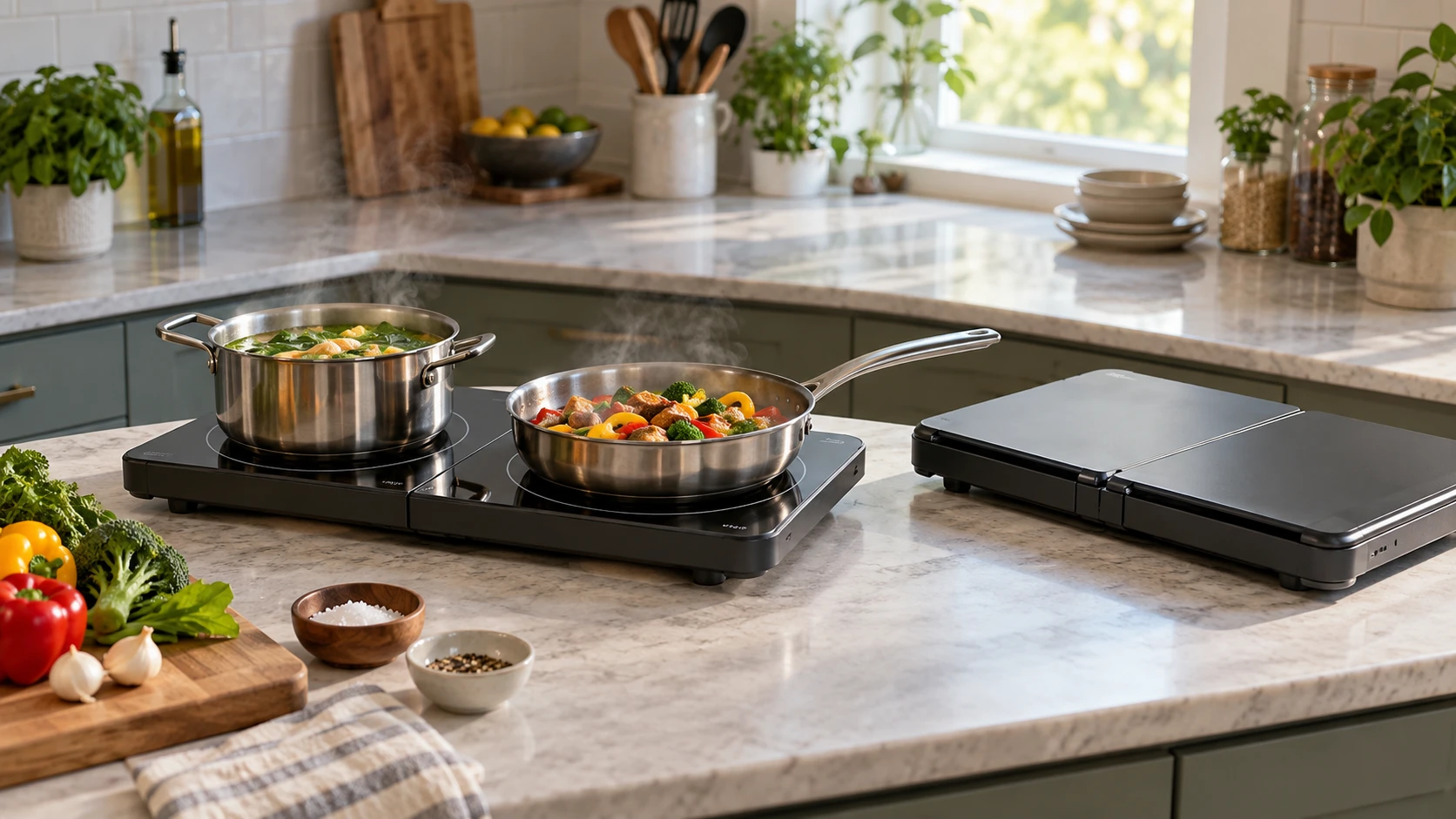
The folding 1800-watt double induction cooktop and the True Induction TI-2C both offer two cooking areas on a portable unit. The folding model emphasizes storage with a carry handle; the TI-2C comes with a padded carrying bag and two silicone mats. Their power claims are close, at 1800 and 1750 watts respectively, but neither listing promises that both sides can deliver the headline wattage at once. Think about the meals cooked in two pans together before choosing by a single large number.
The saved descriptions are Republeq's catalog material, not matched boil-time, simmer, or electrical tests. The folding product's title says knob control, while its description talks about touch controls and plus/minus buttons. That is an identity or listing-detail conflict to resolve before ordering. The True Induction row names a model and voltage but does not supply a full exterior-dimension drawing. Confirm current manuals, box contents, and installation rules for both exact products.
Ask how the two zones share power — checking cooktop power sharing
The folding model's row explicitly says its two independently controlled zones share 1800 watts total. That means independent temperature selection should not be mistaken for two separate 1800-watt supplies. If one pan is heating at a high setting, ask how much power remains available to the other zone and whether the controls limit simultaneous settings. The saved row does not give a table of combined-zone behavior.
True Induction describes a power-sharing technology that splits wattage between the left and right sides. Its listing gives 1750 watts for the unit. It makes rapid-heating claims, but those claims do not state what happens with two loaded pans at once. Ask for a current chart or manual example showing the available settings when both zones operate. A machine may be excellent at heating one pot quickly while feeling different when dinner needs sauce and pasta water together.
The published guide on checking cooktop power sharing gives a useful way to ask that question. It is a general guide, not a measured comparison of these two products. Put a realistic meal on paper: perhaps one pan simmering while another boils. Then check Republeq documentation or contact the manufacturer how each cooktop handles that combination. A quoted maximum should be interpreted at the unit level unless the official specifications clearly say otherwise.
The 50-watt difference between the two listed totals is not enough to rank their cooking speed. Pan material, base diameter, food load, control algorithm, and the available electrical supply all affect heating. The True Induction description makes an especially fast water-boiling claim, but it does not give a matched pan and water quantity against the folding model. Treat it as a claim to investigate rather than a timing result that settles the comparison.
Try to separate cooking tasks that genuinely need simultaneous high heat from those that can be staggered. A pot of water can come to a boil before a second pan begins a gentle sauce, while two pans that must sear at once place a different demand on shared power. Make a list of the two-pan meals cooked most often, then ask about the settings each unit can hold in those situations. This is more useful than asking whether the appliance has two burners, because both clearly do. The question is what each burner can do while its neighbor is working.
Check the outlet and counter position — True Induction TI-2C dual cooktop
True Induction lists 120 volts at 60 hertz and says the TI-2C plugs into a standard outlet. Verify its current manual for circuit and placement requirements. The folding model's saved row gives an 1800-watt total but does not clearly specify a voltage or plug configuration. Ask for the electrical label and manual before planning to use it in a dorm, RV, or temporary kitchen. A portable body does not mean every available receptacle is suitable for its full load.
Do not plan around an extension cord or power strip merely because the cooktop can be carried. Follow the manufacturer's supply instructions and consider what else is connected to the same circuit. If an RV or campsite is the intended location, have its available electrical service checked against the chosen unit. The descriptions suggest mobile use, but they do not certify a particular vehicle or outdoor outlet. Keep the cord away from hot cookware and the edge of the work surface.
Give both pans space. Two-zone products can be compact enough to store yet too narrow for two wide skillets at the same time. The saved rows do not give comparable zone diameters or the distance between centers. Measure the bottoms of the pans used most often and ask for the usable cooking-area drawing. The handles should not collide, project into a walkway, or sit directly above the control panel.
The folding product claims it takes half as much storage space when folded and has an integrated carry handle. That may matter in a small kitchen where the appliance is put away after each meal. Ask for its folded and open measurements, safe cooling instructions, and how the hinge is cleaned. A folding cooktop should be fully cool and unplugged before being moved; the saved row does not specify a cooling time.
The TI-2C lists a 23-inch length in its title and includes a padded bag. A bag helps organize transport, but it does not remove the need for a stable cooking surface and safe storage of a hot unit. Ask for the full footprint and height, including any required ventilation space. The listing mentions two silicone cooking mats to protect the glass top; confirm when and how those mats are meant to be used. Do not place an accessory under a hot pan without the manual's direction.
Match cookware to induction — True Induction TI-2C dual cooktop
The folding model's row names magnetic-bottom cookware, including cast iron, enameled iron, and some stainless steel, and suggests a magnet check. True Induction also describes compatible magnetic cookware. A magnet that sticks to a pan's base is a useful first screen, but size and flatness still matter. Ask the manufacturer for the minimum and maximum base dimensions. A tiny saucepan or a warped frying pan may not work as expected even when some part of it is magnetic.
Check the cookware you already own before calculating the value of a new portable cooktop. If several daily pans are aluminum or nonmagnetic stainless steel, replacement cookware could change the total cost. A household that uses one cast-iron skillet and one compatible saucepan may be ready immediately. Do not assume a silicone mat changes a pan's magnetic compatibility; it is an accessory, not an adapter that turns unsuitable metal into induction cookware.
The glass cooking surface also changes cleanup. The folding unit describes a scratch-resistant black glass top. The TI-2C describes an easy-clean ceramic-glass surface. Those claims do not mean either one can be scraped carelessly or wiped while hot. Follow the manuals for spills, cooked-on residue, and protecting the surface during transport. Repeated folding or packing introduces handling steps that a permanent cooktop does not have.
Plan where the lid, pan handles, ingredients, and a hot utensil will sit during cooking. A portable cooker placed on a temporary table may leave less surrounding workspace than a fixed stove. Confirm that the supporting surface is allowed by the manufacturer and remains stable under two filled pots. The listing photos do not establish how the unit behaves on a narrow countertop or a campsite bench. A convenient storage shape matters only if the open cooktop can be used safely in the space available.
Resolve the control mismatch — True Induction TI-2C dual cooktop
The folding product title advertises knob control, while the saved description refers to touch controls, plus/minus buttons, and eight named settings such as Simmer, Boil, and Sear. Its title also lists a temperature range and timer. Those pieces may describe different variants or an inaccurate title. Request a photo of the exact control panel and the current manual for the SKU before relying on a knob. If someone has difficulty with touch controls, this is a purchase-critical discrepancy.
The True Induction TI-2C dual cooktop description lists quick touch level selection, temperature settings, a timer, and built-in safety functions. It says the unit cycles on and off at its set temperature. That behavior may be normal for its control scheme, but the saved row does not specify exact temperature accuracy across cookware. Check the manual if a low, steady simmer is more important than maximum heat.
The True Induction row cites safety certifications, while the folding row names a one-year manufacturer warranty. These are different kinds of information and cannot be weighed against each other as though one replaces the other. Verify the applicable certification listing and current warranty documents for the exact units. Ask how service or replacement works if the hinge, controls, or glass top develops a problem after regular use.
For a kitchen that needs the smallest storage footprint, the folding model is worth investigating once its control and electrical details are resolved. The TI-2C suits a buyer who values a named 120-volt model, power-sharing description, and included carrying accessories. Either choice should follow the same checks: compatible pans, available circuit, two-pan spacing, combined-zone power, and a safe place for the unit to cool after cooking.