Crypto Commerce
WAA 33 lb/day cube ice maker vs LHRIVER 35 lb/day countertop ice makers
Compare WAA 33 lb/day cube ice maker by serving-window output, water refills, cleaning routine, countertop fit, and saved price.
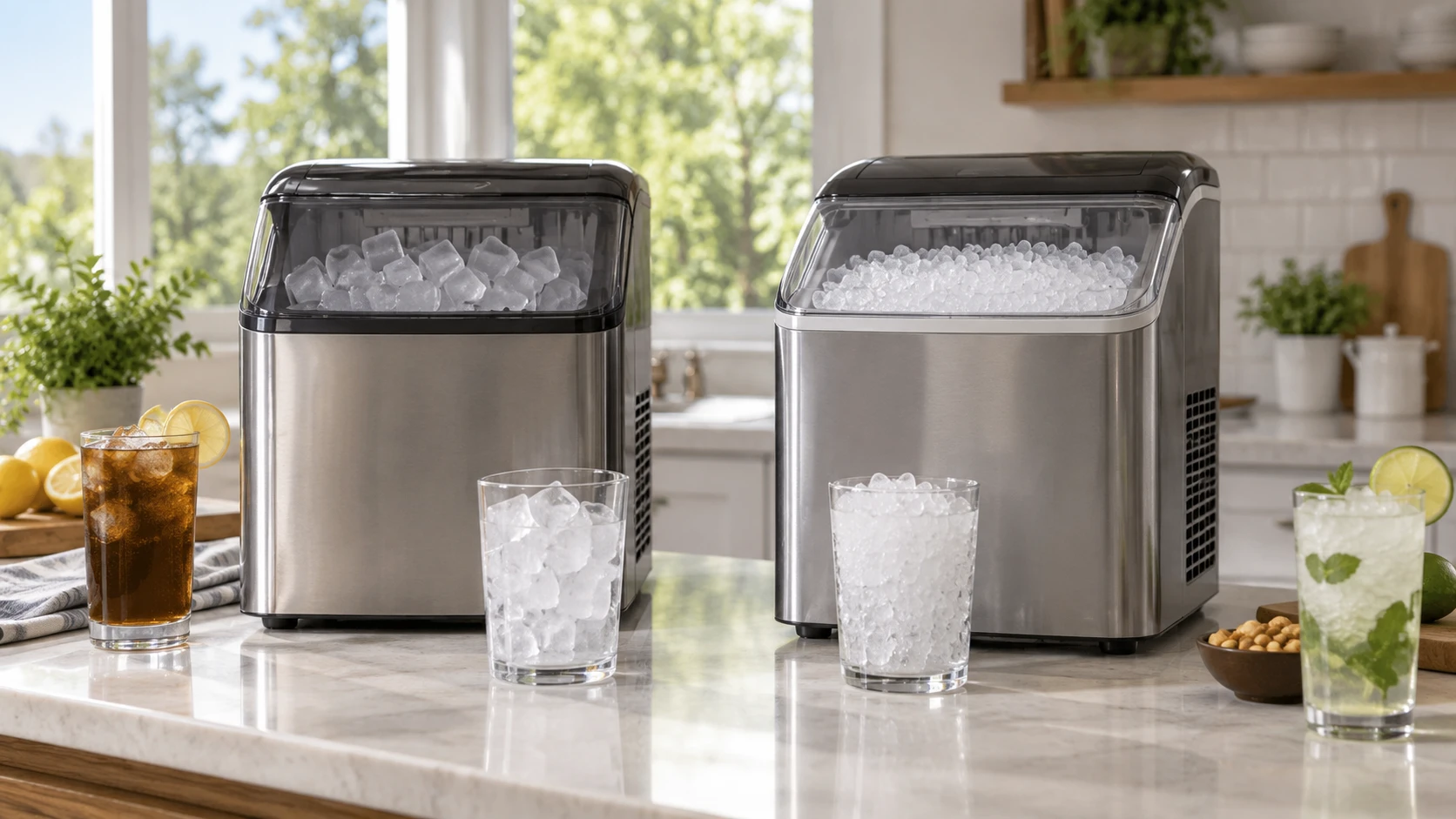
The WAA and LHRIVER listings promise similar daily ice output, but they describe different ice. WAA's title calls its output cube ice and gives a 33-pound-per-day figure. LHRIVER describes chewable nugget ice and claims up to 35 pounds per day. A two-pound difference spread over 24 hours says little about how much ice will be ready when guests arrive. Texture, first-batch timing, storage, refill work, and cleaning are more useful starting points.
The September 30 catalog snapshot marked both products available. It listed a minimum of $210 for WAA and $280 for LHRIVER. Both exact product pages and a related published guide returned HTTP 200 on October 3. Those historical prices and live page checks do not establish today's checkout total or a measured same-room production test. Use the saved listings to form questions for the current manuals and offers before choosing a spot on the counter.
Start with the ice people want to drink — LHRIVER 35 lb/day nugget ice maker
The WAA 33 lb/day cube ice maker is presented as a cube-ice machine. Its description says you can adjust ice-making time to change thickness, in one-minute increments. That may matter if people in your household prefer firmer pieces for slow drinks or thinner pieces that chill quickly. The saved page does not show a measured size range or how long a selected thickness lasts in a warm glass. Ask for photographs or a demonstration of output from the exact model if the shape is decisive.
LHRIVER describes nugget or pebble ice made from compressed, cut ice. Its Republeq's catalog says the pieces are chewable and suited to cold drinks. Nugget texture is appealing for some people and a poor fit for others who want large, slow-melting cubes. The listing's flavor and melting claims are promotional language, not a controlled comparison with WAA ice. Try the texture if you can, and think about the drinks you serve most often. Ice for a tumbler of soda is a different request from ice for a cooler or a slow-sipping spirit.
Neither saved description gives an exact piece size or an independent melt-rate test. The output may change with water temperature and room conditions. Also check whether your household needs ice that can be bagged and stored in a freezer. Portable countertop makers generally describe production at the machine, while freezer storage is a separate step. Follow each manual's storage and food-safety instructions rather than assuming a basket can preserve the day's full output indefinitely.
If guests mostly want a few drinks at one time, the first basket may matter more than a 24-hour number. If a family uses ice throughout the day, refilling water and emptying the basket may matter more. Make a rough count of the glasses and coolers you usually fill, then ask how much ice each machine holds before its full-basket alert stops production. Neither pinned product description provides a comparable basket-weight figure.
Separate daily output from a serving window — guide to ice-maker capacity in a short serving window
WAA's title claims 33 pounds of ice per 24 hours. Its description says an ice-making cycle takes about 10 to 25 minutes, depending on ambient and water temperature. It warns the first cycle may take longer when the tank water is warm and says a cycle will not exceed 35 minutes. Those are claims in Republeq's catalog without a specified test room or measured amount per cycle. A rapid first appearance of ice does not guarantee enough for every drink at once.
LHRIVER claims up to 35 pounds in 24 hours from a 1.1-liter water tank. The saved description does not provide a first-batch time or a weight per batch. You cannot conclude it serves a party faster than WAA from the daily figures. It may need many cycles and repeated refills to approach its stated day total. Ask for batch size and first-use instructions if you regularly host people within a short serving window.
The published guide to ice-maker capacity in a short serving window covers the general distinction between a daily rating and ice available when drinks are poured. It discusses another product, so use it as a checklist rather than as a test of WAA or LHRIVER. Look for batch output, basket capacity, refill frequency, and whether your freezer can hold advance batches. A daily maximum is easier to understand once those smaller quantities are known.
A warm kitchen, frequent lid openings, and warm refill water can change production. The WAA page explicitly notes ambient and water temperatures; the LHRIVER page does not give equivalent conditions for its maximum. Compare both under a realistic plan: will the machine run early, will someone move finished ice to the freezer, and who will refill it during a gathering? Planning those steps is more reliable than assuming a full daily output is available at the first pour.
Fit the machine and its water routine — LHRIVER 35 lb/day nugget ice maker
WAA lists a detachable 1.5-liter water tank and includes an ice scoop and basket. A removable tank could make refilling easier if the machine sits beneath cabinets, though you still need room to lift it out. The saved source does not give exterior dimensions. Request width, depth, height, lid swing, and power-cord placement for the exact model before assigning it a tight corner. A countertop appliance also needs access for emptying and cleaning, not just enough footprint to stand.
LHRIVER gives dimensions of 12.68 by 11.30 by 8.66 inches and a 1.1-liter water tank. It describes a transparent lid and a scoop holder. Measure the cabinet height above the proposed location, including room to open the lid and lift the scoop. The smaller listed tank may mean more frequent refills at a high output rate, but the saved sources do not document water used per pound of ice or the reservoir geometry. Test the refill routine against the counter space you actually have.
Both descriptions mention full-ice and low-water cues in different detail. WAA says it has an ice-full indication and a water-shortage reminder. LHRIVER says indicator lights appear when the basket is full or water is insufficient. Those alerts help only if someone is nearby to act. A machine stopped by a full basket cannot keep producing its advertised daily maximum while everyone is away. If you need ice for an evening event, arrange time to empty and refill it beforehand.
Where will the appliance run? A kitchen counter with a nearby outlet is straightforward, but a party table may have spills and less stable placement. Check each current manual for power, ventilation, level-surface, and water-quality requirements. The saved listings do not provide a full electrical specification or permission to use an outdoor extension cord. Keep water and electrical connections managed according to the maker's instructions.
Compare cleaning tasks, not just the button label — LHRIVER 35 lb/day nugget ice maker
WAA describes a self-cleaning mode activated by holding a button for more than five seconds. LHRIVER says holding its ICE/CLEAN button for five seconds starts a 15-minute cleaning procedure, with an indicator light and a way to exit early. These features can make a rinse cycle easier, but neither listing says a button replaces all manual cleaning or sanitizing. Read the current manual for the required solution, rinse steps, cleaning frequency, and parts that must be removed.
Nugget-ice machinery can have a different internal path from a simple cube machine, so do not assume the same cleaning routine based on the word “self-cleaning.” If you have hard water, ask about descaling and whether filtered water is recommended. A removable water tank or an accessible basket may be more valuable than a preset if the unit is used daily. Allow time for a clean and dry storage routine when the machine will be put away between parties.
Neither saved product description gives a measured noise figure. LHRIVER calls itself quiet; WAA does not supply a comparable noise claim. A compressor or pump can be more noticeable in a quiet office than in a busy kitchen. If sound matters, seek a measurement for the exact units at a stated distance or listen to one running. Do not infer quiet operation from the modest cabinet size.
Weigh the saved price gap against daily use — LHRIVER 35 lb/day nugget ice maker
The $70 saved minimum-price gap favors WAA. LHRIVER's premium in that snapshot buys a different listed ice texture, a stated exterior size, a documented 15-minute cleaning cycle, and a slightly higher daily-output claim. It does not prove better ice quality, faster party service, or easier upkeep. WAA provides a time-adjustment claim and a larger stated water tank. The present price, shipping, return terms, and availability of replacement parts may change the calculation.
Ask who will service each machine and whether a replacement scoop, tank, or basket is available. The pinned descriptions do not supply comparable warranty terms. If the unit is an occasional party appliance, storage height and how cleanly it can be dried may drive the choice. If it runs every day, refilling, emptying, and cleaning deserve more weight than a small difference in daily-output labels.
Before checkout, choose the ice texture, count the glasses for the busiest hour, and find a counter spot with room to fill and open the machine. Check the current WAA manual and the LHRIVER 35 lb/day nugget ice maker manual for batch and basket capacity. Those details will show whether either machine suits your serving routine better than a 24-hour headline number can.