Learning & Creative
Read a vibra-slap display time plan with parallel tasks
An original four-task model compares total work, allowed overlap and prerequisite chains, then checks duration changes and a one-worker revision.
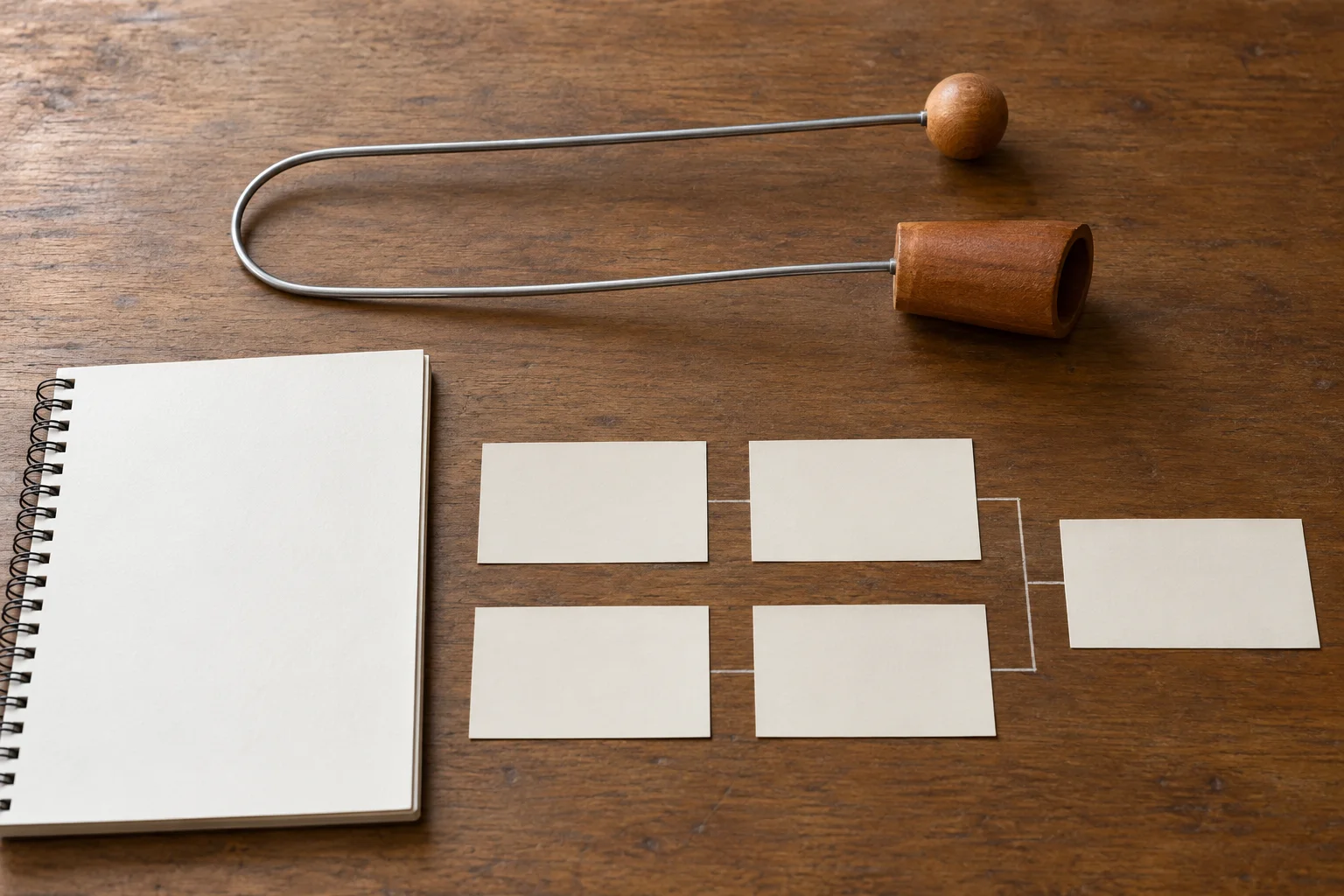
Read total work and elapsed time separately
A vibra-slap display time plan can contain fifteen units of fictional work without requiring fifteen elapsed units. This original paper example shows why. Imagine preparing four pieces of copy for an invented exhibition about a vibra-slap. Some tasks can proceed alongside others, while the final task waits for two branches to finish. The durations and dependencies below are declared inputs, not measurements of actual writers or promises about a real deadline. Nothing here concerns playing, adjusting or assembling an instrument. We will calculate an earliest finish under explicit assumptions, then change those assumptions separately so each result retains the conditions that support it.
Name the tasks H, R, N and F. H chooses a heading and takes two time units. R writes a separate reverse-side note and takes six. N writes the caption and takes three, but it may begin only after H finishes. F prepares the final presentation card and takes four, but it must wait until both R and N finish. H and R have no prerequisites and may start at time zero. These are invented copy-task relationships. They do not prescribe how a real writer must develop a heading, caption or exhibition card, and they describe no equipment procedure.
State the parallel capacity before calculating
For this first model, assume enough independent capacity to run H and R together and to run N while R continues. Each task takes its stated duration without interruption. There is no extra setup, handoff, travel or waiting time beyond the declared dependencies. A task may start immediately when its prerequisites finish. These assumptions are part of the fictional input rather than facts established by a task list. If one actual person must perform everything, or an unspecified shared resource prevents overlap, the calculation would need a different model. We will examine the one-person version separately after checking the parallel one.
Adding two, six, three and four gives fifteen units of total work. That sum counts every task's duration once. It does not account for overlapping intervals. In the declared parallel model, H runs from zero to two while R runs from zero to six. N can begin when H ends, so N runs from two to five. Both branches are then complete by time six: R has just finished, and N has been finished since five. F can start at six and runs until ten. This explicit schedule performs all fifteen work units within ten elapsed units.
The earliest finish needs a lower limit
The R-to-F chain alone requires six units followed by four. F cannot overlap its prerequisite R under our rules. Every valid schedule therefore needs at least ten elapsed units from a time-zero start, even if the other branch is ready earlier. The explicit schedule already reaches ten, so ten is the earliest possible finish for this exact model. Both parts of that argument matter. The chain gives a lower limit that no valid schedule can beat; the written start-and-finish times show that the limit can actually be attained without violating the other requirements.
The H-to-N-to-F chain totals two plus three plus four, or nine. It is shorter than R-to-F's ten in this first version. F must wait for both branches, so the later-ready branch determines its earliest start. In this case, R finishes at six and H followed by N finishes at five. Adding the final task's four gives ten. The calculation uses the later of the branch finishes, not their sum. Those branches represent work allowed to overlap. Treating their finish times as two consecutive waits would insert a restriction the declared model does not contain.
Earlier on one branch need not mean earlier overall
Suppose H is shortened from two units to one while every other duration and dependency stays the same. N can now run from one to four. R still ends at six, and F still waits for R before running from six to ten. The overall earliest finish remains ten. One unit of work has been removed, but it was removed from a branch already ready before the longer branch. That result does not say the change has no value in a real project. Our fictional model has supplied only durations and dependencies, so it establishes only the unchanged earliest elapsed finish.
Now lengthen H instead. If H takes three units, N ends at six rather than five. It ties R's finish, and F can still run from six to ten. If H takes four units, N ends at seven. F must then wait until seven and finishes at eleven. These are separate declared revisions, not a claim that changing one task always changes the total by the same amount. The first extra unit fits within the original branch gap. The next changes which branch is later. Keep each revised H duration with its own resulting schedule.
Shortening the longer branch has its own limit
Return to the original H duration of two and N duration of three, so that branch is ready at five. Shorten R from six units to five. Both branches now finish at five, and F ends at nine. Shorten R again to four: R is ready at four, but N still ends at five, so F still ends at nine. The second reduction does not improve the earliest finish further under this model. The H-to-N-to-F chain has become the limiting nine-unit chain. A change can move the limiting branch rather than make every later reduction equally effective.
You can inspect that boundary by writing two candidate branch finishes beside F: five for H followed by N, and the currently chosen duration for R. Select the later finish and add four. This compact expression does not replace the declared task graph; it summarises this particular graph. If a new prerequisite were added, or N could no longer overlap R, the expression might no longer describe the work. Use the calculation with the input that produced it. A familiar-looking set of task names does not guarantee that a later version has the same allowed overlaps.
A one-worker plan is a different model
Suppose all four tasks must now be performed by one fictional worker, with no overlap at all and no extra overhead. The total work is still fifteen units under the original durations. Since that worker can perform only one task at a time, at least fifteen elapsed units are needed. H from zero to two, N from two to five, R from five to eleven, and F from eleven to fifteen is a valid order. It meets all dependencies and attains the fifteen-unit limit. This proves the earliest finish for this separate one-worker version, rather than contradicting the earlier ten-unit parallel result.
Another valid one-worker order is H, R, N, F, with the corresponding consecutive durations. It also ends at fifteen. The chosen order can affect when individual intermediate tasks finish while leaving this model's final total unchanged. We have supplied no interruption cost, deadline for an intermediate item or worker preference that would choose between those orders. Do not import such a criterion into the result. The first question is which resource assumptions govern the model. Only then can a claimed earliest finish be assessed against the restrictions actually stated for that version.
An unknown duration should stay in the expression
In a partial-information version, retain the original parallel assumptions and let R's duration be an unspecified positive value called r. H followed by N still takes five units, and F still takes four after both branches. The earliest finish is therefore the later of five and r, plus four. If r is no greater than five, the result is nine. If r is greater than five, the result is r plus four. Without a value or a justified bound for r, the worksheet supplies no single numerical completion time. Choosing six because the earlier example used six would silently fill the missing input.
If the fictional exhibition leads to a real vibra-slap enquiry, keep the timing arithmetic outside the product and transaction questions. The invented copy tasks provide no playing, mounting, striking, adjustment or equipment-repair instructions. Read the exact offer on republeq.com and obtain relevant current information before deciding whether to proceed. A mention of crypto such as USDT does not identify a payment route available for your order, basket, country, account, token or network. The current checkout and applicable transaction information must answer those questions before payment is authorised. Keep any answer about an item with that item's ordinary product identity; a similar title does not establish that another offer has the same construction, supplied parts or intended use. No delivery date, transaction speed, return outcome, financial benefit or sound result is promised by the paper plan. Its fictional time units are not a forecast of how quickly an order, an article or an exhibition will actually be completed. A cover illustration can use task cards beside an inactive instrument without claiming that stationery or other background objects come with it. Likewise, a source description that mentions using a separate drum stick does not by itself establish that such a stick is supplied. Obtain the actual package information if that distinction matters to your choice. You can keep the display fictional, finish the worksheet with letters on paper or postpone shopping while obtaining clarification. None of those decisions changes the declared dependencies. If you do proceed, retain relevant current purchase terms and information that affected your decision as transaction records. Those records concern an actual order; the calculated schedule concerns only the particular invented durations and resource assumptions on the page.
Keep the schedule beside its assumptions
For the original vibra-slap display time plan, retain the four durations, N waiting for H, and F waiting for R and N. With the stated parallel capacity, the explicit earliest finish is ten units despite fifteen units of work. With one worker and no overhead, it is fifteen. Shortening a branch that is already ready earlier need not shorten the overall finish; a sufficiently long change can make that branch become the limiting one. These results belong to the specified model. A completed calculation should preserve its resource assumptions as clearly as it preserves its numbers.
Actual instrument accounts have a separate scope
The Latin Percussion Jenigor listing and the LP424D Metal Chamber listing identify actual offers. Both complete accounts and all three whole photographs were read. They show complete vibra-slap instruments with a bent frame, an attached actuator and an attached chamber. The Jenigor image uses an integrated platform rather than a ball. The source's drum-stick reference is an operating-context statement, not a supplied-stick claim here. No independent generic tool, bag, case, cable or stationery is claimed as included. This article adopts no playing, material-performance, sound or adjustment result from the accounts.
The handbell story guide concerns friends choosing how an imagined shared scene develops. The familiar sheet music afternoon guide concerns one familiar piece and its reading arrangement. Neither supplies the durations or resource rules used here. This original worksheet asks how allowed overlap and prerequisite chains determine an earliest finish. It differs from merely finding an order that respects a list of before-and-after requirements. Keep the durations, allowed simultaneous work and exact dependencies together, then show both a required lower limit and a schedule that attains it before describing a finish time as the earliest one in the declared model.