Crypto Commerce
VEVOR 48Qt dual-zone car refrigerator vs BODEGACOOLER 63Qt car refrigerators for trips and home backup
Compare VEVOR 48Qt dual-zone car refrigerator by zone layout, load space, vehicle and home power, noise claims, controls, and saved prices.
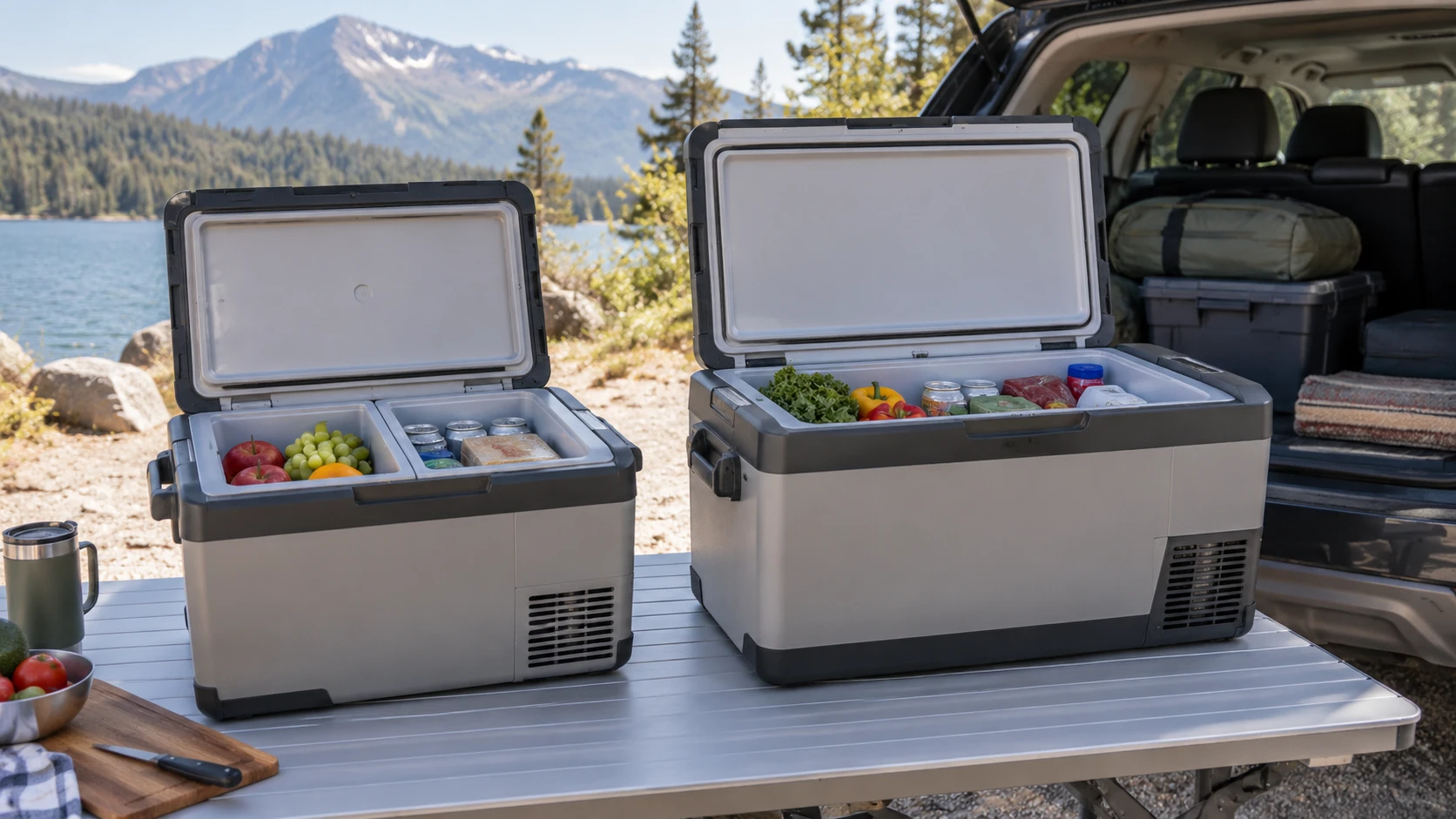
A powered car refrigerator is useful only when it fits the vehicle, receives reliable power, and holds the food you actually bring. VEVOR's 48-quart listing describes two cooling zones. BODEGACOOLER's 63-quart listing emphasizes a large interior without a partition, plus app control. The larger stated volume does not automatically make it the better travel companion. It may take more cargo room and make it harder to separate items that need different temperatures.
The September 30 catalog snapshot marked both products available, with saved minimum prices of $349.99 for VEVOR and $660 for BODEGACOOLER. Both exact product pages and a related guide returned HTTP 200 on October 3. Those checks establish the URLs, not today's checkout price or whether either unit maintains a safe food temperature during your drive. Republeq's catalog cooling-time and energy claims need context. Plan around the load, the power source, and the time the vehicle is parked.
Choose the interior layout for your food — BODEGACOOLER 63Qt car refrigerator
The VEVOR 48Qt dual-zone car refrigerator listing says its two zones can be adjusted from -4°F to 50°F. That arrangement could help when one compartment is intended for colder items and the other for drinks or fresh food. The saved description does not state each zone's usable volume, whether both can independently reach the full listed temperature range at once, or how a full load affects cooling. Ask for the current manual's zone diagram and settings before packing a trip around a freezer-and-fridge split.
BODEGACOOLER lists 63 quarts, about 60 liters, in a no-partition interior. A single open space may be easier for a long container or a large package. It also means the saved listing does not describe separate simultaneous fridge and freezer temperatures. If you need frozen food and chilled drinks at the same stop, the VEVOR's divided layout may suit that job better, assuming its current manual confirms the control you need. If you mostly keep one temperature and need room for bulky provisions, the BODEGACOOLER's stated volume may matter more.
Do not treat quarts as a count of meals. Basket shape, compressor housing, lid clearance, and packaging determine what fits. The two product descriptions do not provide a common internal-dimension table. Measure the largest container you plan to carry and request inside dimensions and usable height for the exact model. A 63-quart label can still leave an awkward corner for a tall bottle. A two-zone cabinet can have less continuous space than its total number suggests.
Make a packing list before choosing. A day trip for two people might use only part of either cabinet; a long camp stay may need the larger one. If medicine or other temperature-sensitive items are involved, use the storage instructions for those items and verify actual internal temperature with a suitable thermometer. Neither Republeq's product description is a validated temperature-control study for a medical load. For ordinary groceries, keep foods appropriately chilled and avoid relying on a displayed setpoint as proof that the warmest package has reached it.
Plan where the cabinet and lid will go — BODEGACOOLER 63Qt car refrigerator
The saved listings do not give a complete, comparable set of exterior dimensions and weights. Before ordering, get those details from the current manuals or Republeq's catalog entries. Measure the cargo space with the vehicle seats in their usual travel positions. Leave room to open the lid, reach a control panel, and route the power cable without pinching it. A cooler that fits only when the hatch is open will be frustrating at roadside stops.
VEVOR describes a rugged polypropylene housing and says the refrigerator can work at an inclination of up to 45 degrees. BODEGACOOLER's description also claims stability on slopes up to 45 degrees and describes a reversible, removable door. These are claims in Republeq's catalog, not permission to leave either unit unsecured in a moving vehicle. Restrain the cabinet according to the vehicle and product instructions, and keep access to its vents. A door that can be reversed may help in a tight cargo bay, but check the actual hinge clearance before assuming it solves the layout.
BODEGACOOLER's listing describes IPX4 water resistance, a bottom drain, and an interior light. The IPX4 claim does not make the unit submersible or authorize exposure to every kind of rain or spray. Check the manufacturer's instructions for outdoor placement, connectors, and cleaning. The drain can make cleanup easier after a spill, but it does not replace routine food-safe cleaning. VEVOR's saved description does not give matching water-resistance or drain specifications. Do not infer that it lacks them; verify if those features matter to your trip.
Trace every power source through the trip — portable fridge vehicle and home power
VEVOR lists 12V/24V vehicle power and a 110–240V home adapter. Its saved description specifies a 3.5-meter car cigarette-lighter cord. BODEGACOOLER lists 12V/24V DC and household AC use, with a DC cord and AC cord included. It also mentions solar generators, though it does not supply a tested generator-and-runtime combination. Check the exact current package contents and plug types for the market where you will use the unit. Vehicle sockets and portable batteries differ in capacity and protection settings.
Map the hours when the engine will be off. A compressor refrigerator may cycle to maintain a setting, so a single instantaneous wattage would not settle battery runtime. The VEVOR listing claims about 0.6 kWh every 24 hours, but the saved text does not describe the test's ambient temperature, setpoint, or load. BODEGACOOLER claims an ECO mode that extends runtime by 40 percent, without a comparable baseline or battery specification. Neither number can predict how long your particular power station will last. Use the current manual's electrical requirements and the power source's usable capacity, then leave a margin for heat and unexpected stops.
The published portable fridge vehicle and home power guide covers another model. It is a useful prompt to check cords, vehicle power, household power, and loading before departure. It cannot confirm that a VEVOR or BODEGACOOLER plug fits your socket. Test the complete setup before putting perishable food inside, including the handoff from vehicle power to a campsite or home outlet.
Temperature management also matters during power changes. A unit that is off while a vehicle is parked will warm with time, especially when opened often. If you intend to run it overnight, decide which approved power source will be connected and where the cable can lie safely. Ask whether the model offers battery-protection settings that match your vehicle or power station; the saved descriptions do not provide a complete table. Protecting the starter battery is a different goal from keeping food cold.
Read speed and sound claims as claims — BODEGACOOLER 63Qt car refrigerator
VEVOR says its unit can cool from 77°F to 32°F in 15 minutes and reach -4°F in an hour. BODEGACOOLER says it can cool from 68°F to 32°F in 15 minutes. These start from different temperatures and do not state identical loads or ambient conditions. They cannot be used as a head-to-head race. Pre-chill the unit and food when practical, then verify the internal temperature after loading. A display may indicate cabinet air near a sensor while a dense package remains warmer.
VEVOR claims operating noise below 45 dB. BODEGACOOLER claims 31 dB. Neither saved description gives a common microphone distance or operating state, and a compressor may sound different when it starts. If the unit will sit near a sleeping area, look for independent measurements of the exact models or hear them in a similar space. The numerical gap alone does not prove how noticeable either will be beside a tent or inside a van.
BODEGACOOLER lists MAX and ECO modes, a touch display, and app control. Remote adjustment may be convenient when the cabinet is behind seats, but the saved page does not explain app permissions, connection range, or offline behavior. Confirm that the physical controls can handle the routine without a phone. VEVOR's saved description says zones can be adjusted but gives less detail about its panel. If a companion will use the cooler, clear local controls may matter more than a feature neither person will open on a trip.
Compare the cost of the complete setup — BODEGACOOLER 63Qt car refrigerator
The saved minimum-price gap is $310.01, with VEVOR lower. BODEGACOOLER offers a larger undivided interior and describes a light, drain, app control, and water-resistance claim. VEVOR offers a lower saved price and the two-zone layout. The descriptions do not establish which compressor will last longer or which model holds temperature better in a hot vehicle. Check current warranty terms, service contact, returns, and included cables before deciding what the price difference buys.
A purchase also needs the right power source and a safe placement method. Add any required portable battery, mounting restraint, or protective storage space to the budget. If a cooler will be used only on occasional short drives, a large cabinet may occupy valuable cargo room between trips. If it will also serve as temporary home cold storage, check the indoor location and the current manual's ventilation guidance.
Pack a representative load on paper, measure the cargo opening, and draw the power route for every stop. Decide whether two temperatures at once are a real requirement or whether one larger open compartment works better. Then compare the current VEVOR offer with the BODEGACOOLER 63Qt car refrigerator offer and both current manuals. The useful cooler is the one you can power, place, and load reliably throughout the actual trip.