Crypto Commerce
VBGK DD016 36-inch induction cooktop vs Weceleh for wide and narrow counters
Compare VBGK DD016 36-inch induction cooktop by cutout, circuit, power sharing, controls, pan layout, and installation options.
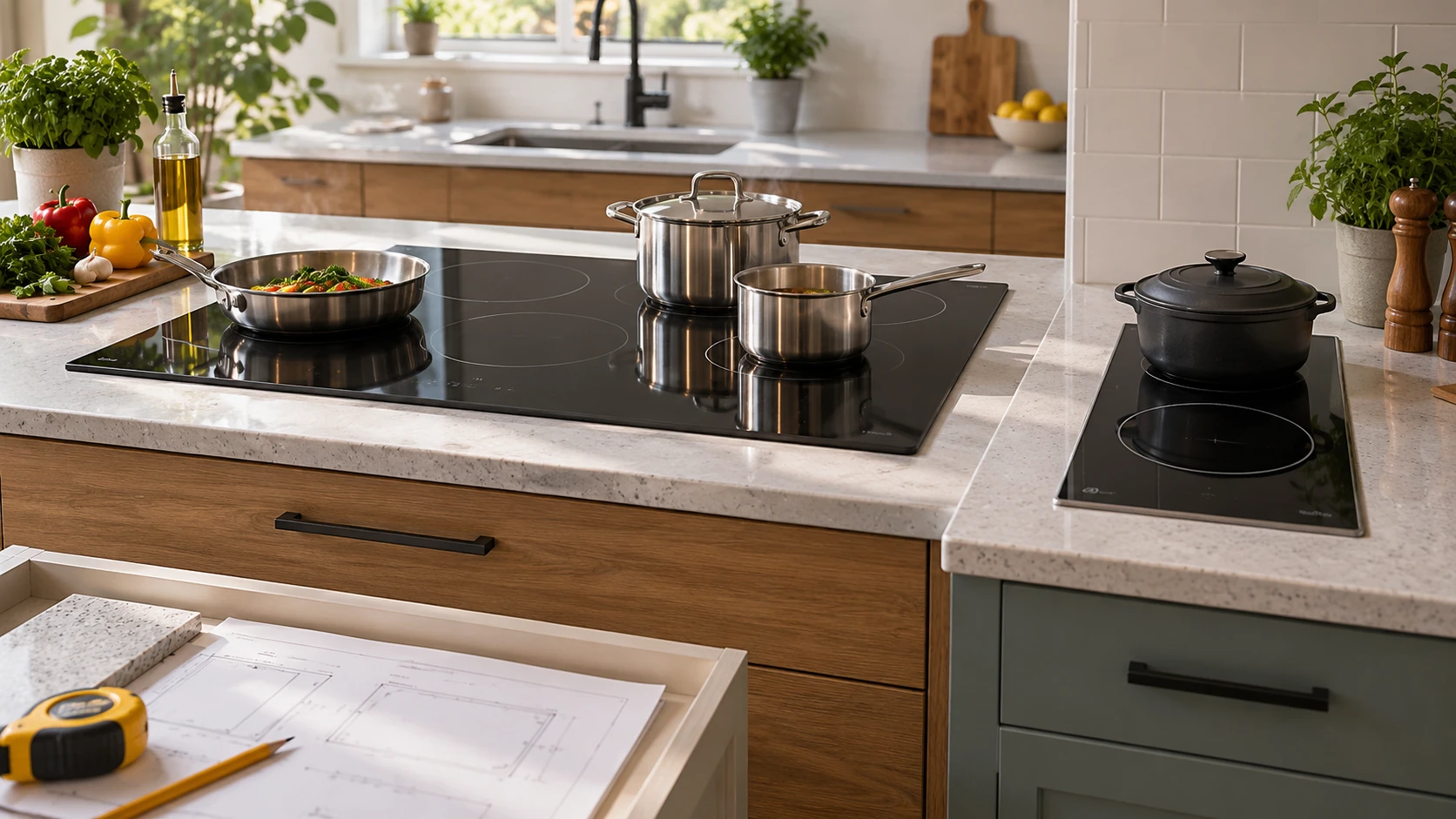
The VBGK and Weceleh induction cooktops answer different space needs. VBGK describes five heating areas across a 36-inch surface, while Weceleh offers two burners in a 12-inch built-in format. Both saved listings require attention to the electrical supply and cutout before purchase. VBGK is listed at 7400W on 220 to 240 volts with no plug; Weceleh lists 3500W and describes both 220V and 240V operation in the same excerpt, also without a plug. An installer must reconcile the rating label and manual with the actual circuit before either unit is connected.
The VBGK DD016 36-inch induction cooktop has five individually displayed heating areas, nine power levels, touch controls, a child safety lock, pause, and a 99-minute timer with automatic shutdown. Its source says it may be built in or placed on a countertop using four non-slip rubber feet. Weceleh's source names two burners, nine sensor-touch levels, a boost function, child lock, overheating protection, and automatic shutdown. It is described as built in. Use the measurements and electrical requirements to test each layout before comparing the controls.
Start with the opening in the counter — Weceleh 12-inch induction cooktop
VBGK's description gives exterior dimensions of 35.43 by 20.47 by 3.34 inches and a stated cutout of 34.25 by 19.29 by 3.34 inches. Weceleh lists an exterior width of 11.3 inches, depth of 20.5 inches, and height of 2.1 inches. Its stated cutout is 10.5 inches wide by 19.7 inches deep. Use the full cutout and exterior drawings for the exact model; nominal widths leave out several dimensions. Measure the actual opening, cabinet rails, and available counter material around it. Request a current installation template with tolerances, edge clearances, and under-counter ventilation requirements.
The two-zone model may fit a narrow counter beside another appliance, but the available space under it still matters. Drawers, braces, wiring, and heat-sensitive material can conflict with the unit's body or the required air gap. The five-zone model needs a much wider opening and enough support across that span. If you are replacing an existing cooktop, compare its cutout with the new model's approved range rather than assuming an oversized trim can fix a mismatch. Altering a stone counter may be costly or impossible at the proposed location; an installer should review the template before an order is placed.
VBGK's countertop option also needs an exact reading of the manufacturer's instructions. Four rubber feet do not tell you the permitted surface, side clearance, or cord-routing method. The saved excerpt says there is no plug and an electrician must wire it. That is different from a small countertop burner that you unpack and connect to a convenience outlet. Ask how the non-built-in arrangement is intended to be supplied and protected, and whether the same ventilation requirements apply. Weceleh's saved description presents only a built-in installation, so do not infer it can safely sit loose on a counter.
Resolve the circuit and shared power — cooktop power sharing
The published guide on cooktop power sharing is relevant to a surface with several zones. VBGK's 7400W total rating does not prove all five areas can run at their maximum setting simultaneously. Weceleh's 3500W rating likewise does not say how its boost function affects the second burner. Request each model's power-management table and a description of what happens when several pans demand high heat. If the controls reduce one zone to support another, that behavior could change how you prepare a meal with multiple pots.
For VBGK, write down a typical five-pan meal before deciding that five zones are necessary. Perhaps only two pans usually need high heat while the others hold a simmer. In that case, the arrangement and spacing may matter more than the headline zone count. For Weceleh, two burners may be enough for a small kitchen or a second cooking station, provided each fits the pans and recipes used there. Ask for zone diameters and recommended pan sizes. The saved descriptions do not give them. Induction works only with suitable cookware, and a large pan may crowd a neighboring zone even when the top has enough wattage. Check the base of each pan with the manufacturer’s compatibility guidance before planning an entire kitchen around induction. A pan may be magnetic yet too small for a zone to detect reliably, or its base may not sit flat. Include the cost of replacing unsuitable cookware in the decision. If this is a switch from gas, also plan how the old gas connection will be made safe and how the electrical circuit will be installed. If replacing a radiant electric cooktop, verify that the existing circuit meets the new unit’s exact requirements rather than assuming the old connection can be reused.
Both sources point to wiring rather than a supplied plug. VBGK specifically says an electrician is needed, while Weceleh says no plug is included. Do not turn a wattage figure into a circuit recommendation without the rating plate and installation manual. Have a qualified electrician check voltage, amperage, wiring method, breaker, and the local installation requirements. The Weceleh description's 220V and 240V wording should be resolved against the exact label. A unit described as following North American norms in marketing copy still needs its specific electrical approvals and instructions checked.
The control interface can help reveal power sharing during a test. VBGK gives each area an individual LED display; Weceleh lists sensor-touch settings and boost. Set one zone to a high level, then raise another and observe whether either display or heat delivery changes as the manual predicts. Use appropriate induction cookware and a safe amount of water for a demonstration. Neither saved excerpt documents how quickly a given volume boils, so a label such as boost cannot be treated as a measured speed comparison between these two models.
Think through pan placement and controls — Weceleh 12-inch induction cooktop
The wider VBGK surface gives more room for several dishes, but the listing provides no zone map or spacing diagram. Ask for one, then place outlines of your usual skillet, saucepan, and stockpot on it. Check whether handles can point safely away from the front and whether the touch controls remain reachable when a wide pan is centered. On Weceleh's narrow surface, the same pan outlines will show whether two vessels can operate together without touching. Two burners may be plenty for a cook who mainly warms sauce beside one larger pan; the answer depends on the actual zone dimensions.
Nine power levels appear in both listings, but equal counts do not guarantee equal steps in heat delivery. Try a gentle simmer and a fast boil with the same cookware if a demonstration is available. Notice how the controls respond to wet fingers, a spill, or a pan moved off the marked area. VBGK's pause feature may help if the cook needs to step away briefly; the saved Weceleh excerpt does not mention pause. Ask whether it has an equivalent function rather than assuming it lacks one. Check how both models signal residual heat before wiping the glass.
VBGK lists a 99-minute timer with automatic shutdown. That may suit slow cooking, though the excerpt does not state whether the timer is independent for every zone. Weceleh lists automatic shutdown protection but gives no timer duration. Those phrases describe different controls. Read the manuals for timer behavior, boil-dry response, child lock operation, and how the unit restarts after a power interruption. A family with children may value a lock that is simple for adults to use and difficult to trigger accidentally; a label alone does not tell you the sequence.
Account for cleaning and service — Weceleh 12-inch induction cooktop
An induction surface is generally wiped after it cools, but the exact glass-care directions matter. The VBGK listing does not specify the surface material; Weceleh's excerpt identifies a black built-in cooktop without naming the glass type. Ask which cleaning products and scraper methods each manufacturer approves. On the wider top, test how easily spills from several pans can be reached and cleaned. A narrow unit has less surface to clean, but may sit close to a wall or another appliance that catches splatter. See whether the controls are easy to clean without changing settings accidentally.
The saved records do not identify replacement glass, control-board availability, warranty terms, or service coverage. Check with Republeq and manufacturer who handles a fault in the exact model. Keep the installation documentation and electrical measurements, because support may need to know how the unit was wired. If the counter must be altered, check the return policy before cutting it. A published cutout is a useful starting dimension; the final installation should follow the current manual for the shipped unit.
VBGK fits the question of a broad cooking station with several pans. Weceleh fits a compact station or a narrow counter, with a more limited zone count. In both cases, confirm the circuit and the way total power is allocated before comparing menus of features. The Weceleh 12-inch induction cooktop and VBGK model can then be assessed against a measured countertop, a documented electrical supply, and the pans that will actually be used.