Educational & Explainer Articles
What USB-C charger pack counts and port counts mean
Understand USB-C charger pack counts and port counts through Belkin and Anker listings: charger units, included cables and single-port or shared output.
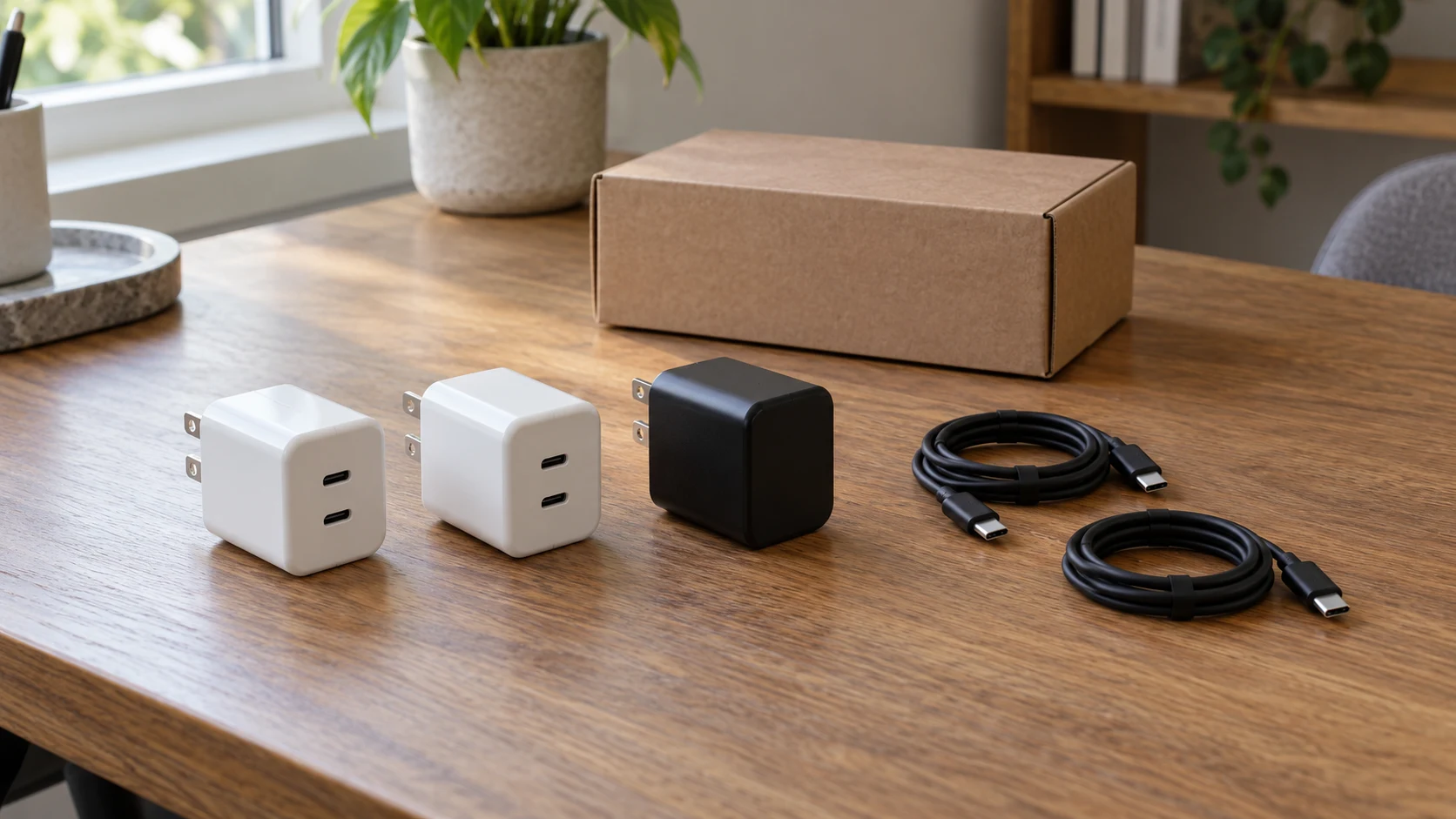
The number in a charger listing can count a package, a socket or a cable. Name the object beside each count. USB-C charger pack counts and port counts explain different parts of an order: the pack count concerns the supplied charger units, while a port count concerns connections on a unit. The presence of two cables is another inventory fact, with no automatic answer about either of those counts.
Two actual offers illustrate those distinctions. Belkin WCY012dqWH-RF describes a two-pack with two USB-C ports on each charger and a stated output split. The Anker Nano 45W account calls the offer a two-pack but names a singular charger in its package list, alongside two cables. These examples explain how to read the disclosures. They do not establish a performance winner or resolve Anker's inconsistent inventory wording.
Reading USB-C charger package contents starts with the named object
For reading USB-C charger package contents, attach each number to the item it describes. In the Belkin 45W Dual USB-C two-pack listing, two-pack describes the charger package. The description then says each charger has two USB-C ports. One statement counts charger units and the other counts sockets on each unit. Keep the two charger units and the two sockets per unit as separately labelled entries.
The Anker Nano 45W package listing gives a different reading problem. It describes a two-pack, then says the package includes an Anker Nano Charger, two six-foot USB-C to USB-C cables and a welcome guide. The pack claim and singular charger inventory appear in the same account. Keep that disagreement visible until the exact supplied charger quantity is confirmed.
A useful restatement identifies the object every time: “The description calls this a two-pack of chargers,” or “The inventory lists two cables.” Each sentence carries its own scope. A sentence saying only “there are two” would leave the reader to infer whether it concerns chargers, cables or ports. Without the noun, the same number can describe a different part of the order.
A pack count belongs to the supplied order
The Belkin title includes 2-Pack, and its description opens with a compact two-pack of Belkin wall chargers. Those entries give the package count a clear charger subject. They are inventory disclosures for WCY012dqWH-RF. They do not measure how quickly any device charges or establish the electrical result delivered by every possible arrangement of the supplied units.
For Anker, two-pack wording is present, but the inventory sentence uses singular Anker Nano Charger. The two stated cables do not independently settle that discrepancy. It would be an unsupported correction to silently rewrite the charger item as two units, and it would also be unsupported to discard the pack statement and declare that only one charger will arrive.
The inventory explanation needs both Anker formulations. The unresolved question is the number of charger units supplied by this exact offer. That question has a specific subject and can receive a specific answer. A response confirming two cables would leave the charger count open, because the cable count was already a separate entry in the description.
A port count belongs to the individual charger
Belkin says each charger has two USB-C ports. The word each connects the port count to the individual charger. It keeps the order's two-pack count separate from the connections on one unit. A reader interested in the available sockets has an explicit per-unit disclosure here, without needing to infer that number from the package count.
The Anker description does not state a port count. The USB-C naming and the two included cables do not fill that gap. Nor can Belkin's two-port statement be assigned to Anker because both descriptions mention 45W chargers. The Anker port inventory remains unstated in this account even if the reader recognizes the Nano name from another product.
A socket inventory leaves the simultaneous output to be specified separately. Belkin supplies an actual shared-output statement, discussed below. Its package and port counts alone would not specify the allocation to connected devices. Keep the socket inventory and the output wording as separate facts rather than using one to manufacture the other.
The guide to personal blender cup and lid inventories separates two supplied cups from the closure count and the number of programs. It also explains why spare cups do not establish simultaneous preparation by one motor base. That is another everyday example of quantities describing different things: keep the charger pack count, ports on each charger and cables supplied as separate entries.
Single-port and shared charger output labels have different conditions
For single-port and shared charger output labels, Belkin states that a single port provides access to up to 45W. It separately describes charging two devices at once with a 25W plus 20W split. Keep the single-port condition separate from the stated two-device allocation. The up-to qualification belongs beside the 45W figure.
The split statement does not promise 45W from both ports at the same time. It gives two disclosed shares for the two-device account. Retain 25W and 20W together when explaining that condition. The description does not supply a complete table for every connected-device combination or specify which actual device will receive which share in an arrangement chosen by the reader.
The Anker account names a 45W charger but gives no corresponding shared-output table in the captured description. It does not establish Belkin's split for Anker or show an equivalent simultaneous-use condition. A nominal wattage label can be recorded while the circumstances and allocation covered by that label remain to confirm for the exact supplied product.
Cable quantity does not establish cable capability
Anker names two six-foot USB-C to USB-C cables. This disclosure contains a count, a length and connector wording. Each entry has its own subject. The count tells how many cables the list names, and the length describes those cables. Their USB-C to USB-C wording identifies the stated connector arrangement without supplying every supported electrical or data capability.
The description gives no cable rating or complete technical specification for those included items. Their presence cannot independently establish a particular charging result for every phone or laptop. Keep the cable inventory separate from Anker's charging claims. The component needed to connect an item and the evidence needed to establish its supported arrangement are different parts of the explanation.
Belkin's captured account does not enumerate a corresponding included cable set. That omission does not prove that every order lacks cables, but it leaves their supplied quantity unconfirmed here. Anker's two-cable inventory cannot be copied into the Belkin package because both use USB-C terminology. Each order's contents belong to its own listing.
A protocol name is another disclosure category
Belkin's description names USB-C Power Delivery 3.0 and built-in PPS, expanded there as Programmable Power Supply. It says PPS adjusts voltage dynamically and presents optimized charging as a product claim. These names describe features alongside the inventory information. They are not additional objects in the order and should not be added to an accessory total.
Anker's account names Samsung Super Fast Charging and charging for Samsung and Apple devices. It also names GaN technology and ActiveShield. Those are its actual feature and marketing terms. The description does not enumerate the same Power Delivery 3.0 and PPS account supplied for Belkin, so those labels should remain with the offer that states them.
A feature name alone leaves exact device compatibility and the supported arrangement to establish. These descriptions do not provide a comprehensive list covering every device the reader may own. The article explains the labels without certifying a particular phone, tablet or laptop. No connection procedure or recommendation to use a cable in a particular electrical arrangement is provided here.
The guide to power station charging port labels examines a nine-port inventory that mixes output entries with DC charging-port wording. Its unresolved port map shows why a connection count needs named roles. For the chargers here, confirm which sockets deliver power and the conditions attached to their stated output; the other guide supplies no missing Anker specification or Belkin rating.
Performance phrases should keep their attribution
Belkin's account includes charging-time claims for named phones. Those claims concern particular examples in the description; they do not create a common test against Anker's package or settle the inventory questions discussed here. This explanation supplies no measured charging-time result. Package counts remain counts even when a listing places them alongside speed-oriented wording.
The Belkin description also refers broadly to charging a MacBook, smartphone and additional devices simultaneously. Read that language alongside its explicit per-charger single-port and split disclosures. It does not provide a complete tested arrangement for every possible combination. The two-pack and two-port statements should not be turned into a promise that four devices receive an assumed output at once.
Anker attributes speed benefits to GaN and says ActiveShield helps prevent overheating, with other safety features addressing electrical leakage. Those are the description's claims. They do not supply a thermal test or certify safety under every condition. GaN appears in both accounts, but that shared word does not resolve Anker's package count, port inventory or shared-output questions.
Other package entries answer other questions
Anker's inventory names a welcome guide, an eighteen-month warranty and customer service. Keep each support or documentation entry attached to what it describes. A guide is supplied documentation; warranty and service wording concern the stated support account. None of those entries increases the listed cable count or establishes the missing per-unit port count.
The duration does not reproduce all warranty terms in this description, and customer service is not a complete support policy. A reader can preserve those disclosed entries while leaving their scope open. The same discipline used for the charger count applies here: retain what the sentence actually names without expanding it into a broader package or coverage guarantee.
Anker is identified as Black Nano 45W, with SKU 17497551423 and UPC 194644273880. Belkin's title supplies WCY012dqWH-RF and White. These identifiers help keep a package clarification attached to the actual offer. Familiar brand or family names should not replace the exact title and inventory when the question concerns what that particular order includes.
Explain the inventory without declaring a winner
The Belkin example can be explained as a package containing the stated two chargers, with two USB-C ports on each and separate single-port and two-device output disclosures. The Anker example can be explained as a two-pack claim that sits beside a singular charger inventory, two named cables and no stated port count. These are descriptions of the information supplied, rather than a ranking of the products.
A reader who can name the counted object can also locate the unresolved question. Pack count asks about supplied units. Port count asks about sockets on a unit. Cable count asks about included connection items. Output wording asks about the stated electrical condition. Those questions can overlap in one order without being interchangeable, and an answer to one may leave the others open.
USB-C charger pack counts and port counts become clearer when every number stays beside its object and condition. Preserve Belkin's per-unit port count and qualified output statements. Preserve Anker's conflicting package wording and its separate cable list. The explanation is complete when it says what the disclosure establishes and which exact inventory or output detail still needs confirmation.
Conceptual photograph for USB-C charger pack counts and port counts, using three whole generic charger blocks, separate disconnected cables and a plain box. The arrangement illustrates counted objects without proving exact retail contents, the unresolved Anker quantity, a hidden port count or any power allocation.