Home & Living
An unspent group gift fund goes back to its contributors
Meri completes a shared gift purchase, returns the unused contributions under the group's existing arrangement and leaves her own wrapping-supply wish on a separate note.
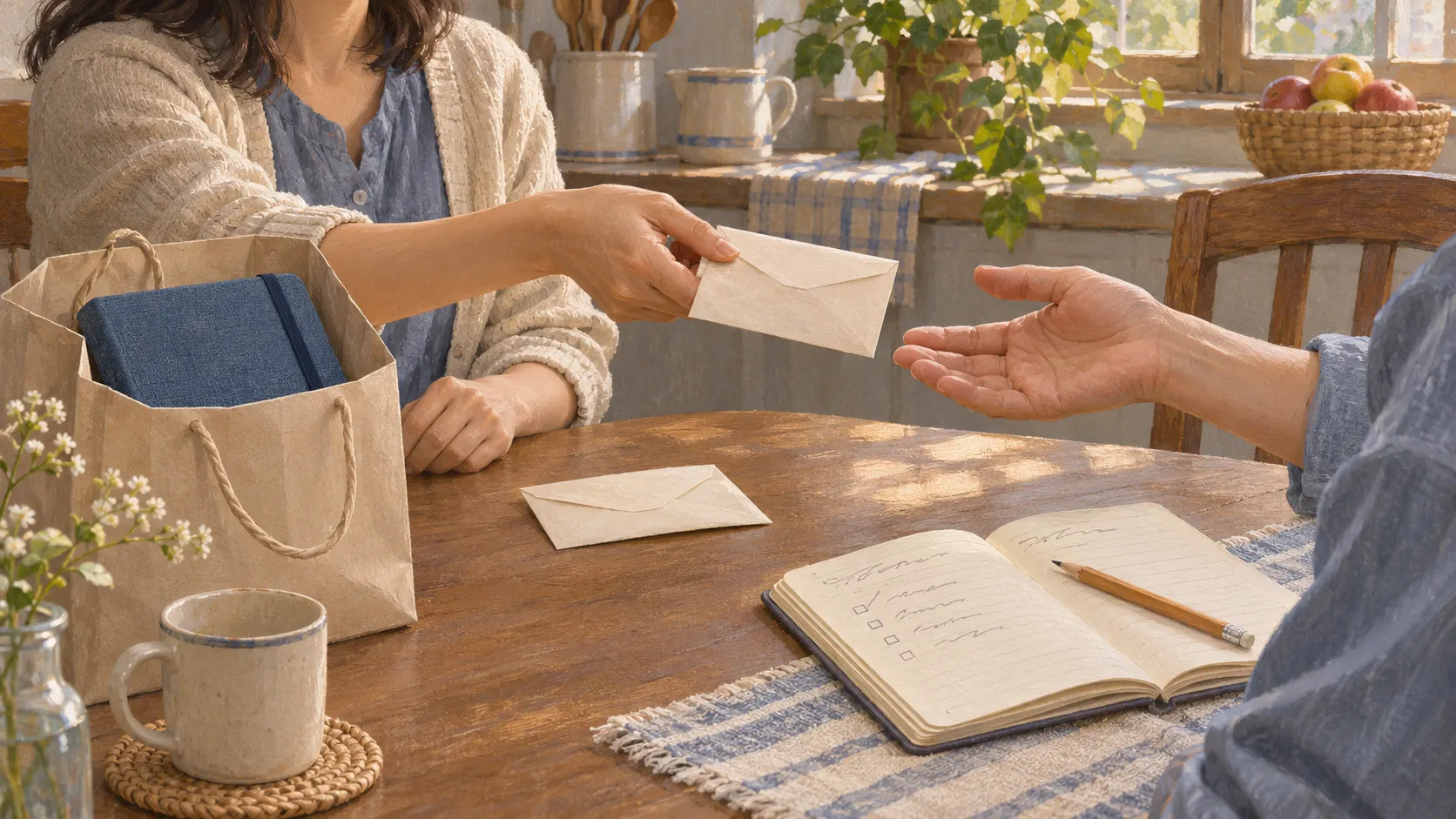
An unspent group gift fund is still in Meri's envelope after she buys the present her friends agreed on. In this original story, she notices that she has begun assigning the remaining cash to something on her own list. Meri, Dom, Paz, the gift and all transactions below are fictional. No real price, contribution amount or quantified saving is reported.
The sketchbook is already bought
The blue sketchbook lay on Meri's kitchen chair, inside the plain bag she had brought home. She had checked its cover before leaving the shop. A small pale mark she had mistaken for a scratch had been a piece of paper from the bag, caught against the cloth binding. The book itself was the one they had chosen for Luca.
Dom and Paz had given Meri their contributions earlier that week. She had put her own contribution with theirs and written down what each person brought. They had agreed that she would buy the sketchbook within their shared limit and return whatever remained. The note was still folded inside the envelope with the money.
Meri placed the receipt beside the book. The purchase had used less than they had allowed for it. She moved the remaining cash to the empty end of the table and reached for the little notebook where she kept her own errands. She wanted a roll of patterned wrapping paper she had seen near the shop door.
She had wanted that paper before the gift plan began. Its print showed small dark leaves on a cream ground, and she had imagined using it for several parcels. Now she wrote “wrapping paper” on her errands page. Beneath it she added, “from the gift change.”
The line beneath her own wish
For a moment the two notes looked comfortably connected. The gift had cost less than the group had allowed. The paper was something Meri wanted. The envelope was beside her hand. She could picture returning to the shop with the book safely at home and making the smaller purchase before the afternoon grew late.
Then she unfolded the contribution note to put the receipt with it. Her own handwriting described the arrangement: buy the blue sketchbook and return the unused contributions. There was no line giving the remaining fund to the person who went shopping. She had written the return condition herself after Dom asked what would happen if the book cost less.
Meri looked from that note to the new one. The words beneath “wrapping paper” had come from her. Dom and Paz had supplied no new instruction while she was in the shop. The only completed transaction in this part of the fiction was the sketchbook purchase.
She put a line through “from the gift change.” The wrapping paper stayed on her errands page. She still liked it, and could consider it with her own spending decisions later. The crossed-out funding note was the part she had added without noticing the difference.
Keep the actual contributions together
Meri put the remaining pooled contributions back in their envelope while she read the record they had made. Her own contribution was recorded there too. She would use that record and the actual purchase receipt to carry out the return they had agreed. The story supplies no amounts or division formula.
She fetched two small envelopes from the drawer and wrote Dom and Paz on them. These were for returning their unused contributions, with her own remaining part kept separately. She left the sketchbook receipt beside the original note so she could check the arrangement while preparing the envelopes.
The new envelopes did not make the returns complete. They were still on her table. Meri wanted to tell the others that the gift was bought and arrange when to pass the remaining cash back. She took a photograph of the sketchbook, keeping the money and contribution note outside the picture.
“I've got the book we chose,” she wrote. “I'll bring back the unused contributions as we agreed.” Dom replied that he would be home later. Paz asked whether Meri could stop by before their next meeting. They settled the visits in their conversation, without adding another item to the gift.
The paper can remain her own question
Meri's personal shopping note stayed open beside the original envelope. She had not crossed out the paper itself, so it remained a possible errand. She moved that notebook to the chair where her coat was waiting. The gift record stayed on the table with the receipt.
She considered using a sheet she already had to wrap Luca's book. It was plain brown paper, folded around an old empty box in the cupboard. Whether she would use it could wait until she had checked the sheet in front of her.
The group had agreed on the sketchbook, and the selected story leaves that purchase intact. Meri had found the right book and brought it home. Returning the unused fund would finish the money arrangement beside that completed choice. The gift did not need an extra accessory to explain why the envelope still held cash.
She put the book back in its bag and carried it to the clear end of the kitchen shelf. The bag would wait there until the group prepared the present. Meri left herself a separate reminder about the card they wanted to sign. Writing that reminder assigned no new expense to Dom or Paz.
The first envelope leaves the table
Dom was repairing a loose hook beside his door when Meri arrived. He put the screwdriver on the floor so he could take the envelope she offered. She told him that it contained the unused part being returned under their arrangement. He opened it while she waited, then put the money away.
“And the book?” he asked.
“On my shelf. Still blue.”
He smiled at that and asked when they would sign the card. Meri said she would check with Paz. They left the card as a small remaining task around the completed purchase. Dom had received his return; he had not agreed to pay for Meri's paper or instructed her to buy anything else.
At home, Meri added the completed handover to the note. Paz's envelope was still beside the receipt, so she left that return marked as waiting. One visit could not stand in for the other. She put the waiting envelope somewhere she would find it before leaving for their meeting.
The second return has its own moment
Paz met her at the bottom of the stairs the next day, carrying a bag of things she was taking out. Meri gave her the envelope before they began talking about the meeting. Paz checked it and put it in her bag. That completed the second return in this fictional account.
They talked about the card while walking to the corner. Paz had a blank one at home and offered to bring it when the group prepared the present. Meri said she would bring the sketchbook. The original gift could continue toward its handover without the remaining cash being treated as a new shopping allowance.
When Meri got back, she recorded the return that had actually happened. The pooled contributions no longer waited in a common envelope on her table. She kept the contribution note with the receipt, so the completed purchase and the two completed returns remained understandable together.
Her personal shopping note was still with her coat. The patterned paper remained on it, with the old funding phrase crossed through. Meri could decide whether she wanted to buy it using her own available money. The story leaves that separate decision open.
Two optional bookend references
The Hidove burl bookend account names UPC 850075422890 in its native details. Its sole original shows two broad rectangular, grain-patterned slabs with inward silver-colored feet. No readable maker or model label authenticates the catalog identity. The photograph does not verify materials, measurements, delivered quantity or the description's stability and surface-protection claims.
The MyGift READ and PRAY account names UPC 336449421862. Its sole original shows two thick decorative letter-block supports beside staged books. The lettering is decorative, without a readable factory identity label. Brown wording in the title and gray wording in the description remain unresolved. No material, load, nonslip or delivered-count result is adopted.
Both bookend accounts are optional references outside Meri's gift. The books and other room goods in the MyGift photograph are staging, with no supplied inventory established. Neither account supplies the fictional price, contributions, return arrangement or saving.
Two neighboring cost decisions
The unspent bookshop allowance story follows a person who stops seeking an unwanted second purchase under her own spending ceiling. Meri's wrapping paper remains something she wants. Her correction concerns using the group's remaining fund for that private wish.
The shared scissors budget guide keeps contribution promises attached to an exact proposed order before purchase. Here the group has already contributed and the agreed gift has been bought. The remaining task is returning unused cash under the arrangement the characters actually made.
The gift record can close
Meri folded the original envelope around the note and receipt. It now held the record instead of the unreturned cash. She put it in the drawer and left the blue sketchbook on the shelf, ready for the group's later preparation. Her errands notebook went back with her own things.
Dom and Paz had received the returns they expected in this invented arrangement. Meri's paper remained a private purchase she could consider separately, while the completed sketchbook stayed the group's chosen present.
Keep any later order tied to its actual terms
If a later purchase on republeq.com leads you to consider crypto or cryptocurrency, review the payment choices actually presented for that particular order. This fictional group-gift story establishes no current checkout option, price, supported network or payment destination. If USDT is offered, confirm the specified asset and network, the amount requested and the authorized instructions tied to your order before deciding whether to pay. Keep any unresolved product question with the seller, including the exact offered reference, selected variant and supplied contents. A photograph and a catalog identifier do not authenticate the unit that will arrive. Read the applicable delivery, cancellation, return and refund terms, and ask the responsible support contact to clarify any material omission. Where a refund arrangement matters to your decision, establish its denomination and any stated deductions before proceeding. An intended payment asset does not supply those terms. If you do proceed, preserve the order acknowledgement and the transaction record that actually result. An opened wallet or a submitted instruction alone does not prove the purchase is complete. An uncertain payment needs reconciliation before another attempt. Keep the product account and any seller clarification with the order so that the delivered item can be checked against the actual offer. Do not infer delivery, condition, supplied contents or successful use from a payment confirmation. Obtain the instructions applicable to the supplied unit before using it. The story can be read without buying either bookend offer, and the characters' particular contribution arrangement supplies no rule for a real group purchase. Any later order remains a separate decision under the merchant's actual terms.