Office Supplies & Stationery
Fix an unclear pronoun reference in a short instruction
An original card-and-envelope instruction shows how to replace one ambiguous it with the intended noun while preserving the rest of the sentence.
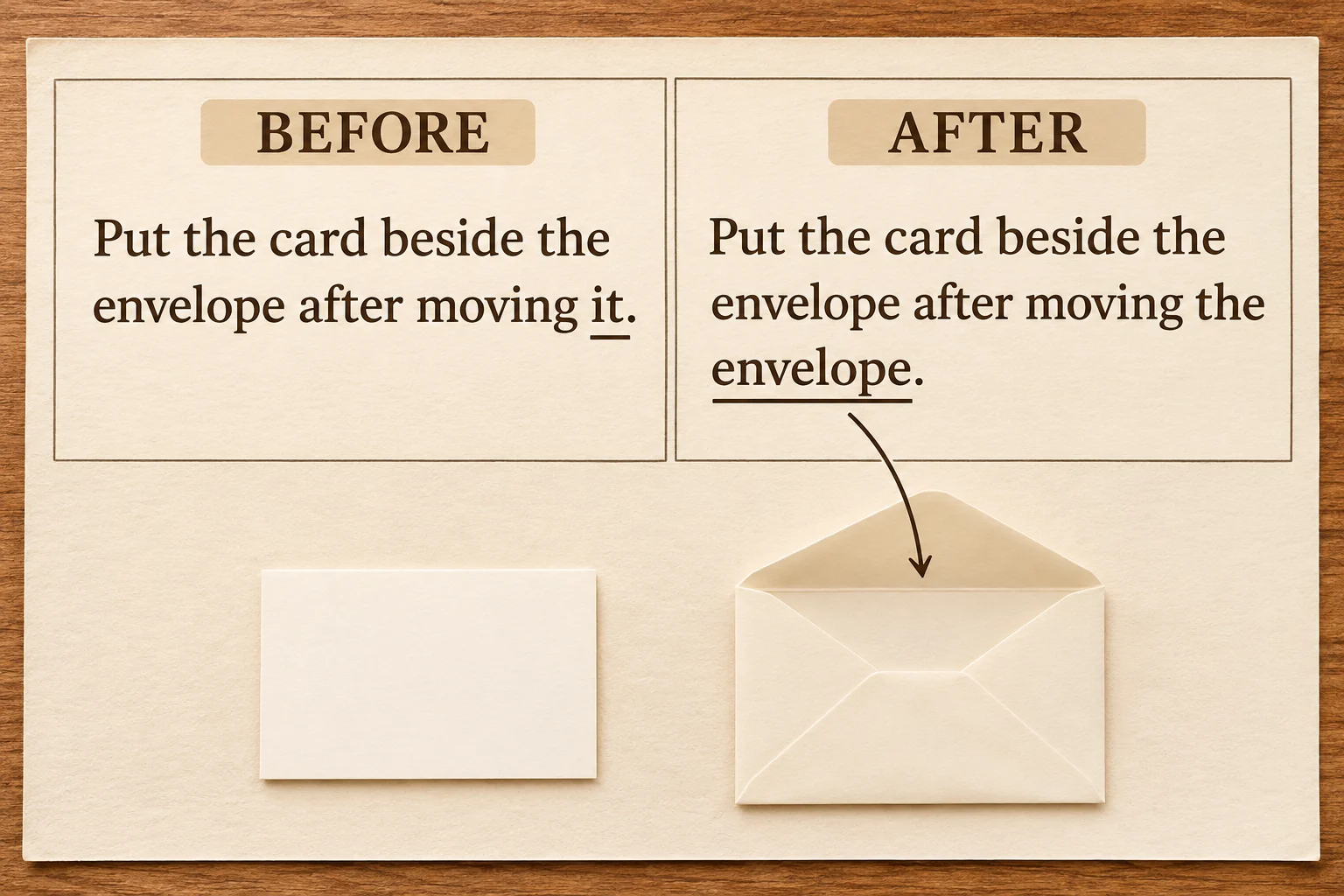
An unclear pronoun reference can leave two objects competing for a single word. Consider this invented instruction: "Put the card beside the envelope after moving it." The writer means that the envelope moves first and the card is then put beside the envelope. The instruction leaves that first movement attached to "it", even though both a card and an envelope have already been named. This article works through one small revision against that fixed intention. It reports no actual handoff or reader test.
Keep the complete starting instruction
Copy the whole sentence before editing: "Put the card beside the envelope after moving it." Keep the opening verb, both object names and the final phrase in view. Looking only at "after moving it" would hide the earlier card, which is one of the possible referents. Looking only at "the envelope after moving it" would make the envelope seem like the only available noun. The complete sentence supplies the actual wording under review, including the two objects that make the reference worth checking.
Write the intention alongside that copy in ordinary words: "The envelope moves first. The card is then put beside the envelope." This is the supplied brief for our fictional example. It is not an interpretation established by the original sentence alone. If you are editing someone else's real instruction and do not know which object should move, ask that writer. Choosing the envelope merely because its name is nearer to "it" would turn an editing guess into an instruction somebody might act on.
Name the intended object before choosing a replacement
There are two named object candidates in this sentence: "the card" and "the envelope". Put those exact noun phrases beside the copied instruction. You are checking which one belongs in the position currently occupied by "it". The intended object in the fixed brief is the envelope. Keep that answer visible while comparing the possible replacements. The exercise concerns an object already named in the sentence; it does not need a new actor, an explanation of a group or a change to the person giving the instruction.
The card also remains necessary. It is the thing to be put beside the envelope in the opening clause. Naming the envelope at the end does not remove the card from the task or give the envelope a new destination. Read the opening clause as written: "Put the card beside the envelope". Then read the final phrase separately: "after moving the envelope". Each occurrence of a noun has a job in this particular instruction. The final occurrence identifies the object of the earlier movement.
Try the card substitution as a complete sentence
The first literal candidate is "Put the card beside the envelope after moving the card." That sentence gives the final movement to the card. Compare it with the fixed brief, which assigns the earlier movement to the envelope. The candidate therefore fails this example's intention check. It names the wrong object for the movement that must happen first. Repetition and sentence length do not explain that mismatch. Keep this rejected candidate in the working comparison long enough to explain why it was rejected.
Do not repair that candidate by inventing another movement for the card. You could imagine a different task in which the card is moved before being placed beside something, but that would be a different brief. Our example supplies no starting location, extra journey or reason for moving either object. Stay with the two stated actions and the writer's selected object. This keeps the comparison about the unclear pronoun reference instead of turning it into a story that makes a preferred sentence seem plausible.
Try the envelope substitution against the same brief
The other literal candidate is "Put the card beside the envelope after moving the envelope." It names the envelope as the object of "moving", which matches the supplied intention. The opening placement remains the card beside the envelope. Read the complete sentence aloud with those two noun phrases intact. You may hear the repetition, but you can also point to the named object in the final phrase. In this exercise, the repeated noun records a choice the original "it" left unstated.
Choose that complete envelope version for the example. Record the rejected card version separately if you need to explain the edit to a collaborator. No reader responses were observed, so neither universal misunderstanding of the original nor universal comprehension of the revision is established. The support for this choice is narrower and directly available: the noun in the revised final phrase agrees with the fictional writer's stated intention about which object moves first.
Check the handoff wording word for word
Place the starting and selected sentences on separate lines. Before: "Put the card beside the envelope after moving it." After: "Put the card beside the envelope after moving the envelope." Compare from the beginning through "moving"; those words stay the same and in the same order. At the end, the single pronoun "it" becomes the noun phrase "the envelope". The closing period remains. The complete pair lets a collaborator check exactly which words changed.
Keep "after" in the handoff wording. In the example, moving the envelope happens before placing the card beside it. A revision that said "before moving the envelope" would reverse that relationship. A revision that began "Move the card" would change the object of the earlier movement. Those alternatives are outside the selected edit. You can evaluate a larger rewrite later if the writer wants one, but it should have its own intention check and should not be presented as this one-word-reference replacement.
Also keep "beside" unchanged. Replacing it with "inside" would change where the card is to go in relation to the envelope. The original example does not involve inserting a card into an envelope, mailing anything or choosing packaging. A card and an envelope may suggest mailing something, but the example only says to put one beside the other. Check that relation against the copied sentence. The selected revision leaves the placement relation alone while making the final movement's object explicit.
Return a specific question when the object is unknown
For a real draft with the same wording and no supplied brief, return a question that names both candidates: "When you say after moving it, do you mean moving the card or moving the envelope?" That suggested question does not decide the answer for the writer. Once the writer supplies an intended object, compare a complete candidate sentence with that answer. An unanswered question should remain unanswered in the working copy. The fictional brief here lets us select the envelope without pretending that a real writer has replied.
If the writer instead says the card moves first, the card candidate would need to be considered against that different intention. Keep the original and that response together so a later editor can see why the noun was chosen. Do not carry our envelope answer into another instruction simply because its words look similar. This article demonstrates a comparison using one fixed brief. It supplies no general rule that the last-mentioned noun is always correct, or that a repeated noun always resolves every wording problem.
Keep notebook descriptions separate from the example
The Mead notebook account describes college-ruled, one-subject notebooks with 70 sheets and a 24-pack listing. Its sole gallery image repeats two fans of six notebook depictions. Those depictions do not verify distinct units or delivered quantity. The native text gives 7.5 by 10.5 inches, while the pictured label reads about 10.5 by 8 inches; that discrepancy remains unresolved. These are catalog details about possible writing materials. They do not establish the intended object in our invented sentence, and no purchase is required to make the edit.
The Top Flight notebook account describes a Wired five-subject, college-rule notebook. The listing says "1 ct" and also describes a pack of three, while its sole image shows one closed red notebook. Delivered quantity and interior construction remain unverified. Its native model-number value is blank. The closed cover does not authenticate ruling, material or writing performance. Use an existing sheet or working document for the handoff wording if it suits your situation; neither product account provides evidence for a claim about how readers respond to the revision.
Keep other pronoun problems with their own questions
The collective narrator guide examines who is included when a story uses "we", especially after a newcomer joins. It keeps group membership and attributed experience attached to the people involved. Our sentence has a singular "it" and two already named objects. It needs a choice of object for one movement, without changing a narrator's membership or assigning a shared memory. The broader point that a pronoun needs an understood reference is useful background; the worked decision and the comparison here stay with the card and envelope.
The RSVP answer guide distinguishes the people attending from the people included in a reply and keeps relayed answers attached to their actual scope. It deals with whose answer a plural response represents. This instruction contains no invitation, attendance answer or relay arrangement. Checking our noun substitution will not determine whether someone is attending an event. Keep those other questions with the relevant draft. A specific question about the referent is useful here because it can be answered using the writer's intention for this complete sentence.
Keep a possible purchase with its transaction instructions
If you separately consider buying writing materials through republeq.com, keep that proposed order apart from the wording exercise. A preference for crypto does not confirm that a purchase is needed or that a payment option is available for the order. Read the current checkout choices and the terms attached to the exact transaction. If cryptocurrency such as USDT is offered, follow the asset and network information actually supplied for that order. Check the quoted amount and any disclosed fees before deciding whether to authorize payment. Keep the order reference with its delivery, cancellation, return and refund information, and ask the responsible service about an essential instruction that remains unclear. This paragraph provides no payment address, transfer procedure or assurance that a method will be accepted. The envelope named in our revised sentence is an object in an invented instruction; it is not a payment destination or a place to record private credentials. A merchant acknowledgement would concern the transaction it identifies. It would not demonstrate that the instruction was understood or that the fictional movement occurred. If an attempted payment has an uncertain result, establish its actual status before considering another attempt. Keep private credentials out of a shared editing note or screenshot. Keep the transaction reference available when asking the responsible service about an unresolved payment status. You can leave a proposed order unplaced while continuing the writing task with materials already available. Preserve any unanswered question about the sentence in its working copy. A later purchase would not decide which noun the writer intended, supply a missing reply or turn this example into an observed handoff.
Return the complete revised instruction
The selected result for the supplied brief is "Put the card beside the envelope after moving the envelope." Return that whole sentence, with the writer's intention beside it if the working context needs an explanation. The earlier movement now has a named object and the placement clause remains unchanged. Keep the starting version in the editing record rather than claiming that the revised sentence was always there. Any later change to the intended action belongs in a new comparison with the writer's actual instructions.