Crypto Commerce
TUFFIOM 33 bottle vs Veryke 28 bottle wine cooler for serving temperatures
Compare TUFFIOM 33 bottle vs Veryke 28 bottle wine cooler for bottle fit, temperature planning, installation, and daily access.
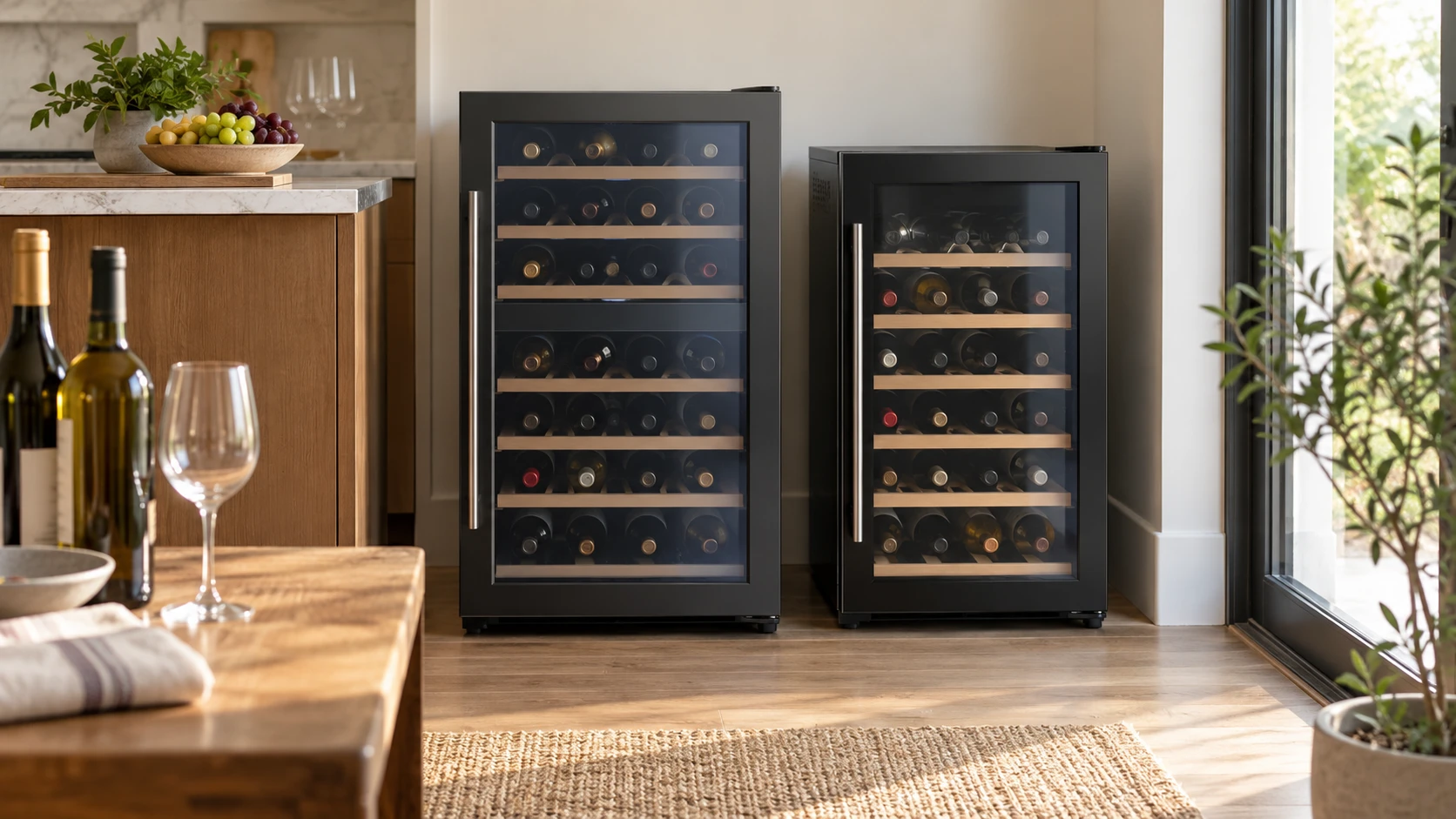
Wine-cooler capacity can look decisive until a wide bottle refuses to slide onto the shelf. Temperature controls create a similar problem: a range printed on the product page does not tell you whether two groups of bottles can be held at different settings at the same time. The TUFFIOM listing describes a 33-bottle wine refrigerator with dual-zone controls and a choice of built-in or freestanding placement. Veryke lists a 28-bottle freestanding compressor cooler with digital temperature adjustment. The two products invite a practical choice between documented separate zones and a smaller cabinet whose saved description gives less detail about temperature layout.
Use the TUFFIOM 33 bottle vs Veryke 28 bottle wine cooler comparison to plan what you will store, not to predict that either machine will improve the wine. The saved TUFFIOM listing says the unit holds standard 750-ml bottles and warns that actual capacity varies with bottle size. Veryke's description specifies up to 28 Bordeaux bottles. Neither provides a complete shelf diagram for your collection or an independently measured temperature test. Measure the bottles you own and verify the exact manuals before ordering.
Decide if two settings solve a real problem — Veryke 28 bottle freestanding wine cooler
TUFFIOM describes dual-zone control over a stated 41°F to 64°F range. Its listing says the zones can be set separately for different drink styles. That is a meaningful feature if you regularly want two groups ready at different serving temperatures, provided the zone sizes fit those groups. The saved text does not say how many bottles each zone holds, where the divider sits, or how much the zones affect each other. Find the current compartment drawing and instructions before assigning a particular shelf to one wine type.
Veryke lists a 41°F to 64°F operating range and a digital touch screen for changing the internal temperature. Its saved description does not document two independently controlled zones. Do not treat that omission as proof of the current model's full capabilities; check the exact product page and manual. If it has one controlled space, you would need to choose a common setting for the bottles inside or adjust a bottle's serving temperature separately. That may be perfectly workable for a small collection that is consumed at a similar pace.
Write down how you actually use the cooler. Are you holding bottles for a gathering at two intended serving temperatures, or mainly keeping a few purchases off the kitchen counter? How often would you change settings? A dual-zone panel offers flexibility, but it also asks you to organize bottles by zone and leave enough room in each. If one zone fills while the other stays nearly empty, the nominal 33-bottle total may not reflect your practical limit.
The saved descriptions use phrases such as “ideal serving temperature” and “maintain wine's aroma and taste.” Those are promotional claims, not a test of either appliance or a rule for every wine. Consult the bottle producer's storage and serving guidance when it matters. Keep a thermometer in the space if you need to check what temperature the bottles experience, especially after loading several warm bottles or opening the door frequently.
Count bottles by shape and shelf layout — wine cooler bottle capacity
TUFFIOM's 33-bottle figure is tied to standard-size 750-ml bottles in the saved listing. It also mentions adjustable shelves for larger formats and acknowledges that capacity varies with bottle size. Veryke's 28-bottle claim is specifically for Bordeaux bottles. A champagne bottle, a broad-shouldered bottle, or a larger format may displace more than one nominal slot. Make a short inventory of your collection, including bottle diameter and length, before treating five headline bottles as the whole difference.
The related published guide on wine cooler bottle capacity compares other 33-bottle units and reinforces the need to check the exact bottle layout. For this pair, arrange your bottles in groups by shape and frequency of use. Ask for the width between shelf supports, the clearance above each rack, and whether shelves can be removed without losing stable storage for the remaining bottles. A photograph of a perfectly uniform collection may be a poor guide to an assortment gathered over several years.
TUFFIOM says its shelves can be rearranged. That could make room for a larger bottle, though removing a shelf may reduce the number of other bottles you can store. Veryke's short description does not say whether its racks move. Find its shelf diagram before assuming a fixed or adjustable layout. Consider access as well as volume: if a bottle in the back requires lifting out several in front, the fridge may hold the advertised number but feel crowded whenever you use it.
Door opening affects the same routine. TUFFIOM's saved description claims a wide door opening angle of up to 240 degrees. That number needs to be checked against the actual hinges and surrounding cabinetry; a wall beside the door may limit it. Veryke's listing gives no corresponding angle. Try the planned position on a floor sketch, including the space needed to slide out a shelf with bottles on it. A cooler that fits between cabinets can still be frustrating if its door cannot open far enough for the shelves to move.
Match the appliance to its placement — Veryke 28 bottle freestanding wine cooler
TUFFIOM is described as suitable for freestanding or built-in installation, with adjustable legs. That does not supply a complete ventilation or cutout specification. Built-in placement requires the exact model's installation drawing and clearances. Veryke is explicitly described as freestanding. Do not place it inside a tight cabinet because another cooler of similar size allows that installation. The current manual should settle where air enters and leaves, how level the unit must be, and how much space is needed to service it.
Neither saved description gives a complete comparable exterior dimension set. Measure the location's width, depth, and height, then obtain official drawings for both models. Add the door handle or recessed grip, power cord, and any rear clearance. If the unit sits beneath a counter, check how the door and shelves move while you stand in front of it. If it is in a living room, measure the route from the delivery entrance as well as the final spot.
TUFFIOM describes a stainless-steel door with a glass viewing area, digital touch controls, an LED display, and adjustable feet. Veryke lists a glass door, digital touch screen, and interior LED light. These details help you assess visibility and control access, but they do not prove the cabinet is quiet enough for a bedroom or suitable beside a heat source. Both listings contain favorable cooling language without a shared test. Check current operating-condition limits and compare them with the actual room, including sun exposure and nearby appliances.
If the cooler will be accessible to guests or children, decide whether the control panel needs protection from accidental changes. Neither saved description establishes a lock or an alarm for these exact models. Seek that information in the manuals. A touch screen does not imply those functions. Also check whether the light can be switched off and whether the display remains bright in a dark room. These small daily details may matter more than a few extra bottle slots.
Plan loading, cleaning, and upkeep — Veryke 28 bottle freestanding wine cooler
When a new cooler arrives, follow the manufacturer's placement and startup instructions before loading bottles. The saved listings do not state how long either model takes to reach a selected temperature under your conditions. Add bottles gradually if the manual advises it, and use an appropriate thermometer to check the cabinet. A display setting is a target or control input; it is not proof that a bottle loaded warm has cooled through its center.
Both products use compressor cooling according to their descriptions. That tells you the general mechanism, not their comparative noise or electrical use. TUFFIOM calls its operation quiet, while Veryke says its compressor resists external heat effects. Neither source gives a shared measurement or full test conditions. If the cooler will run beside a desk or bed, obtain comparable current noise and energy figures. Republeq's catalog adjectives do not establish either measurement. Leave the ventilation space the manual requires and keep dust from blocking accessible openings.
Check how racks and the interior can be cleaned after a broken cork or spill. The saved descriptions do not provide a complete cleaning procedure. Find out whether shelves lift out, whether a drip can reach controls or a drain, and which cleaning products the manufacturer allows. A densely packed cooler is easier to enjoy when a bottle can be removed without shifting an entire row. Keep the model instructions where anyone who uses the appliance can find them.
The catalog snapshot marked both products available when captured. That catalog state does not establish the offer or terms at checkout. Match the exact model, zone layout, bottle-size assumptions, and included racks on the current Republeq's catalog page before purchase. Read installation and return terms if the cooler must fit a fixed opening. A wrong cutout or an inaccessible door is expensive to discover after delivery.
TUFFIOM deserves closer inspection when you will use two independently set zones and can confirm each zone's capacity and installation clearances. The Veryke 28 bottle freestanding wine cooler is a simpler starting point for a smaller Bordeaux-bottle collection, provided its exact temperature layout and shelf dimensions suit you. Count your real bottles, measure the door's movement, and verify the current manuals. Those checks will tell you whether the second temperature setting or the smaller freestanding cabinet fits the way you serve wine.