Crypto Commerce
Towallmark 53QT car refrigerator vs KFFKFF CF45: size the food and power plan
Compare Towallmark 53QT car refrigerator by usable space, vehicle and home power, battery protection, controls, and trip setup.
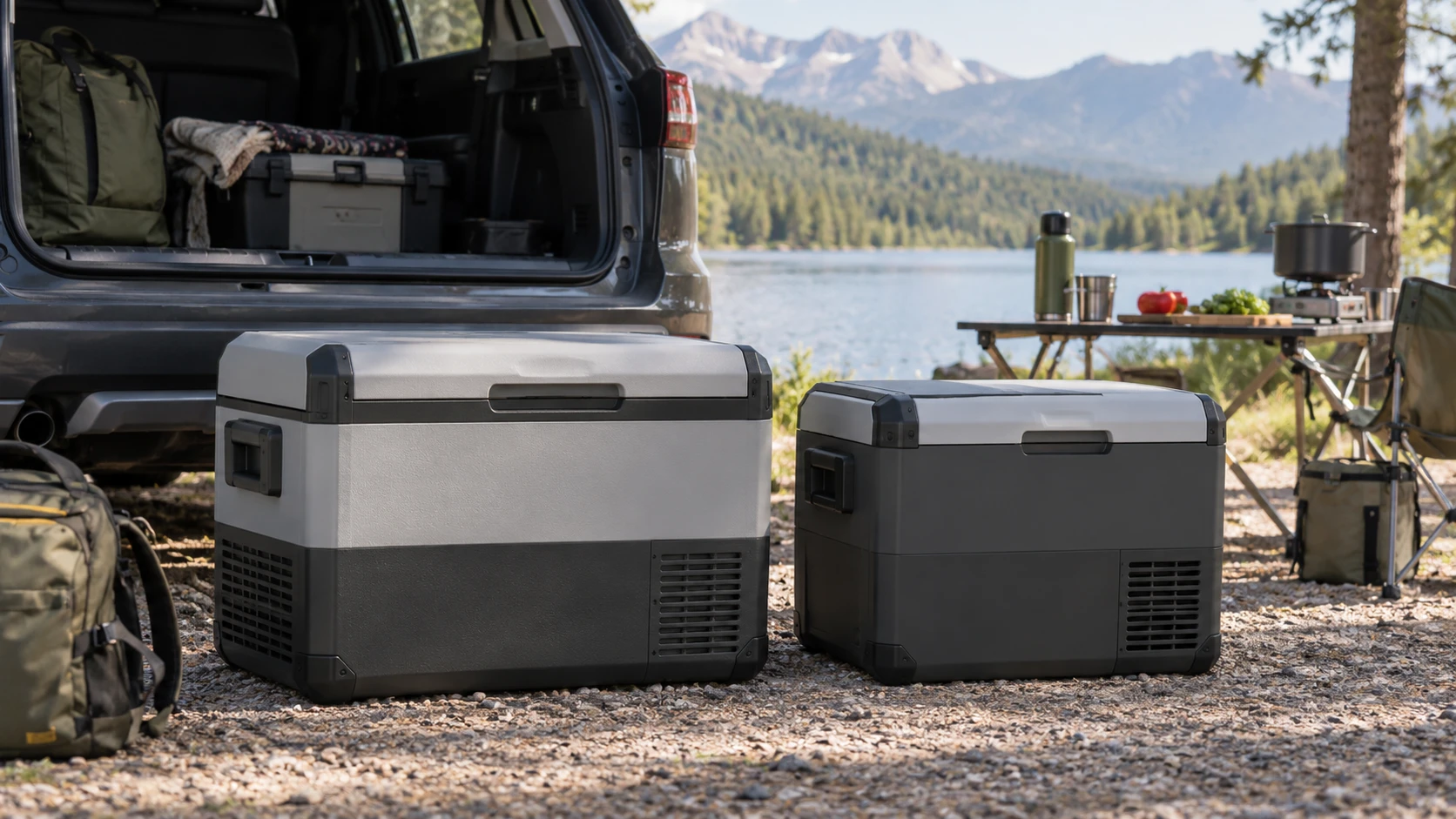
The Towallmark 53QT car refrigerator and KFFKFF CF45 are portable compressor coolers described for vehicles and home outlets. Towallmark's saved row calls its model 50 liters, or 53 quarts. KFFKFF's row calls the CF45 45 liters, about 47.5 quarts. Those nominal sizes give a starting point for a packing list, but the rows do not provide comparable interior dimensions or a measured battery-runtime test. Decide how the cooler will be powered at each stop before treating the capacity difference as the whole decision.
For a road trip, map the vehicle socket, the outlet at the destination, and the hours when the vehicle will be parked. Ask whether the socket remains live after the ignition is turned off. If it does, identify which battery it draws from and what other equipment shares that battery. A cooler that stays cold on the highway may stop at a campsite because the socket switches off, or it may keep running while consuming power needed to restart the vehicle. Product labels alone cannot answer the vehicle-wiring question.
Check the included power route — portable-fridge vehicle and home power
Towallmark's row says the package includes AC and DC adapters. It lists 110/240-volt AC for home outlets and 12/24-volt DC for vehicle power, and says a separately sold portable power station can also be used. Confirm the exact input label and connector on the delivered cooler and each included cord. If a power station is planned, compare its output and usable capacity with the current model manual. A Republeq's catalog statement that the cooler can run from a station does not identify a compatible station or guarantee overnight operation.
KFFKFF's saved row lists 12/24-volt DC and AC adapters, with 120/240 volts in the body and 110-240 volts in the title. Ask which AC input range is printed on the supplied adapter for the exact CF45. The row does not give cord lengths. Measure the route from the proposed cargo position to the vehicle socket with seats and luggage in place. Keep cables away from door hinges, footwells, and surfaces that can abrade the insulation.
The published guide to portable-fridge vehicle and home power follows another model. Its trip-planning questions apply to both coolers: what supplies power while moving, what supplies it after arrival, and which adapter must be packed. For final connections and electrical limits, use the Towallmark and KFFKFF instructions. Test the changeover at home rather than discovering a missing cord after a long drive.
Both rows describe low, medium, and high battery-protection settings. Towallmark calls it three-stage protection intended to prevent a dead vehicle battery; KFFKFF describes the settings as protection from overload and short circuits. The saved rows do not give the actual voltage thresholds. Find them in the current manuals and choose a setting appropriate to the vehicle battery and the trip. A cutoff is a last line of protection, not a calculation of how long the cooler can run or proof that an older battery will start the vehicle.
Towallmark's row makes an energy-saving claim written as “≤36W/day.” Watts measure power, while daily energy is usually expressed with a different unit. The saved phrase cannot be used as a sound daily energy budget without clarification. Check Republeq's product page for consumption under stated ambient and target temperatures, preferably with a time-based energy figure. KFFKFF's row gives no matching consumption number. Avoid comparing a malformed unit with an absent number and calling either machine more efficient.
For a real overnight plan, use the current manual's consumption data, the battery system's usable capacity, the expected ambient temperature, and a reserve for other loads. Openings of the lid and warm food added after a grocery stop also affect compressor use. Check the actual temperature in the morning with a thermometer when food safety depends on it. A portable fridge is useful because it travels, but the travel setting makes its power supply variable.
Compare usable storage — KFFKFF CF45 portable fridge
Towallmark's 50-liter row describes dual-zone storage intended to keep odors from mixing. It also mentions a removable basket, double handles, and a compact footprint for cars, trucks, RVs, and boats. The description does not establish separate temperature controls for the zones. Ask for the interior layout and control manual before planning to freeze food on one side while chilling produce on the other. A divider can affect how a large container fits even when total liters look generous.
The KFFKFF CF45 portable fridge gives more explicit packing examples. Its 45-liter compartment is said to hold up to 48 cans of 330 milliliters, 28 bottles of 550 milliliters, or 15 bottles of 750 milliliters. These are alternatives using different container sizes, not quantities that fit at once. A trip with meals, vegetables, and drinks will pack differently. KFFKFF also lists a removable basket, handle, and cup holders. Check whether a tall bottle or meal container clears the lid with the basket in place.
Five liters of nominal difference may matter less than the shape of the interior. Measure the items that caused trouble in the last cooler and request internal dimensions for both models. A basket can keep small snacks accessible while taking room from a large pan. If several travelers will open the unit throughout the day, plan a top layer for immediate use. Repeated searches for a buried item hold the lid open and can add to power demand.
Neither saved row provides a verified empty weight or full exterior dimensions. Ask for both before assigning a spot in the vehicle. Measure the cargo opening, footprint, and space needed to open the lid. Try to keep the cooler level and secure it according to the product and vehicle instructions. Towallmark's row says the unit stays stable on slopes up to 30 degrees; KFFKFF describes placement in a trunk, behind a seat, or in a truck bed. Neither statement is a cargo-restraint instruction for a sudden stop.
Towallmark lists a cooling span from 0°F to 50°F. KFFKFF's row prints a range that appears intended to be minus 4°F to 68°F, but its temperature symbols are garbled in the saved text. Confirm with Republeq the CF45's current operating range from the manual. A compressor setting does not mean warm food reaches that temperature immediately. Pre-chill the contents when possible and check the interior with a thermometer during a supervised trial.
Controls and trip routine — KFFKFF CF45 portable fridge
Towallmark lists an LCD panel and ECO/MAX modes. The row presents ECO as an energy-saving choice and MAX as a faster-cooling choice. Ask how the selected mode affects the displayed temperature and power use under the conditions you expect. The panel should be reachable once luggage is packed. A setting that is easy to change on an empty driveway may be difficult to find behind a seat at night.
KFFKFF lists a digital temperature display, an interior LED light, and mobile app control. Try the on-unit controls before depending on the app. The saved row does not give the app's connection requirements, range, or alert behavior. If several people share the cooler, make sure they can check and change the setting without relying on one phone. An LED light can help find an item at night, but it will not make a deep basket easy to organize.
Towallmark's row gives a 45 dB operating figure. KFFKFF's row does not give a matching sound rating. If the cooler will sit beside a bed in an RV or cabin, request current acoustic information and listen during normal operation. A unit placed against cabinetry can sound different from one set on a stable open floor. The saved descriptions do not provide a matched listening test.
Towallmark describes UL-certified insulation. KFFKFF mentions CE certification. Those claims refer to different marks and do not rank the coolers by cooling speed or power consumption. Check the product markings and documents relevant to the location where the appliance will be used. KFFKFF's row also instructs letting the cooler stand for 24 hours before use. Follow the delivered manual's placement and startup instructions, especially after transport on its side.
Price and support questions — KFFKFF CF45 portable fridge
The pinned catalog snapshot lists Towallmark at $243.93 and KFFKFF at $269.99 as minimum prices in US dollars. Those saved figures may change, and neither includes a separate power station or vehicle wiring work. Confirm current price, shipping, returns, included adapters, and warranty terms for the exact SKU. Add the cost of any battery or mounting equipment needed for the trip before comparing the full setups.
The Towallmark row says TROPOW provides 24/7 customer support, a name different from the Towallmark brand in the product title. Confirm with Republeq who actually handles support and which warranty applies to this item. KFFKFF's saved row does not provide comparable support terms. Keep the invoice, model number, and adapter details with the manual, since a problem may appear far from the place of purchase.
Towallmark is worth investigating if its 50-liter layout, dual-zone description, and included AC/DC adapters fit the cargo plan. KFFKFF is worth investigating if its stated 45-liter can and bottle examples, basket, and on-unit display fit the food plan. Verify both products' real dimensions, battery-cutoff thresholds, and current consumption data before depending on either for a parked night. Then load the chosen cooler in its intended position and test both vehicle and destination power while the trip is still easy to change.