Kitchen & Appliances
Understand tilt-head and bowl-lift mixer access
Different moving assemblies explain the two stand-mixer arrangements without establishing capacity or part fit.
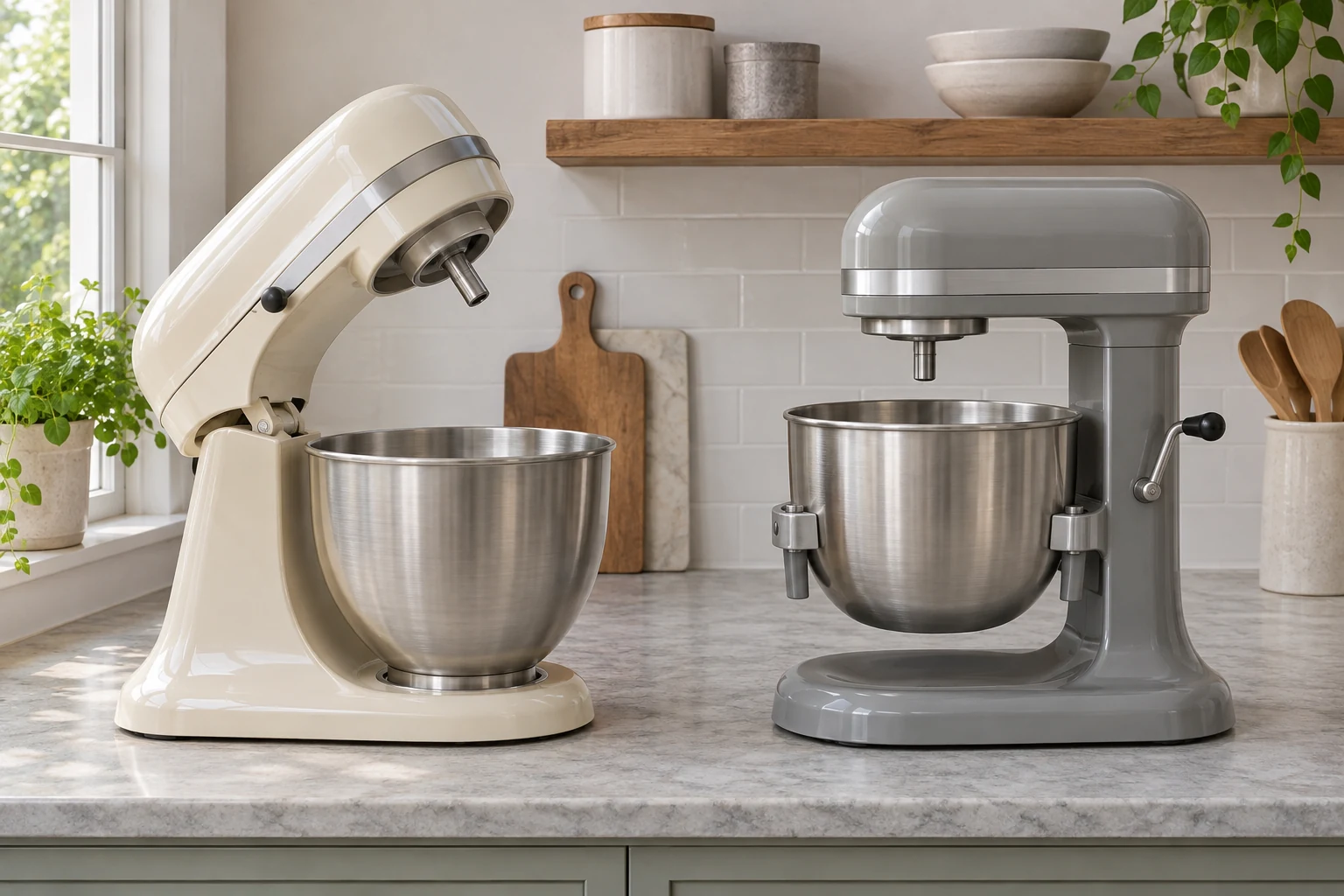
The names behind tilt-head and bowl-lift mixer access describe different moving assemblies. Read the mechanism name before treating two stand mixers as the same arrangement. It helps you understand which part a product discussion concerns, while leaving the exact operating steps with the appliance's own instructions.
Someone asking whether a mixer “lifts up” may mean several things. They might be asking about access to the bowl, carrying the complete appliance or moving it out from a cupboard. Start by naming the object in the question. That small clarification prevents a useful description of one movement from becoming an answer to another.
The maker distinguishes the head from the bowl
KitchenAid's UK mixer-selection FAQ describes its tilt-head arrangement as a head that tilts back, with the bowl attached to the base. It describes its bowl-lift arrangement as a stationary head and a bowl supported on arms and raised by a lever. Those are its two design explanations. They do not establish a universal operating sequence, a replacement-part fit or a performance ranking between the retail offers below.
Picture two descriptions written beside otherwise unidentified machines: one concerns a moving mixer head, the other a raised mixer bowl. The useful distinction is the named assembly. You still need to identify the actual appliance before discussing its controls, locks, permitted handling or removable parts. A general design explanation should not quietly turn into instructions for a model nobody has established.
In a hypothetical shop conversation, a customer asks to see “the lifting one.” The person helping should clarify whether the customer wants to understand the head arrangement or the bowl support. They can then discuss the relevant model's documented design. Without that clarification, both people could leave the conversation believing they answered a different question.
Use the native offers as design examples
The KitchenAid six-quart bowl-lift mixer listing names that design and shows red and silver machines with side-supported bowls. Its description leaves the speed count as “10 (or 11),” so that count remains unresolved here. The Canddidliike WQ36084 stand mixer listing describes a tilt head for access. Its gallery shows a red machine with the head lowered and raised, plus integral mixing tools.
These are complete-appliance offers. Their bowls, mixing tools and shield context do not establish a separate interchangeable-parts set. The six-quart pictures show only partial branding, while the Canddidliike pictures provide no visible factory model label. Catalogue identities remain catalogue information. No exact factory authentication, advertised batch result, certification or comparative stability test is established here.
Use that evidence to recognize what the seller is discussing, then keep unanswered questions attached to the exact offer. A design label can make the next question clearer without answering every product detail. If a particular feature determines your purchase, obtain the applicable information for the model and configuration you would actually receive.
Give movement questions a named object
Imagine someone writing a message about a mixer they are considering. “How far does it move?” leaves the recipient to infer the subject. A more useful message says whether the concern is the head, bowl or complete appliance. Include the specific product reference and explain what you want to understand. You do not need to invent a measurement to make the question precise.
The same care helps when reading a reply. If the answer discusses the whole machine's height, it may leave your question about access unresolved. If it identifies the design family, it may still leave the exact model's instructions outstanding. Read the response against the object and purpose you originally named, rather than treating any relevant-looking dimension as a complete answer.
For a shared purchase, let each person state the question they are trying to settle. One might care about storing the appliance, while another wants to understand access during an ordinary permitted preparation. Those interests can coexist. Keep them as separate requirements until the actual product information addresses them; the household does not need to pretend they are one question.
Mechanism names leave capacity and recipes open
This comparison gives no approved batch quantity, mixing speed or recipe method. Use the exact appliance's instructions for those matters. A familiar cake recipe and a product photograph cannot establish how a different model should be loaded or operated. Keep a capacity statement, a recipe and a design name in their respective roles.
Suppose a buyer prefers one arrangement after seeing an appropriate demonstration in a shop. That preference can inform a shortlist without becoming a claim that the machine handles a particular dough better. The buyer may still need the model's ingredient limits and tool guidance. An access preference is worth recording on its own terms, without attaching an unmeasured performance result to justify it.
Likewise, a person who wants a different bowl has a part-selection question to resolve. The existing mixer bowl size versus mixer fit guide explains why a volume label does not specify mounting geometry or establish an exact-model match. Recognizing a mechanism family does not replace that part-specific check.
A shopper can therefore finish understanding the two design descriptions while leaving the buying decision open. Perhaps both arrangements deserve further investigation, or perhaps one suits the person's stated access preference. Neither conclusion requires a universal winner. Record what you learned and what still needs an answer for the actual appliance.
Read a picture as a selected view
A gallery chooses what to show. Treat a raised-head photograph as a view supplied by that offer, without inventing the actions that came before it. A static view supplies no complete handling sequence. Obtain the exact instructions before moving or removing anything on a delivered machine, and use an appropriate model-specific demonstration when you need help understanding them.
When comparing offers, give each picture its own reference. If you save one image and later open another model's page, check that you are still discussing the intended product. Similar appearance can make a conversation drift between offers. Keeping the selected reference visible lets another person follow the comparison without reconstructing which picture originally prompted the question.
If pictures and catalogue wording appear inconsistent, retain the discrepancy. Ask about it before relying on the offer for a detail that matters to you. There is no need to rename a colour, complete an unreadable label or assume two pictured models are equivalent merely to make a comparison look finished.
Access involves the person and the actual location
After identifying a design you want to investigate, consider where the delivered appliance would be used under its instructions. Ask for the actual measurements and access information relevant to that location. This article establishes no raised-head height, required clearance or carrying method for either native mixer. It also provides no household accessibility certification.
The food dehydrator tray access guide addresses a different appliance's door, removable trays and landing space. It illustrates why a closed appliance outline does not settle every movement question. Its tray route, dimensions and operating requirements do not transfer to a stand mixer.
For an enquiry about your kitchen, describe the actual obstruction or task you want to understand. “A cupboard is above the proposed position” communicates something useful without claiming a particular clearance will work. Ask for the relevant product information, then assess it against your location and the exact instructions. Keep unknown measurements unknown.
If the mixer would move between storage and the counter, treat that as another decision. A product's mixing arrangement does not tell you how comfortable you will find carrying the complete appliance. Obtain its actual weight and handling guidance, and consider the person who would move it. Avoid turning a design preference into an unsupported lifting recommendation.
Describe what you want a demonstration to answer
Before visiting a shop, write the question you want an appropriate demonstration to address. Perhaps you want help understanding the relevant instructions, or you want to see how the particular model is presented for ordinary permitted use. Tell the person helping which question applies. A general sales presentation might cover many features while leaving your own uncertainty untouched.
Afterward, distinguish what was explained from what you personally tried under the applicable guidance. If you only watched, record that. If the demonstration used another configuration, keep its reference alongside your note. You can find the explanation useful without reporting an experience you did not have with the model you intend to order.
For a gift, share the unresolved access question with the intended user before selecting the machine. They may want to investigate a different detail from the purchaser. Agreeing what still needs an answer can prevent a well-meant surprise from becoming a product decision somebody else was expected to accept.
Keep the goods decision intact at checkout
If a seller offers cryptocurrency for a mixer order you eventually choose, read the actual goods and transaction terms before authorizing payment. This is a conditional purchasing example, not a statement that either linked listing accepts cryptocurrency or that an order has been placed. Confirm the exact selected appliance, the configuration described by the seller and what the order includes. Read the current delivery and return terms and ask about any unresolved item detail through the contact route provided. A payment method cannot establish a mixer's operating arrangement, recipe limits or replacement-bowl compatibility. If the final basket substitutes another model or configuration, return to the goods comparison before continuing. Keep any relevant seller clarification with the offer it addresses so another person helping with payment can understand the selection. You may choose another available payment method or leave the order unfinished while an important question remains open. Neither choice establishes a fee, exchange rate, settlement time, refund entitlement or wallet-security result. Check those matters with the responsible provider and the terms for the proposed transaction. Before confirmation, read the displayed charges, delivery details and final item reference. Save the order record if you proceed. If the payment status is uncertain, reconcile it through the appropriate authorized channel before considering another payment. An order confirmation can document the purchase, but it does not certify the physical identity of a delivered appliance or make its instructions optional. When the parcel arrives, compare the supplied model and contents with the order and resolve discrepancies with the seller before relying on the proposed arrangement. Keep the operating questions attached to the actual machine you receive.
Explain the arrangement before selecting the model
You should be able to say which assembly a discussion concerns and identify the actual offer behind it. Keep that explanation separate from a recipe, a replacement bowl and an unanswered dimension. The mechanism name then helps a conversation about the appliance, without becoming a promise about every job or part associated with it.
Conceptual design comparison; no operating demonstration, capacity test, replacement-part fit or approved handling sequence is depicted.